
 РУССКИЙ
 10:17 10.12.2025 •
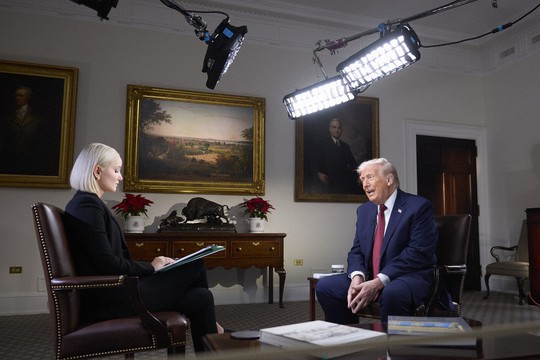
President Donald Trump sat down with POLITICO's Dasha Burns for a special episode of The Conversation at the White House, Dec. 8, 2025.
Photo: POLITICO
President Donald Trump is closing out his first year in office, feeling bullish about how he has reshaped the economy and the world even as allies abroad and supporters at home raise increasing concern about who, exactly, his policies stand to benefit.
Republican pollsters and operatives, including those supportive of Trump, have warned that Democrats are overperforming in part because the president has not done enough to assuage concerns over the cost of living.
But Trump, during an interview with POLITICO’s Dasha Burns for a special episode of The Conversation, gave himself an “A-plus-plus-plus-plus-plus” grade on the economy. He defended trips abroad as fundamentally aimed at helping Americans back home by securing new investments.
“Prices are all coming down. It’s been 10 months,” Trump said. “It’s amazing what we’ve done.”
Still, the president said he was open to new carveouts on tariffs, appearing to recognize that a reversal on one of his signature economic policies would provide short-term benefits to Americans’ pocketbooks. And in the most direct challenge to the Federal Reserve’s independence, he said that lowering interest rates immediately is a litmus test for the next central bank chair.
For Hill Republicans eager for direction on health care affordability, Trump didn’t give any — declining to say whether he would push Congress to extend health care subsidies expiring at the end of the year.
His message to European allies worried about Russian aggression was that the real threat to their country is unchecked immigration and political correctness. He warned that decades-old alliances with the United States are at risk and that the most famous capitals — including London and Paris — are unrecognizable.
Here are seven takeaways from the interview on domestic and foreign affairs.
Trump had a litmus test for his new Fed chair: lowering interest rates immediately
Trump has spent the last several months pressuring the Federal Reserve and its chair, Jerome Powell, to lower interest rates. Now, he’s openly making rate cuts a screening tool for Powell’s successor.
Asked whether support for immediate rate cuts is effectively a litmus test for picking the next Fed chair, Trump said “yes,” adding that Powell “should too” and berating Powell as “not a smart person” who “doesn’t like Trump.”
The exchange represents Trump’s most direct effort to bring the central bank under his thumb, tearing at the independence of an institution the president has long sought to influence. And it comes as the Fed is expected to on Wednesday approve its third-straight interest rate reduction at the central bank’s final meeting of the year.
Trump said last week he has already selected Powell’s successor. Though the president has declined to name that person, National Economic Council Director Kevin Hassett is widely seen as the front-runner for the job.
Trump gave the economy an ‘A-plus-plus-plus-plus-plus,’ argued foreign trips are focused on the U.S.
The president, asked what grade he would give the economy, awarded it an “A-plus-plus-plus-plus-plus,” casting his stewardship as an unqualified success despite persistent anxiety among consumers and tepid job gains in key sectors.
It comes as Trump continues to insist the emphasis on affordability is a “hoax.” Democrats, he said, broke the economy under former President Joe Biden, leaving him with a mess to clean. But that message is at odds with some of Trump’s top advisers who have said the president needs to focus more on selling his economy, especially as 37 percent of those who voted for him last year say the cost of living in the U.S. is the worst they can remember it being, according to a recent POLITICO Poll.
He also defended the string of high-profile foreign trips he has taken in his second term — to the Middle East and Asia — insisting they are fundamentally about improving conditions at home.
“When I go on a trip, I only have one place in mind. It’s the United States,” Trump said, arguing that his personal diplomacy has yielded trillions of dollars in new investments into the U.S.
But much of the capital Trump has touted will take years to manifest into new factories and jobs. Meanwhile, a recent report from the payroll processing firm ADP found that private companies cut 32,000 workers in November, including a loss of 18,000 jobs in the manufacturing sector.
Trump offered little clarity on health care legislation
Trump left Republicans on the Hill who are struggling to coalesce around a plan to avoid health insurance premiums spiking in January hanging. The Senate on Thursday is expected to vote on a three-year extension of enhanced Obamacare subsidies, a Democrat plan that is almost certain to fail. Republicans have discussed broad outlines for reforms but have not agreed on a path forward.
Asked whether he would urge Congress to temporarily extend those subsidies, a move that would stave off premium increases for millions of Americans, Trump declined to take a position.
“I don’t know. I’m going to have to see,” he said. “I’d like to get better health care.”
Instead, he again leaned into a populist frame that appeals to his base but complicates Republicans’ immediate reality, reiterating support for a plan that would send enhanced Affordable Care Act subsidy funds directly to health savings accounts that Americans can use for out-of-pocket costs.
It’s the one policy tenet Trump has explicitly endorsed even as Republicans debate thornier questions such as income caps and whether to prohibit the subsidies from being used to pay for abortion.
“No money for the insurance companies, I want to pay the money directly to the people,” Trump added.
Trump said he will consider more carveouts from tariffs to lower prices for Americans
The White House last month pared back tariffs on select imports — including beef, tomatoes, bananas and coffee — as inflation jitters and voter frustration over grocery prices mount. Trump now says he’s open to expanding those exemptions.
“Sure, and I’ve done that already with coffee,” Trump said. “They’re very small carveouts, it’s not a big deal.”
But even as he downplayed the shifts, Trump made clear he sees them not as a retreat from his tariff agenda but as tactical adjustments. He stressed that any relief on consumer staples would likely be offset elsewhere.
As he cuts duties on some goods, he would raise them on others, he said, preserving his broader strategy of using trade penalties as leverage. That approach underscores the push-pull inside his economic policy: trying to blunt inflationary pain at home while still brandishing tariffs as a political and geopolitical tool.
But that power may prove short-lived. The Supreme Court is currently weighing the constitutionality of many of the president’s new tariffs, a decision that could significantly curtail his ability to use levies to get his way in foreign affairs.
Trump’s hands-off approach to a ‘decaying’ and ‘weak’ Europe
Trump cast Europe as culturally and politically adrift, and suggested that the U.S.’s traditional alliances are not as ironclad as many European leaders might have hoped. The president argued that lax immigration policies are changing the culture of Europe, making it a “decaying” continent, and that political correctness had left Europe “weak.”
The critique, which comes days after the administration released a National Security Strategy that encouraged “cultivating resistance to Europe’s current trajectory,” doubled as a signal of Washington’s increasingly arm’s-length posture toward traditional allies, a shift that has unsettled European officials already anxious about U.S. reliability.
“I want to run the United States, I don’t want to run Europe,” Trump said, before alluding to NATO Secretary General Mark Rutte’s description of him as “daddy,” a flourish that captures both his pride in dominating the alliance and the discomfort it triggers among allies who see it as belittling.
At the same time, he made clear he intends to insert himself into politics abroad by backing ideological allies, citing Hungary’s Viktor Orbán and Argentina’s Javier Milei as past examples. That selective engagement, distancing himself from the continent broadly while elevating nationalist figures underscores his approach: a retreat from collective security norms coupled with personal intervention in other nations’ politics.
Pressed on whether he meant European nations would cease to be U.S. allies, Trump offered little reassurance: “Well, it depends.” The conditional answer highlights the uncertainty confronting governments that once assumed an automatic American guarantee and now find their status contingent on his personal approval.
Trump: Hegseth can testify before Congress ‘if he wants’
The president was ambivalent about whether Defense Secretary Pete Hegseth should testify before Congress about the recent U.S. strikes on suspected drug-smuggling vessels, including a Sept. 2 follow-up strike that killed two survivors of an initial blast.
Lawmakers are trying to use the annual defense bill to force answers on a strike some experts warn could meet the threshold of a war crime, but Trump offered no signal he expects his Pentagon chief to comply.
“I don’t care if he does. He can, if he wants. I don’t care,” Trump said, adding, “I don’t care. I would say do it if you want. He’s doing a great job.”
Trump also said he reviewed footage of the operation, arguing “it looked like they were trying to turn back over the boat.” That framing mirrors Sen. Tom Cotton’s (R-Ark.) assertion that the video showed “two survivors trying to flip a boat loaded with drugs bound for the United States back over so they could stay in the fight.”
Whether the survivors were attempting to resume alleged smuggling activity or were stranded and in need of aid is central to the legal debate over the second strike’s justification.
Trump declined to say whether he thought the second strike was necessary: “I don’t get involved in that.” The remarks offered a split screen between a president standing by his Pentagon chief while distancing himself from one of the most contentious military decisions of his tenure.
Trump said it’s time for Ukraine to hold an election
Ukraine has postponed national elections under martial law as it fights Russia’s invasion, a constitutional requirement that bars voting during wartime. Trump, however, said Kyiv should press ahead anyway, arguing that delaying the ballot undermines Ukraine’s claim to democratic legitimacy.
“They’re using war not to hold an election, but I would think the Ukrainian people should have that choice. And maybe [President Volodymyr] Zelenskyy would win. I don’t know who would win, but they haven’t had an election in a long time,” Trump said. “You know, they talk about a democracy, but it gets to a point where it’s not a democracy anymore.”
Russian President Vladimir Putin has seized on Ukraine’s inability to hold elections to label Zelenskyy illegitimate, while Ukrainian officials have argued that holding a national ballot amid mass displacement, occupied territory, active shelling and millions of citizens abroad is neither feasible nor legal under its constitution.
Against the backdrop of reports of a new peace framework being floated to Kyiv, Trump struck a bleak tone about Ukraine’s prospects on the battlefield and suggested Zelenskyy will soon be forced into concessions.
“Well, he’s gonna have to get on the ball and start accepting things, you know, when you’re losing — because you’re losing,” Trump said, a blunt assessment that undercuts the administration’s public line that Kyiv still has viable options.
Asked about Donald Trump Jr.’s recent assertion that the U.S. might walk away from Ukraine, Trump offered a hedge: The statement wasn’t “exactly correct, but not exactly wrong,” either.
read more in our Telegram-channel https://t.me/The_International_Affairs

















