РУССКИЙ
 12:11 24.02.2026 •
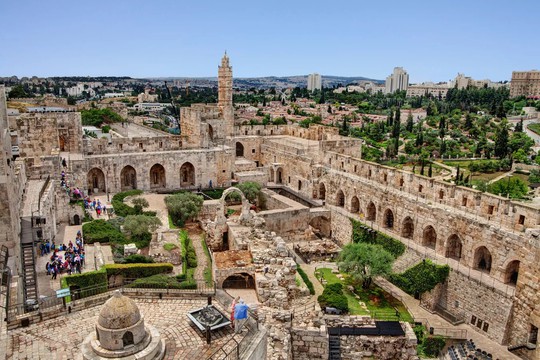
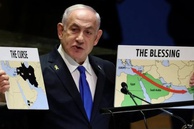
"To your descendants I give this land, from the river of Egypt to the great river, the Euphrates," says God to Abraham in Genesis 15:18.
2013: Way of the Suffering
The year was 2013. Led by a Palestinian guide, I walked through the Via Dolorosa. This meandering, 600-meter path through the Old City of Jerusalem is believed to be the route where Jesus had walked while bearing his thorn-spiked cross from Pilate to Golgotha.
Trekking across the labyrinth of steep, sun-slicked limestone and dark archways, I felt the weight of centuries as shouting merchants, with their aromatic wares of spices and coffee in the modern bustling artery, failed to drown out the sharp voices of mockers and the agonizing wails of shattered believers pouring over Jesus in a symphony of discord. The latter was so loud it hollowed out my chest with its own jagged rhythm.
“This is the Way of the Suffering,” my guide lamented, as if noticing my gasps for air. “We live a daily life of checkpoints and partition. See those guys over there?” My eyes followed his finger as it pointed to heavily armed Israeli security forces standing watch over pilgrims carrying wooden crosses in a ritual procession, reminding us that this “Way of Peace” is in fact enforced by an apparatus of control.
How a place could feel so much like a sanctuary and a crime scene at the same time is hard for me to describe, but there I was, standing upon the most “prayed over” earth on the planet—saturated with the blood of those who claim to love it most.
My guide and I lingered at the Western Wall as we watched worshippers shuckle in a cadenced movement short of hypnotizing. Afterwards, he led me to a high point where, right before my eyes, a land—where faith has been weaponized into a border—unfolded.
There, upon the bitter irony of the soil, ancient olive groves have been uprooted to make way for fortified settlements. Written in stone and wire was the heavy silence of a “Title Deed.” I tried to find comfort in recalling the Abrahamic Promise of being a “blessing to all nations," yet all I saw was the daily logistics of subjugation and the searing recollection of those who did not survive the struggle for it.
2026: Fine if They Took It All
Fast forward to 2026. Whereupon I sat sipping my hot beverage, I heard Mike Huckabee on TV framing Israel’s settlement and land acquisition in the Middle East as a divine right rather than a political choice. “Fine—if they took it all,” his concluding words rang through the vacuum of my room, where all air had been sucked out from.
The US Envoy to Israel was, of course, no more than a smug mouthpiece of the United States, which has served as the primary geopolitical anchor for Israel’s expansionist vision. Providing a unique blend of diplomatic cover, massive military subsidies, ideological alignment, and billions in annual military aid, American support has been well bolstered by a powerful domestic current of Christian Zionism, which views the territorial expansion of Israel as a necessary precursor to biblical prophecy.
This special relationship has frequently shielded Israel from accountability at the United Nations, with the U.S. using its veto power to block resolutions condemning settlement expansion or human rights violations. By validating the "Title Deed" narrative through unwavering political support, the U.S. has effectively underwritten the infrastructure of the occupation, making the realization of a sovereign Palestinian state impossible.
In its place are decades of forced displacements, the fragmentation of Palestinian communities, and a cycle of perpetual warfare. Huckabee mentioned he had no idea how many have been killed in Gaza. One can’t blame him—for the human toll has been so great it can only be measured in generations of lives lost to the conflict, the destruction of thousands of homes, and a systemic de-development of occupied areas that has left millions in a state of permanent humanitarian crisis and trauma.
Isn’t Israel inheriting that which was promised by God?
In the ancient past, the identity of Israel might have been inextricably linked to bloodline and soil; however, with the advent of Christianity, Israel has ceased to be a matter of genealogy and geography. Instead, it is a community of faith that has transcended national borders. This overpowering shift, reflected in the writings of the Apostle Paul, has fundamentally redefined the concept of the Promised Land from a physical locale to a spiritual reality.
In Romans 9:6–8, Paul addresses a burgeoning crisis in the early Church: how could the promises made to ethnic Israel remain valid if many in Israel did not follow Jesus, while many non-Jews (Gentiles) did? Paul’s answer was revolutionary.
He wrote, "For not all who are descended from Israel are Israel. Nor because they are his descendants are they all Abraham’s children... It is not the children by physical descent who are God’s children, but it is the children of the promise who are regarded as Abraham’s offspring."
With these words, Paul decoupled for us the identity of "Israel" from biology. He argued that the true lineage of Abraham was not one of DNA, but of faith. By this logic, a person’s status as part of the "chosen people" was no longer determined by their birth in Judea but by their internal spiritual orientation.
This was the birth of the concept of Verus Israel (the True Israel), which carried with it profound implications. Because the True Israel was spiritual, the Church did not require a specific nation-state to validate its existence. The "Kingdom of God" was "not of this world" (John 18:36). This means Christianity is to become a global religion that could feel "at home" in Israel, as the physical geography of Palestine was relegated to the status of a "Holy Land" for pilgrimage rather than a necessary political possession for the people of God. In other words, the true inheritance of Abraham belongs to a global community of faithful followers.
So, if "Israel" is a spiritual community, the modern State of Israel must be viewed as a secular political entity like any other, subject to international law and human rights standards, rather than a divinely protected exception. This aligns well with God’s profound love for all—for a spiritualized Israel is inclusive and universal, while a physical Israel is exclusive and bounded.
And as rulers fill our minds with the old maps of kings and conquests, let’s be mindful of the vineyards we have planted with walls. We are fighting over stones, measuring dust, and arguing over where fences should stand. We have become so busy with guarding the dirt we claim to own that we have forgotten to tend to the land. In other words, we have forgotten the wine.
The True Israel is not a matter of the flesh but of the Spirit. It is not the circumcision of the body but that of the heart. It is a nation of those who have laid down their swords to pick up their crosses.
Likewise, the “Great River” spoken of is not the Euphrates, which can run dry in the heat of summer—just as the Wadi of Egypt could vanish when the sun is fierce—but the Living Water that wells us up unto eternal life. Therefore—drink of this water and never thirst again. Much less for earthly borders.
The author's opinion may not coincide with the position of the Editorial Board.
read more in our Telegram-channel https://t.me/The_International_Affairs