
 РУССКИЙ
 11:35 26.12.2025 •
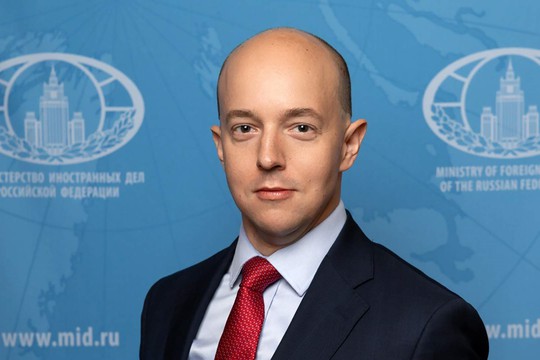
Alexander Gusarov, head of the North Atlantic Department at the Russian Foreign Ministry
Photo: Department of the North Atlantic of the Russian Ministry of Foreign Affairs
Russia sees the United States' interest in joint development of the Arctic, Alexander Gusarov, head of the North Atlantic Department at the Russian Foreign Ministry, said in an interview with Izvestia. In addition, the American business community wants to regain its position in the Russian market. At the same time, the State Department is not ready to discuss the issue of the return of diplomatic property, they refer to unilateral sanctions. Russia expects to start a dialogue without preconditions between relevant agencies to restore direct flights. A few days ago, a new round of expert contacts was held to normalize the work of the embassies of the two countries.
About promising projects with the United States, the subversive activities of Great Britain and the expansion of NATO — in an exclusive interview with Alexander Gusarov "Izvestia".
“The dialogue with the American side on the settlement of a huge array of problems continues”
— How are the consultations on the elimination of "irritants" in Russian-American relations progressing?
— The dialogue with the American side on the settlement of a huge array of problems that have emerged in recent years continues. His starting point was the understanding reached by the presidents of Russia and the United States in a telephone conversation on February 12 about the need for a comprehensive restoration of Russian-American relations.
Normalization of the working conditions of the diplomatic missions of Russia and the United States is seen as an important, although by no means the only part of this work. Several rounds of expert contacts took place, the last one a few days ago at the working level. The importance of the results achieved should not be underestimated. It was possible, in particular, to put the issuance of visas to certain categories of diplomatic mission personnel on a more predictable basis, as well as to make progress in simplifying the restrictive regime of movement of diplomats in the host country. This is not bad, but in order to get seriously closer to fulfilling the task set by the presidents of stabilizing bilateral relations, the level of ambitions of the parties must be significantly higher. In the meantime, we have to admit that the negotiation process is going smoothly, and its pace has decreased, including due to differences in approaches.
— Will the Russian side continue to seek the return of diplomatic property to the United States?
— Back in April, we handed over to the American side a roadmap with the stages of a decision on the return of six Russian diplomatic properties confiscated in 2016-2018 in the United States, the first of which should be an inspection of these facilities to prepare for subsequent return. However, the State Department is not ready to discuss this topic yet, referring primarily to unilateral US restrictions. This approach seems unconvincing to us. The sanctions are illegitimate, they should have been abolished long ago.
We will continue to seek the return of Russian diplomatic property. For us, the restoration of our violated property rights remains an absolute priority in the context of a broad normalization of relations, which the American side is well aware of.
— In November, Russian Ambassador to the United States Alexander Darchiev announced Washington's refusal to discuss the resumption of direct flights. At the same time, the special representative of the president Kirill Dmitriev allowed the launch before the end of the year. Does the United States link this issue with the settlement in Ukraine? Is there any interest from American airlines?
— The resumption of direct flights between Russia and the United States is long overdue. This step would be a clear illustration of the developing dialogue between the two countries and the revival of mutual trust at the interstate level. The advantages of direct flights are obvious in terms of convenience, comfort and time savings. Citizens of both countries, forced to travel both ways with long and expensive transfers, would breathe a sigh of relief.
By the way, normalization of air traffic with Russia would be an important help, first of all, for the American aviation sector, which is going through far from the best of times. It was he who was hit by the self-restrictions introduced under ridiculous pretexts in 2022 by the previous US administration. Their result was, among other things, the inability of American national carriers to use Russian airspace. As a result, the United States has undercut its own competitiveness, which representatives of the local business community say directly and with noticeable regret.
We raised the issue of opening the sky back in February during bilateral consultations on the elimination of "irritants" in Istanbul. During the year, proposals with an effective algorithm for restarting flights were submitted to the US aviation authorities. We are committed to the early start of a depoliticized and unconditional dialogue between the relevant departments of the two countries in order to eliminate technical obstacles standing in this way. We hope that the American side will have sufficient political will to lift the "air blockade" that has lost all meaning.
“We are recording the steady interest of the American business community”
— Vladimir Putin said in an interview with India Today that American companies want to return to the Russian market at the appropriate opportunity. How did the sanctions against Rosneft and Lukoil affect the business dialogue with the United States?
— After the Donald Trump administration came to power, the prerequisites for the restoration of trade and investment ties between Russia and the United States really began to be traced. The head of the White House and his inner circle have repeatedly spoken about the huge and untapped potential of bilateral cooperation in this area. We note the steady interest of the American business community in restoring its position in the capacious and growing Russian market. The meeting of Russian Foreign Minister Sergey Lavrov with the leadership and members of the American Chamber of Commerce in Russia on December 15 proved this constructive attitude.
Nevertheless, a number of barriers have not yet been eliminated on the way to normalizing cooperation between the United States and Russia. For example, intergovernmental contacts in the economic sphere, which were frozen by a unilateral decision of the White House back in 2014, have not yet been fully restored. There is a ban in the United States on any new investments in Russia. Restrictions against entire sectors of the domestic economy, projects in which could be of interest to both countries, have not been lifted. Washington's imposition of new sanctions against Rosneft and Lukoil on October 22, designed to oust domestic exporters from global energy markets, is completely unsuitable for business dialogue. Finally, one cannot help but notice the unfriendly background that is being purposefully promoted in the United States and beyond by opponents of any contacts between our countries in order to discourage business from any thoughts of returning to Russia.
For our part, we aim to restore our relations in the broadest sense of the word and put them in a constructive direction, and we are ready to implement joint projects. However, without making political decisions to dismantle the huge barricade of diverse and large-scale American self-restrictions against our country, it is still very difficult to achieve significant progress on this track.
“There is a cautious hope that we can begin to unwind the tangle of accumulated problems”
— Russia is negotiating with the United States on possible cooperation in the Arctic zone, including Alaska. Are specific projects already being discussed?
— Russia is the largest Arctic power. Our approach is consistent and constructive: we consider the Arctic as a territory of dialogue, peaceful cooperation and sustainable development. We are open to cooperation with all interested parties, including the United States, on the basis of equality, mutual respect and strict observance of international law.
We are receiving signals from the American side indicating an interest in discussing joint Arctic development. However, there is a long way between general words about the prospects of cooperation and real project interaction, which still needs to be overcome. Unfortunately, so far the practice of Western counterparties, including the United States, has been to increase NATO's military presence near the Russian borders, unilateral sanctions measures against our country, and many other actions that are by no means friendly.
This is largely determined by the problems inherited from previous American administrations. When Washington set a course for total confrontation in 2022, to contain Russia at all costs, the Arctic, unfortunately, became one of the areas for the implementation of this destabilizing line, and in a very unsightly form for its authors. I am referring to the refusal of Western countries, led by the United States, to participate in the events of the Russian presidency of the Arctic Council.
Now, as we understand it, the situation may change. The Trump administration declares a pragmatic approach, increased openness to direct dialogue on specific, mutually beneficial topics. And in this context, talking about the Arctic, where we objectively have many points of contact, from the safety of navigation to scientific research, looks quite natural and promising. There is a cautious hope that we can begin to unwind the tangle of accumulated problems.
— Is there any progress on the construction of a tunnel through the Bering Strait?
— To tell the truth, it is still somewhat premature to specifically discuss such grandiose initiatives as the tunnel under the Bering Strait. This is a megaproject on the level of a "wonder of the world", which will require not just investments, but, above all, an unprecedented level of trust and a joint vision of the future for decades to come. Unfortunately, we do not have such a level of relations with the United States yet. But it is important to create a foundation for them: we need to work in specific areas, such as cooperation between rescue services, safety of navigation, science, and ecology.
The key task is, of course, the development of our own Arctic zone, and first of all, the Northern Sea Route as a national transport highway of global importance. If we succeed together with the Americans in building a working, depoliticized agenda for cooperation, it will be in the interests of all Arctic countries and their peoples. It all depends on political will and concrete steps towards each other. We are ready for such joint work.
“Canada is digging a grave for its own status as a reliable financial counterparty”
— Earlier, the upper house of the Canadian parliament resumed consideration of the draft on the seizure of Russia's sovereign assets. How will the Russian Federation react if a precedent is set?
— The question touches upon an extremely important and disturbing trend that we are witnessing from the collective West. The official Ottawa is really trying to become a "trendsetter" in this criminal enterprise. Bill S-278 "On Amendments to the Law on Special Economic Measures" is nothing more than a way to legalize at the state level a possible attempt to steal Russian assets.
The essence of the bill is to circumvent the fundamental principle of state immunity and allow the seizure of sovereign assets without the express consent of their owner. This is a gross violation not only of international law, but also of the basic principles that underpin the global financial system, including the rule of law and the inviolability of property.
Canadians are well aware of this, and therefore the draft law has repeatedly been suspended — they were waiting for the outcome of the elections in the United States, assessing the risks. Now Ottawa has apparently decided to take the initiative in order to further push the hesitant Europeans and set a precedent. The argument "there is nothing to lose, there is no investment in Russia" is significant. He demonstrates not at all principled, but criminal passion and cynical disregard for the consequences for his own reputation. Dreaming of setting a precedent, Canada is actually digging a grave for its own status as a reliable financial counterparty.
We hope that the example of the European Union, which was careful at the summit on December 18-19 to resort to criminal schemes with "reparative" loans, even despite the hysterical incitement of the EU war party, will cool the hotheads in Ottawa. Russia will not allow attempts at robbery and will give them an extremely harsh response. The damage that the initiators of such adventures will inflict on themselves is many times greater than the hypothetical benefits from them. They're playing with fire.
— Ireland does not intend to join NATO in the near future, as its citizens are wary of such a possibility, the Russian ambassador to this country, Yuri Filatov, recently told Izvestia in an interview. Could Dublin's narrative of potential membership in the alliance change?
— Ireland remains a neutral state and is not a member of any military alliance, including the North Atlantic. At the same time, we see that forces are operating both inside and, above all, outside of Ireland, which are completely dissatisfied with the current military-political status of this country. Revisionist impulses are increasingly coming from neighboring Britain, whose authorities, regardless of costs, have long and systematically been working to turn a once peaceful and prosperous Europe into a well-trained anti-Russian military unit in which there is no place for neutral and non-aligned countries. The other day, the British media, speculating on mythical incidents involving unidentified drones, exposed Ireland as the "weak link" of the geopolitical "cordon sanitaire" being constructed in Whitehall against our country. The thinking of London's strategists, although humiliating for the sovereign countries of Europe, is extremely cold-blooded and prudent.
It is encouraging that the majority of the Irish population (about 70%) does not seem to be responding to these provocations and continues to advocate maintaining the country's non-aligned status. Catherine Connolly, a candidate from the United Left parliamentary opposition, who holds fairly sober views and balanced approaches on certain international and foreign policy issues, represents some hope for common sense in the recent presidential elections. We hope that the ruling center-right coalition led by Prime Minister Mihol Martin will listen to these prevailing public sentiments in Ireland and stop participating in assistance to Ukraine. We are talking about those forms of this assistance that only contribute to the enrichment of the corrupt Kiev elite and the continuation of the terror of the neo-Nazi military against the Russian regions, as well as the Russian-speaking population of the territories controlled by Kiev Square.
For its part, Moscow has always advocated building regional security in Europe on an equal and indivisible basis, and has always respected the sovereign choice of neutral or non-aligned status by the countries of the continent in the context of ensuring their national security.
“London has stopped hiding its leading role in fomenting military and political confrontation in Europe”
— How do you assess the steps taken by the British government aimed at consolidating the "coalition of the willing" in Ukraine, the adoption of new anti-Russian sanctions and the deployment of a new program to modernize the country's navy, Atlantic Bastion? Do you think that London is trying to form an anti-Russian core around itself in Europe?
— London has finally stopped hiding its leading role in fomenting military and political confrontation in Europe. This has become especially evident against the background of the change in the foreign policy paradigm in Washington, which has become the embodiment of the new National Security Strategy of the United States.
The current line of the British authorities is, on the one hand, to discredit and undermine the efforts being made by Russia and the United States to achieve a political settlement around Ukraine, contributing to prolonging the conflict even at the cost of destroying Ukrainian statehood and crippling the British economy. On the other hand, it is the replication of anti-Russian tall tales that make it possible to consolidate one's own population and allies around the core idea of building up a geopolitical confrontation with our country.
As part of this ideologized and self-destructive anti-Russian fixation, senseless sanctions continue to be stamped out in London. They are harboring ideas that are obviously unacceptable to us about the deployment of Western military contingents in Ukraine in a post-conflict context. They encourage attempts to plunder, preferably by someone else's, European hands, the state assets of the Russian Federation. Destabilizing military and political structures such as the aforementioned "Atlantic Bastion" are being built along the perimeter of our country, along the Baltic-Black Sea arc, as well as in the North Atlantic.
As for Ukraine, with the help of the criminal Kiev regime, which is closely guarded by London, it has been turned, by and large, into a testing ground for British weapons, as well as a springboard for sabotage and subversive operations against Russia, in which, as it becomes clear, the British military personnel are already involved.
In London, of course, they cannot but realize the futility of this short-sighted course. Even in openly Russophobic local publications, they began to recognize that there was no alternative to finding sustainable compromise solutions with Russia, which was confidently pursuing its national interests in Ukraine. The problem, however, is that the exploitation of the myth of the omnipresent "Russian threat" has become for the British elites not only a tool for the realization of dubious geopolitical ambitions. It is also a valuable domestic political lightning rod in the face of increasing public discontent and polarization in the country. Rather than dealing with complex migration and socio-economic troubles, it is much easier to blame them on Russia.
We hope that London will sooner or later realize its responsibility for preserving the foundations of the post-war world order, to the formation of which Great Britain made a significant contribution as one of the victorious powers and a permanent member of the UN Security Council. The restoration of the international reputation and economic stability of this country will be facilitated by the British authorities' refusal to escalate international tensions, as well as a return to the framework of a respectful and equal interstate dialogue.
read more in our Telegram-channel https://t.me/The_International_Affairs

















