
 РУССКИЙ
 11:30 24.12.2025 •
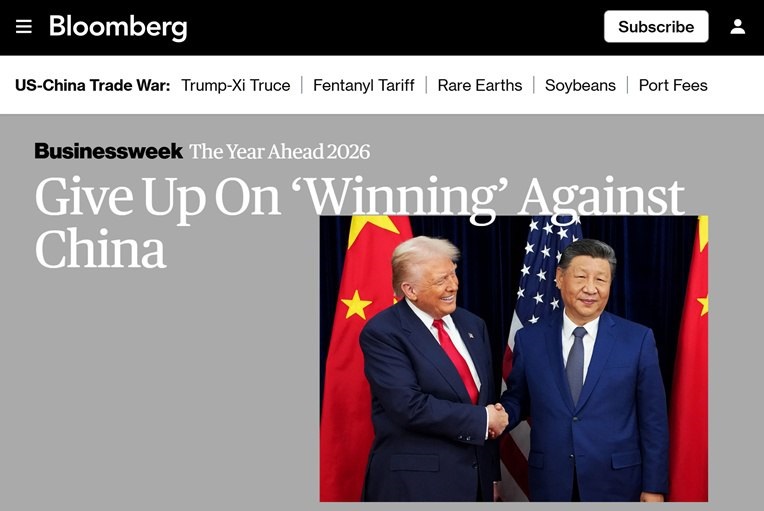
In April, when Washington and Beijing were exchanging tit-for-tat blows in the trade war, US Treasury Secretary Scott Bessent projected confidence. China had a “losing hand,” he told CNBC. “They’re playing with a pair of twos.”
It turned out Bessent and the Trump administration were the ones bluffing. After months of escalation — with the US leveling tariffs on China of 10%, then 20%, then 145%, then back down to 10% — the White House heralded the deal the two countries struck in late October as a “massive victory.” Yet the agreement looked a lot like the previous status quo. The US even made a sizable concession, reversing its decision to expand the list of Chinese companies subject to export controls, a policy tool that had previously been understood as nonnegotiable, Bloomberg writes.
China not only shrugged off Donald Trump’s blows—it also emerged with its strengths on clearer display. “China is no longer just a fast follower, but a system showing a very different — yet perhaps also viable, or even more feasible — model of development,” says Lizzi C. Lee, a fellow at the Asia Society Policy Institute.
China is simply doing too well on too many fronts. And as the trade dispute showed, Beijing is now in a position to make Washington blink. Those hoping to see China humbled must resign themselves to the fact that it remains a formidable rival — and is determined to expand its already substantial advantages, including in future-shaping sectors such as electric vehicles, clean energy and robotics.
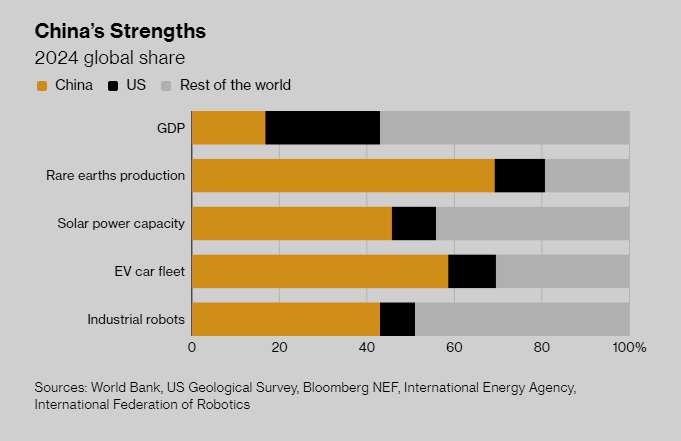
The trade talks showed just how much leverage China has over the US. This is largely thanks to its near-total domination of the supply chain for rare earth minerals, which are essential for building powerful magnets, coloring smartphone screens and boosting digital signals, among thousands of use cases. Beijing’s restrictions on export of the minerals threaten a host of US industries, including EVs, satellites, aviation and consumer electronics. The US is investing to develop domestic capacity in rare earth mining and processing, but “these changes will take years to fully remedy the current overdependence on China,” says Daniel Rosen, co-founder of the economic research firm Rhodium Group.
The US also relies on China for ingredients in nearly 700 medicines—a dependency so sensitive that China’s negotiators didn’t even bring it up in the recent trade talks. And the decision by China in October to cut off exports of computer chips made by Chinese-owned Nexperia, leading to production slowdowns for carmakers including Japan’s Honda and Nissan, shows just how much disruption it can cause when it wants to.
In clean energy, China is running laps around the rest of the world, building twice as much solar power capacity as the US and Europe combined. The country dominates the global EV market, producing 70% of the world’s electric cars. It’s the leader in battery technology too: At this year’s Shanghai auto show, carmaker BYD Co. demonstrated a battery that charges most of the way in five minutes. In 2024, China installed more factory robots than the rest of the world combined. Shenzhen-based DJI sells 70% of commercial drones for consumers and businesses, and the US lags China in military drone technology as well.
The US still has the world’s strongest military, but China is catching up. One Chinese shipbuilder produced more vessels last year than the US has made since World War II. China recently launched an aircraft carrier with capabilities close to those of the US Navy’s carriers. The country has doubled its stockpile of nuclear warheads since 2020 and has beefed up its submarine fleet. Both Trump and Chinese President Xi Jinping have danced around the question of Taiwan’s status, but if Xi were to invade the island, it’s far from clear that Trump would defend it.
Despite China’s growing strength — to say nothing of its willingness to trample on individual rights and freedoms — US perceptions of the country appear to be softening, with fewer seeing it as an “enemy” than even a couple of years ago. Between TikTok and Labubus, perhaps Americans are recognizing the role China plays in their lives. Maybe all those travel influencers agog at Chinese robots and hot pot and high-speed trains are winning hearts and minds. It’s also possible that, compared with the chaos of US politics, China’s relative stability — from a distance, at least — doesn’t look so bad. Whatever the reason, it seems Americans are reconsidering China’s place in the world. It’s about time, if only because rooting for its demise isn’t going to work.
China’s escalation dominance over Trump
On the grounds of never interrupting your enemy while he is making a mistake, Xi Jinping is 2025’s winner, ‘Financial Times’ writes.
The year’s hinge moment was Donald Trump’s cave-in to Xi in South Korea in late October. Trump’s trade war climbdown marked a new epoch. After mulling decoupling for years, talk of US-China divorce was suspended. Even so-called de-risking is now in question. Trump awarded their meeting a 12 out of 10. China took 10 of those points.
Will 2026 be another year of the dragon? Trump’s prize is his summit with Xi next April. Between now and then, he wants nothing to upset the new warmth in US-China relations.
Measured by net outcome, 2025 has offered a harsh tutorial. The US can sell China soyabeans again while the latter assures access to rare earths. As an additional bonus, China gets access to advanced AI processors, though not to the most cutting edge. America’s non-China trading partners, meanwhile, have stopped looking for method in this madness since there is none. In this time of great power competition, Trump’s odyssey has been eye-opening. He has revealed the potency of China’s stranglehold on the world’s most precious commodities. And he has told everyone else that they are on their own. “America first” works as an election slogan. In the real world, China is pulling ahead.
read more in our Telegram-channel https://t.me/The_International_Affairs

















