
 РУССКИЙ
 11:31 26.02.2026 •
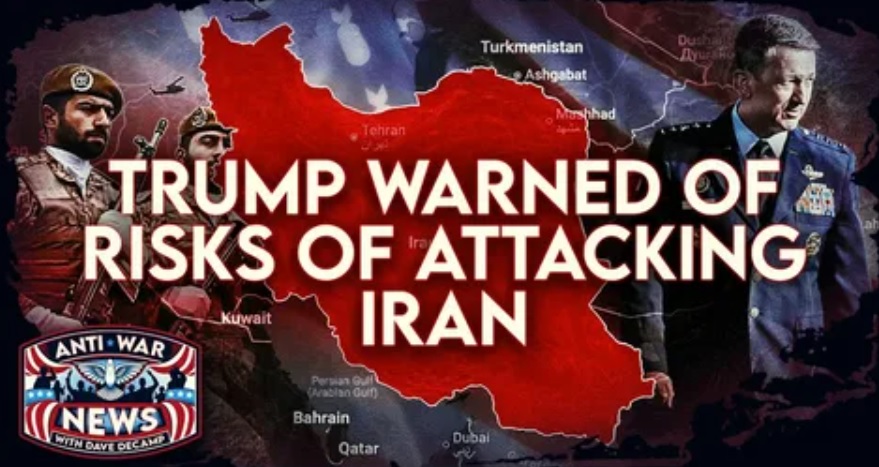
Joint Chiefs Chairman Gen. Dan Caine has been advising President Trump and top officials that a military campaign against Iran could carry significant risks, in particular the possibility of becoming entangled in a prolonged conflict, according to two sources with knowledge of those internal discussions, Axios reveals.
Why it matters: There's an ongoing debate at the top levels of the Trump administration about how to handle the Iran standoff and what the consequences of each option would be. At the moment, several of the voices in Trump's circle are urging caution, though some sources think Trump himself is leaning towards a strike.
Above all, there's the question of what success would look like when it comes to military action, and how risky it would be to try to achieve it.
On the other side, reaching a nuclear deal would likely mean walking back some of the president's previous red lines.
As Trump debates whether and how to attack Iran, his envoys Jared Kushner and Steve Witkoff have been urging the president to hold off and give diplomacy a chance.
This account of where members of Trump's top team stand is based on conversations with five sources who have sat in or been briefed on the high-level meetings.
Caine's position could be particularly influential, because he's Trump's top military adviser and is highly respected by the president.
What they're saying: "In his role as military advisor to the President, Secretary of War, and National Security Council, the Chairman provides a range of military options, as well as secondary considerations and associated impacts and risks, to the civilian leaders who make America's security decisions. The Chairman provides these options confidentially," Joint Staff spokesperson Joe Holstead told Axios.
The White House declined to comment.
Zoom in: Vice President Vance has also raised concerns about entanglement during internal deliberations in recent days.
One source confirmed the VP had been raising questions about the risks and complexity of the operation with military and national security officials, but denied he was outright opposed to striking Iran.
Vance hopes the talks in Geneva on Thursday will produce a diplomatic breakthrough, but is not optimistic about the odds of a deal — a position shared by many other top officials.
Meanwhile, Secretary of State Marco Rubio has been "sitting on the fence" rather than advocating strongly for or against a strike, according to two sources.
Rubio has historically been hawkish on Iran, but he has been focusing more of his energy in recent weeks on Venezuela and Cuba.
Driving the news: Witkoff and Kushner are planning to meet Iranian Foreign Minister Abbas Araghchi on Thursday in Geneva.
Both have advised Trump that time is on his side and that his hand will get stronger with every day that passes.
Their message is that Trump should see what he can get from the Iranians, and pull the trigger if and when he decides diplomacy has lost momentum.
A source with knowledge said Trump has been leaning towards launching a strike for several days, but agreed to give Witkoff and Kushner a bit more time for negotiations. Another source said Trump insisted on more negotiations by Witkoff and Kushner because he wants to make sure all avenues are "exhausted."
Another person advocating for strikes is Israeli Prime Minister Benjamin Netanyahu. He has been growing more concerned since meeting Trump ten days ago that the U.S. will stand down.
A U.S. source who met Netanyahu last week said the prime minister left the meeting with Trump feeling he'd been unable to pull him towards his position.
"Is he still with us?" Netanyahu asked, according to the source.
CBS: Trump growing frustrated with limits of Iran military options
President Trump has grown increasingly frustrated with what aides describe as the limits of military leverage against Iran, according to multiple sources familiar with the matter who spoke to CBS News under condition of anonymity to discuss national security issues.
Unlike previous targeted operations, including the recent one removing Venezuelan leader Nicolás Maduro from power, Mr. Trump has been told that any strike on Tehran's assets would almost certainly not be a singular, decisive blow. Instead, limited strikes could open the door to a wider confrontation — one that risks drawing the United States into a protracted conflict in the Middle East.
Over the weekend, special envoy Steve Witkoff told Lara Trump in an interview on Fox News that Mr. Trump is "curious" about why Iranians "haven't capitulated."
"Why, under this sort of pressure, with the amount of sea power, naval power that we have over there, why they haven't come to us and said, 'We profess that we don't want to be — we don't want a weapon. So, here's what we're prepared to do.' And yet, it's hard to sort of get them to that place," Witkoff said.
In recent weeks, the U.S. has greatly expanded its military posture across the region.
Pentagon officials say the deployments are defensive and designed to deter escalation, yet the scale and tempo of the build up underscore that any strike in Iran would almost certainly trigger a response whether through missile attacks, maritime harassment in the Strait of Hormuz, or proxy forces operating in Iraq, Syria and elsewhere.
The meetings unfolding inside the White House regarding Iran reflect a broader tension between political objectives and military realities. While the president seeks a dramatic show of force to strengthen his hand in negotiations, senior commanders have emphasized that wars rarely unfold according to script and that even carefully calibrated strikes can produce unpredictable consequences.
For now, the buildup of U.S. military hardware continues as contingency plans are refined. Whether it culminates in a limited strike or remains a posture of deterrence may depend less on the president's frustration than on Tehran's next move and ultimately on how much risk Washington is prepared to bear.
read more in our Telegram-channel https://t.me/The_International_Affairs

















