
 РУССКИЙ
 11:57 19.02.2026 •
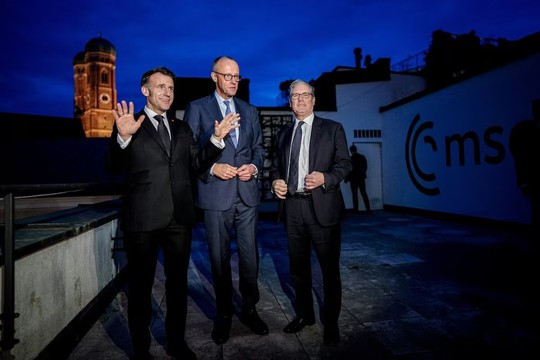
Macron, Mertz and Starmer in Munich – the European game is over…
Photo: Reuters
Europe is losing ground in the new world order. China, the US, and BRICS are actively shaping it, while Europe merely reacts. What does this mean for the future? A geopolitical analysis present by ‘Berliner Zeitung’.
The 62nd Munich Security Conference could hardly have been more aptly titled: “Under Destruction.” What was negotiated at the Bayerischer Hof from February 13 to 15, 2026, was nothing less than the burial of a world order that had guaranteed Europe prosperity and security for decades. But while China, the US, and even Russia are entering this new era with clear visions, Europe stands like a disgruntled spectator on the sidelines — unable to grasp that the caravan has long since moved on.
The end of the assumptions
In his keynote address, Friedrich Merz articulated what many suspected but no one wanted to hear: the existing international order no longer exists. The Chancellor identified the dependencies, the failures, and the necessity of European independence. It was a speech that precisely diagnosed problems. What was missing was the solution.
For this is precisely where the European dilemma is revealed: The continent has forgotten how to think strategically. While other major powers have been systematically working on their position in the new world order for years, Europe reacts at best — and usually too late.
China's long-term perseverance
Anyone who wants to understand what strategic patience looks like must look to Beijing. When Xi Jinping announced the Belt and Road Initiative in 2013, Western observers ridiculed the project as an oversized infrastructure initiative. Twelve years later, China has created a network that stretches from the ports of Pakistan to the train stations of Duisburg.
The Belt and Road Initiative is far more than just roads and railways. It is the backbone of a new geo-economic architecture. China has understood what Europe still refuses to acknowledge: Economic interdependence creates political dependencies. Whoever builds the infrastructure sets the rules of the game.
The numbers speak for themselves. The BRICS New Development Bank now manages a portfolio of over 90 projects totaling around US$30 billion. The Contingent Reserve Arrangement offers emerging economies an alternative to the Western-dominated International Monetary Fund. Currency swap agreements between China and Brazil, rupee-ruble deals for Russian oil — step by step, the dominance of the dollar is being undermined.
America’s transactional turn
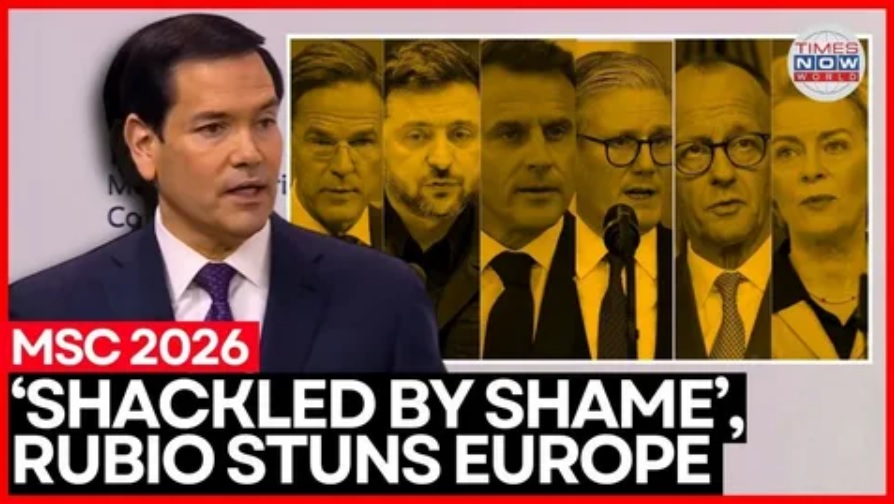
If China is the patient strategist, then the US under Donald Trump is the impatient businessman. Marco Rubio, the new Secretary of State, arrived in Munich with a message as simple as it was brutal: America first, everyone else negotiates.
Rubio's speech was a masterpiece of diplomatic duplicity. He invoked the transatlantic alliance while simultaneously making it clear that this alliance would henceforth be based on American terms. Migration, energy policy, defense spending — everything was declared a bargaining chip. The rules-based international order, for decades an American mantra, was reduced to a negotiable commodity.
The transcript of his speech, published by Foreign Policy, reveals the new American worldview: sovereignty and border control take precedence over multilateral obligations. International institutions are no longer seen as a framework that America helps shape, but rather as constraints to be overcome.
For Europe, this signifies a fundamental paradigm shift. The transatlantic partnership, upon which the European security architecture has rested since 1945, is becoming a business relationship. And in business relationships, those who have nothing to offer pay the price.
Russia's Eastern bet
Moscow, too, has learned its lesson from the Ukraine crisis — but not in the way the West had hoped. Instead of international isolation, Russia is seeking closer ties with the rising powers of the East. Putin's state visit to India in December 2025 marked this realignment. "A just, multipolar world order" with "a central role for the United Nations" — this is how the Kremlin formulated its vision…
As a defender of a rules-based order — just a different one than the Western one. The BRICS coordination, India's BRICS chairmanship in 2026, the Shanghai Cooperation Organisation — Moscow has understood that a multipolar world requires options.
India's strategic autonomy
If any actor at the Munich conference perfected the art of the both-and, it was India. Foreign Minister S. Jaishankar spoke of "strategic autonomy" — a term that sounds familiar to European ears but has a completely different meaning in Indian practice.
India buys Russian oil while simultaneously maintaining its partnership with Washington. It is a member of the BRICS and meets with the G7. It calls for reform of the UN Security Council and works pragmatically with all the veto powers. New Delhi has grasped what Berlin still needs to learn: In a multipolar world, flexibility is not a weakness, but a strength.
The meeting of the G4 nations – Germany, Japan, Brazil, and India – on the sidelines of the conference exemplified this dynamic. They discussed “reformed multilateralism,” as Jaishankar reported. But while India and Brazil, as BRICS members, are already helping to shape alternative structures, Germany remains fixated on reforming existing institutions – institutions whose reformability is becoming increasingly questionable.
The BRICS moment
What was only discussed peripherally in Munich had already manifested itself in Rio de Janeiro in July 2025: The BRICS summit under the Brazilian presidency marked a turning point. The Rio Declaration called for a “revitalized and reformed multilateralism” with a “central role for the UN” – a formula that sounds innocuous but demands a fundamental shift in power.
President Lula spoke of the “unprecedented collapse of multilateralism” and derived from this the necessity of far-reaching reforms. South African President Ramaphosa linked the debate to future-oriented topics such as AI governance. The message was unanimous: The Global South no longer wants to be a supplicant, but a co-creator.
The summit's six priorities — global health, trade and investment, development finance, climate policy, AI governance, and reform of the global security architecture — demonstrate the ambition: BRICS has long since become more than an economic forum. It is the institutional expression of a world that no longer wants to be governed by the West alone.
Europe's void
And Europe? Kaja Kallas, the EU High Representative for Foreign Affairs and Security Policy, indignantly rejected the American rhetoric of the "civilizational annihilation" of Europe. Johann Wadephul, the German Foreign Minister, emphasized the "rules-based international order." These were the right reactions — and yet symptomatic of the European problem.
For in Munich, Europe is defining itself primarily by what it is not and does not want to be. Not American vassals, not Chinese puppets, not Russian victims. But what does Europe want to be? What role does the continent claim in the multipolar order? What instruments does it have to enforce this role? The honest answer is: Europe doesn't know. And worse still – Europe doesn't have a process to find out.
The missed decades
To understand the extent of this failure, one has to look back 26 years. In September 2000, 149 heads of state and government gathered in New York for the United Nations Millennium Summit. It was a moment of optimism. The Cold War was over, globalization promised prosperity for all, and the rules-based order seemed to be taking hold.
The Millennium Declaration identified the challenges: Security Council reform, poverty reduction, conflict prevention, and fair globalization. These were the right issues. But what followed?
Europe spent the next two decades getting bogged down in internal debates. While China was building the Belt and Road Initiative, Europeans were arguing about budget rules. While the BRICS countries were creating alternative financial institutions, Europe was debating limits. While India and Brazil developed their strategic autonomy, Europe became dependent on Russian gas and Chinese supply chains.
The Munich Security Index as a mirror
The Munich Security Index 2026, compiled by Kekst CNC, reveals the gap between Western and BRICS perceptions with alarming clarity. While G7 citizens are concerned about cyber threats,
While terrorist attacks and disinformation are seen as the greatest risks, BRICS populations prioritize climate change and social inequality.
These are not just different priorities — they are different worldviews. The West sees itself threatened from the outside, while the Global South struggles with structural injustices. Europe has failed to understand these differing perspectives, let alone bridge them.
What Europe lacks
The diagnosis is clear, the treatment complicated. First, Europe lacks a common strategic culture. National reflexes — French grandeur, German export fixation, Eastern European security anxieties — overshadow any comprehensive European strategy. What is discussed as “strategic autonomy” remains rhetoric without operational substance.
Second, Europe lacks the institutional capacity for swift decision-making. While China is pushing ahead with its Belt and Road Initiative by decree and the US, under Trump, is governing by executive order, Europe takes years for every change of direction. The unanimity rule in foreign policy is not a safeguard of sovereignty, but rather a guarantee of paralysis.
Third, Europe lacks a narrative. China offers the “Chinese Dream,” America “Make America Great Again,” and even Russia has its “Russian World.” Europe has the “rules-based order” — a concept that excites no one and whose rules are increasingly being written by others.
Fourth — and perhaps most importantly — Europe lacks the willingness to accept power as a legitimate instrument. For decades, the continent could hide behind American guarantees while simultaneously claiming moral superiority. This comfortable position no longer exists. In a multipolar world, Europe must either project power or become irrelevant.
The uncomfortable questions
The 2026 Munich Security Conference raised questions that Europe can no longer ignore. Is the EU ready to build a common army—not in ten years, but now? Is Germany prepared to subordinate its export interests to geopolitical necessities? Is France ready to Europeanize its seat on the UN Security Council? Is Eastern Europe ready to no longer define security primarily through Washington?
The honest answer to all these questions is probably: no. And therein lies the problem. Europe is discussing its future as if it had unlimited time. But the new world order isn't waiting for Europe to rediscover itself.
Potential is not policy. And the 2026 Munich Security Conference demonstrated that Europe has not translated its potential into action. The continent stands by the roadside, watching the caravan go by. "We were once great, too," it seems to be shouting. But greatness must be earned anew every day.
The coming years will show whether Europe learns this lesson. The alternative is not destruction — but irrelevance. In a world shaped by China, America, and emerging powers, Europe could become a museum of its own history. Beautiful to look at, but with no impact on the present.
That would be the real "underdestruction": not destruction by external enemies, but self-marginalization through strategic inaction. The Munich Security Conference 2026 was a warning. Whether Europe heeds it is the crucial question of the coming years.
read more in our Telegram-channel https://t.me/The_International_Affairs

















