
 РУССКИЙ
 11:18 01.02.2026 •
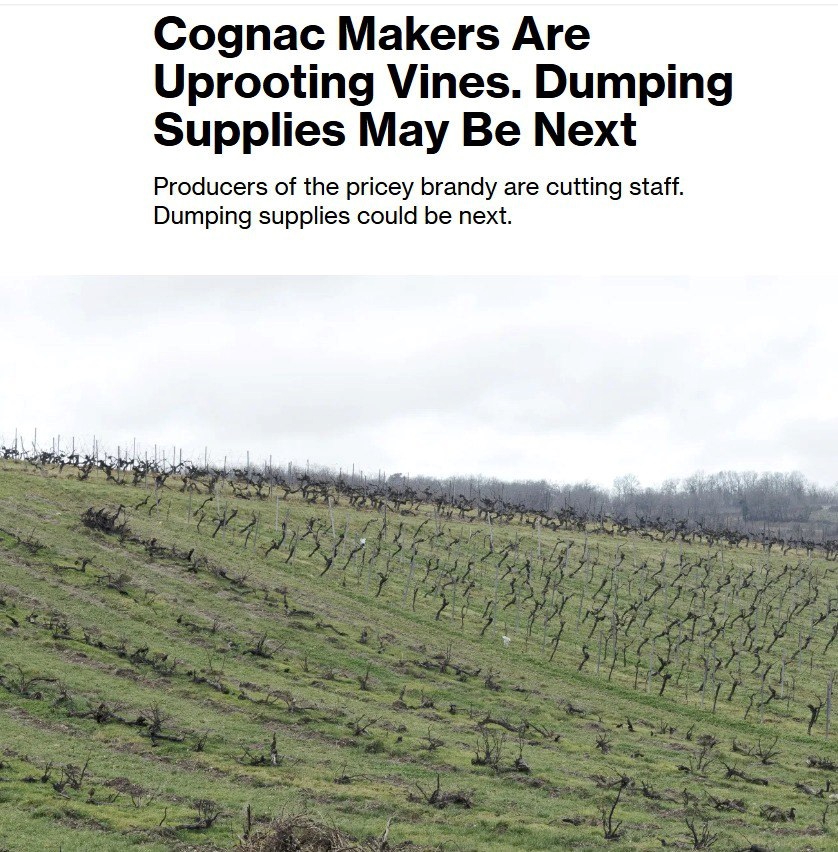 Uprooted vines in the Cognac region
Photo: Bloomberg
The vineyards of Cognac, sprawled across the rolling hills of southwestern France, are typically desolate in January. Once the grapes are harvested every fall and their juice is fermented and distilled to make the region’s namesake spirit, the area goes into hibernation. But this year, there are pockets of activity, with producers uprooting vines, the first coordinated removal since the late 1990s as the industry attempts to reduce production and revive a flagging market, Bloomberg reports
After years of exuberant demand for Cognac, the industry is nursing a hangover, with shipments last year falling to 141 million bottles, the lowest level since 2009, according to BNIC, a trade group of producers. And consumption will drop about 2% annually through 2029, data tracker IWSR predicts.
“We didn’t see this violent crisis coming,” says Thibaut Delrieu, managing director of Hine, a small brand that laid off more than a third of its workers last year and is pulling vines from about 10% of its 129 hectares. “We haven’t yet hit bottom.”
Cognac producers are being shaken by a pronounced shift away from booze coupled with a cost-of-living squeeze that’s cut demand for luxury goods. Those difficulties have been compounded by rising tariffs in the US and China, which jointly account for more than half of total consumption of Cognac. Taken together, those factors threaten a business valued at €2.2 billion ($2.6 billion) a year for distilling giants Pernod Ricard, LVMH and Rémy Cointreau, and scores of smaller houses. And for France, the sales downturn could quickly become a crisis, as more than 70,000 jobs in the country are tied to the spirit’s production, BNIC estimates.
Poor, poor Hennessy
The decline in sales is particularly painful for Hennessy, owned by LVMH Moët Hennessy Louis Vuitton SE. The brand accounts for about half of all shipments, putting it far ahead of Rémy Martin, Martell and Courvoisier, which together make up a third of the market. Although LVMH doesn’t break out numbers by brand, its drinks division accounted for less than 6% of operating profit in the first half of last year, versus 16% for the same period in 2015.
The drinks business in 2025 announced plans to cut head count to 2019 levels amid the drop in demand.
Although the reductions are supposed to come via attrition rather than layoffs, Hennessy employees were upset to learn they won’t be getting a bonus for 2025—which can account for 20% of annual compensation in a good year. Unions are in talks with management to restore at least some of the money, says Matthieu Devers, a labor representative at Hennessy.
Growing trade barriers worldwide
The situation isn’t made any easier by growing trade barriers worldwide. Tariffs on exports to the US seem to change weekly based on President Donald Trump’s mood. For instance, he has floated the idea of a 200% levy on wine and Champagne in response to France’s rejection of an invitation to join his so-called Board of Peace.
And producers are counting on government help in mitigating the damage from a trade spat with China. The country in 2024 imposed hefty levies on brandy — most of which was Cognac — and withdrew the drink from duty-free shops after the European Union announced steep taxes on Chinese electric vehicles. China’s brandy imports declined almost 40%, to 22 million liters, in 2025, according to Chinese customs data.
For now, some in the industry are beginning to consider a more drastic measure: destroying inventory. “It’s something that’s obviously being mentioned,” says Anthony Brun, chairman of the Cognac winegrowers’ group UGVC. There’s huge resistance among producers, though, who have little incentive to dump spirits that theoretically only increase in price as they age.
read more in our Telegram-channel https://t.me/The_International_Affairs

















