РУССКИЙ
 11:24 08.10.2026 •
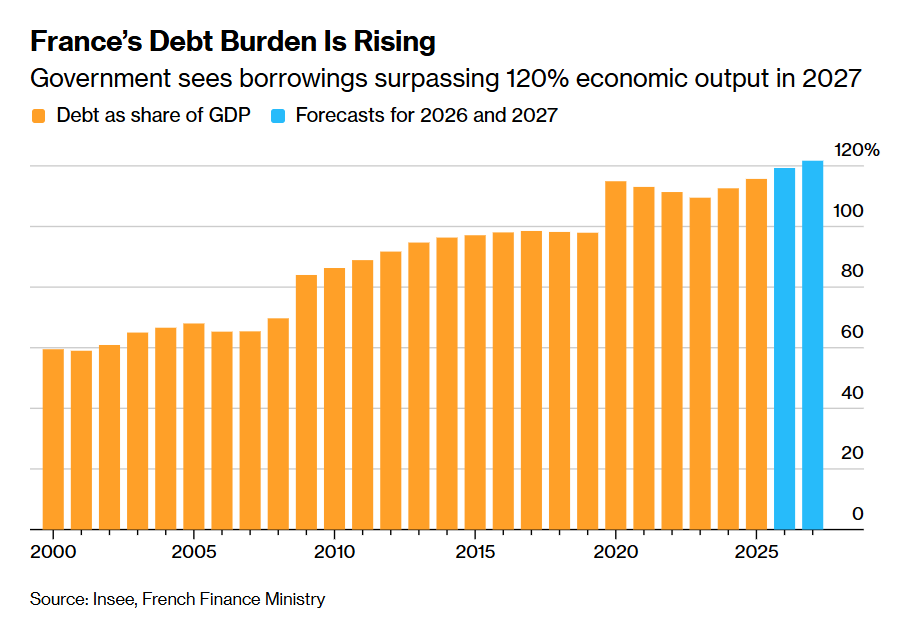
Macron's political ideology produced catastrophe for France. France's public debt, located at more than 3,636 billion euros, increases 4,833 euros per second, either 19.7% of GDP. The country has descended into a form of civil war that is about to explode. For the moment, it is limited to riots which break out regularly. Constant insecurity and rising poverty are indicators of a France that is doing very badly, making it the weak link in Europe.
…Ten years ago, Roland Lescure quit a high-flying finance job in Canada to answer Emmanuel Macron’s call for an economic and political revolution in France. The banker was lured back to his homeland by the opportunity to turn back the rising tide of the far right and hand the next generation of leaders a pro-European, business-friendly bastion.
But when Macron makes way for a successor next year, the movement will be effectively over. The revolution couldn’t crack France’s ambivalent relationship to capitalism. After a decade of political missteps and global cataclysms that made government spending his go-to solution, popular anger is rising, growth is sinking, debt is soaring and investors are dumping French assets in a global bond market rout that has made it the euro area’s weakest economic link, Bloomberg writes.
The messy end of Macron’s decade of economic management stands in stark contrast to his political ambition of turning France into the powerhouse of a retooled Europe with the heft to stand for itself as Donald Trump undermines NATO from within. Russia’s war on the continent’s doorstep and the danger of getting squeezed between the US and China have only raised the stakes for the EU’s second-largest economy against the populist wave that threatens to overtake what’s left of the post-World War II order.
Over three years from 2020, state auditor Cour des Comptes has totaled around €190 billion of crisis and stimulus spending linked to the Covid pandemic. In a later report, it estimated gross spending during the energy crisis at €72 billion (more than a year of defense spending), including almost €8 billion in untargeted subsidies at the pump.
The cash helped Macron fend off Le Pen’s challenge in the presidential vote in 2022, but he lost his majority in parliament.
France’s public finances and Macron’s political capital have not recovered. The president’s attempt to regain control over policy making with snap elections in 2024 made matters worse, returning a parliament that twice forced prime ministers to resign and delayed efforts to repair finances.
Amid the struggle for political survival, the killer blows to Macronomics have come in budgets for 2025 and 2026.
Yet the losses have mounted. Last year, Prime Minister Sébastien Lecornu suspended Macron’s pension reform and extended what was meant to be a one-off tax on large firms to convince opposition groups not to topple him in no-confidence votes of fiscal plans.
The final budget battle is the messiest yet as investors lose confidence in France’s capacity to address its fiscal difficulties, sparking a rout on bond markets that has driven the yield premium the country pays on 10-year debt over Germany to levels not seen since 2011.
Lescure has proposed unusually sharp spending cuts including unpopular freezes to public sector wages and some pensions.
read more in our Telegram-channel https://t.me/The_International_Affairs