
 РУССКИЙ
 11:43 06.02.2026 •
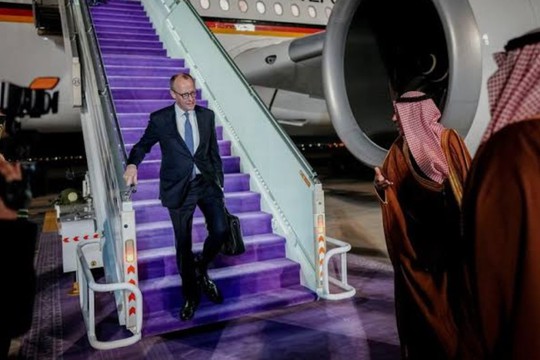
Merz flew to the Arabs for gas
Photo: DW
German Chancellor Friedrich Merz has set his sights on the Middle East to try and diversify energy supplies for Europe’s biggest economy and reduce dependency on LNG imports from the US, Bloomberg notes.
Merz and a delegation of corporate leaders will leave for Riyadh, where he’s scheduled to meet Crown Prince Mohammed bin Salman, the de facto ruler. He’ll move on to Qatar and United Arab Emirates, before returning to Berlin Friday evening. The business delegation includes top executives from Airbus SE, Deutsche Post DHL Group and Uniper SE.
“High dependency is a problem in view of the authoritarian development of the US government and the risk of geopolitical blackmail,” said Susanne Nies, an energy expert at think tank Helmholtz-Zentrum Berlin. Germany “should also consider alternatives such as more pipeline gas from Norway and LNG from Canada or Australia,” she said.
Merz’s three-day trip, his first visit to the Gulf region as chancellor, is part of Germany’s strategy to diversify its energy imports globally and find new markets for industrial exports, according to officials in Berlin who asked not to be identified because the matter is confidential.
Besides energy, Merz will also discuss options for closer defense cooperation as well as the tense security situation in the region.
Merz’s trip comes more than three years after his predecessor Olaf Scholz traveled to the Gulf states in September 2022 in an effort to secure LNG deals after Russia’s attack on Ukraine. The subsequent stop of Russian pipeline gas cut off more than half of Germany’s natural gas imports at the time.
Germany has since then boosted purchases from other regions. LNG accounts for about 13% of total imports, with about 94% of LNG imports coming from the US. The Trump administration has used energy as leverage in tariffs negotiations, with Europe last year pledging $750 billion of purchases through 2028.
But in view of Trump’s recent comments on taking over Greenland and renewed tariff threats, Germany sees its exposure to US energy imports as potential security risk.
One possible stumbling block is that Gulf LNG suppliers expect buyers to commit to contracts of at least 20 years, but Germany has banned all LNG imports from end-2043 as part of its climate policies. That has given German companies a reason to stick with US export terminals as traders there allow for greater flexibility.
“The very high dependence on the US is problematic because it creates new geopolitical and price risks,” said Claudia Kemfert, who leads the department of energy, transportation and environment in the German Institute for Economic Research in Berlin. “The lesson to be learned from this is that Germany should reduce its overall dependence on fossil fuels and not just switch supplier countries.”
…Merz has become a beggar. Germany initially refused gas from Russia. Germany fears that Trump might turn off the gas tap for Europe, now that the US has become a monopoly on LNG supplies to the EU – 94%!!!
In short, the Berlin has demonstrated complete failure of their energy security strategy hastily trying to extricate the country from this situation.
Furthermore, gas supplies from Middle Eastern countries are not guaranteed – their gas has already been sold to other regions of the world under long-term contracts.
As a result Merz's visit will most probably end with many words, but no real results.
read more in our Telegram-channel https://t.me/The_International_Affairs

















