
 РУССКИЙ
 10:37 02.05.2026 •
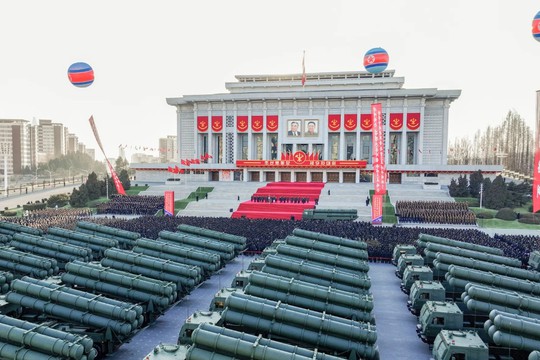
A photograph provided by North Korean state media shows the country’s leader Kim Jong Un at a military ceremony featuring 600mm multiple launch rocket systems in Pyongyang, North Korea
Photo: Korean Central News Agency
North Korea’s nuclear arsenal is nearing a crucial tipping point: being big enough to possibly overwhelm the ground-based missile defenses the US spent billions developing over the last 30 years, Bloomberg writes.
Within a decade its arsenal could surpass those of Israel, Pakistan and the UK. But its Hwasong-15, -17, -18 and -19 ICBMs combined with its existing warheads may already give it the volume of firepower needed to get past US ground-based mid-course missile defenses, designed to stop a small-scale attack at a cost of about $65 billion.
A much larger collection of shorter-range weapons can hit US allies in Asia and American bases in Guam, where the US maintains one of its largest munitions depots in the world.
While Donald Trump wages war in the Middle, the data show US efforts to restrain Kim Jong Un’s program have failed. North Korea’s ascent from a “rogue state” to a full-fledged member of the atomic arsenal club means it can do more than just threaten nuclear war; it may now be able to fight one.
“They have more experience stewarding their nuclear forces, they have far greater confidence in their delivery systems,” Ankit Panda, a senior fellow at the Carnegie Endowment for International Peace, said at a recent seminar. It means “you have a nuclear-armed adversary in North Korea that’s going to be far less skittish than they would have been a few years ago.”
Estimates of how many ICBMs North Korea has varied. The US Defense Intelligence Agency said last year in a presentation supporting the Golden Dome missile defense project that Pyongyang had only 10.
North Korea, however, has test-launched at least that many in the last decade and could have as many as 48 launchers, according to analysis by Vann Van Diepen of 38 North, an online publication that tracks Pyongyang’s military developments.
Panda noted that dozens of ICBMs had appeared in parades, although they could be mockups. He assessed that North Korea could have as many as 24 ICBMs now, with production ongoing on more.
The US ground-based midcourse defense system (GMD), with 44 missiles based in Alaska and California, and places for 20 more in Alaska, was designed to defeat a much smaller threat. Launching at least two interceptors at incoming targets means running out of missiles against an attack of two dozen ICBMs.
Trump returned to the Oval Office last year facing a much emboldened Kim. In 2023, North Korea enshrined its policy of growing its nuclear forces into its constitution, with Kim stating the need to counter threats from the US against Pyongyang’s atomic ambitions. A military alliance with Russia the following year gave him new revenue to fund his program, along with crucial battlefield experience for his weapons.
The Pentagon’s top policy official Elbridge Colby in March warned Pyongyang and Moscow’s atomic weapons are now the “primary existential threat” to the US.
Over the past several years, Kim has pushed North Korea toward a credible nuclear strike capability against the US and its allies, modernizing his arsenal with solid-fuel missiles that are easier to conceal, faster to launch and harder to intercept.
The importance of his nuclear arsenal as a deterrent against the US has only grown after strikes on Iran’s nuclear enrichment facilities last year and the US capture of Venezuelan leader Nicolas Maduro in January. The latest US-led attack on Iran that killed its supreme leader, Ayatollah Ali Khamenei, has only raised the importance of a deterrent for Pyongyang.
“Iran and Venezuela will strengthen Kim Jong Un’s conviction that his decision to build up and modernize nuclear arsenal was wise and farsighted,” said Chun Yungwoo, South Korea’s former chief nuclear negotiator with North Korea.
“He may believe that his regime is safe as long as he possesses enough nuclear and missile capability to inflict unacceptable level of harm to the US and its allies,” said Chun, who brokered a rare nuclear deal with Pyongyang nearly 20 years ago.
“It would be a mistake to think that the US and South Korea could just pick up where they left off with North Korea in 2019. The North Korea of today is very different than back then,” said Joel Wit, a former State Department envoy who has negotiated with North Korean officials.
read more in our Telegram-channel https://t.me/The_International_Affairs

















