РУССКИЙ
 12:06 27.02.2026 •
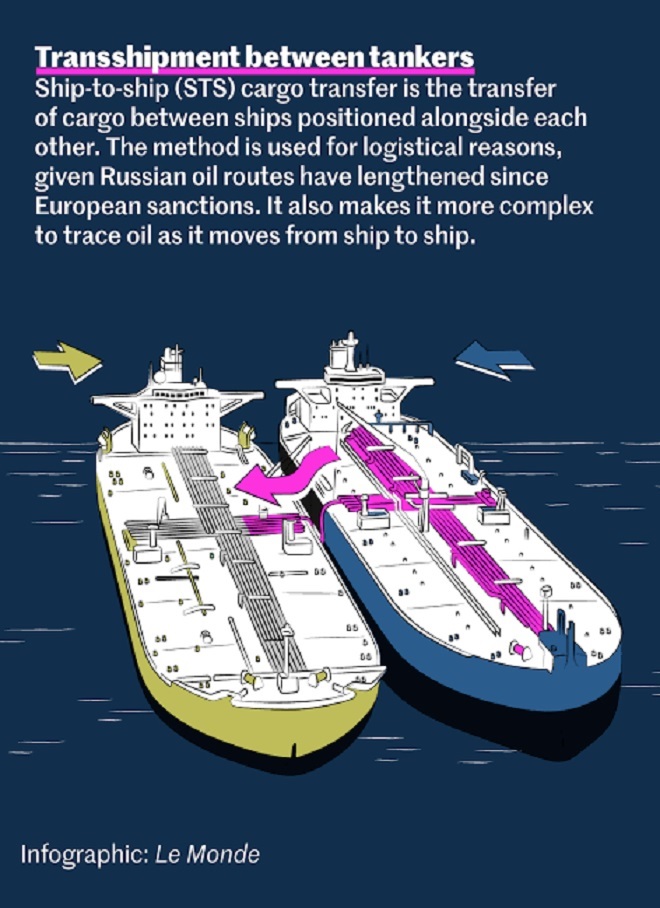
Russia is changing its oil supply chain to cope with the growing number of barrels going to China, shifting some shipments from smaller to larger tankers at a new at-sea site for the longer voyage East, Bloomberg notes.
For most of the past few years, India took most seaborne cargoes from Moscow, but it’s since pulled back, leaving space for China — and prompting Russia to transfer oil to very large crude carriers, which can haul up to 2 million barrels.
Since December, some 6.3 million to 6.9 million barrels of Urals — the nation’s flagship grade — were carried on smaller tankers through European waters and the Suez Canal to the Red Sea, then transferred to four very-large crude carriers, data from tracking platforms Vortexa Ltd. and Kpler show. That maritime area isn’t a well-established spot for at-sea transfers.
The ship-to-ship transfers — and use of larger VLCCs — point to a shift in buyers’ profiles, with Beijing taking more, while Indian refiners have scaled back, according to Vortexa. “This would signal a growing reliance on China as the primary outlet for Russian Urals,” said analyst Anna Zhminko.
Moscow proved adept at shifting its crude exports to keep the trade alive, even if that incurs extra costs and workarounds. Recent pressure from the US against flows of Urals crude to India has seen China pick up the slack.
The shift is apparent in the volumes. Deliveries of Russian crude to Chinese ports rose to 2.09 million barrels a day in the first 18 days of February, tracking data show. The rise — from 1.72 million barrels a day in all of January and 1.39 million in December — has more than offset a drop from India.
It makes commercial sense to use a VLCC, given the far greater distance from Russia to China. The larger ships can also serve as more economical floating storage if no buyer for the cargo can be found.
The emergence of the Red Sea for transfers of Russian oil follows greater scrutiny of more traditional sites, including north of the Suez Canal, or occasionally off Greece or Malta. In the Middle East, the presence of the US Navy appears to have made it less attractive to do switches near Oman.
The Sahara — a 2007-built, US-sanctioned supertanker — was among the VLCCs that recently performed a transfer off the Sinai Peninsula, taking on crude delivered by a Suezmax and Aframax. It then discharged the 1.7-million-barrel cargo off Nakhodka in Russia’s Far East onto other tankers, which in turn ferried the oil to China.
Russia will always have new answers to new sanctions. This is how the modern world works and how geopolitical logistics operate.
read more in our Telegram-channel https://t.me/The_International_Affairs