РУССКИЙ
 11:12 05.06.2026 •
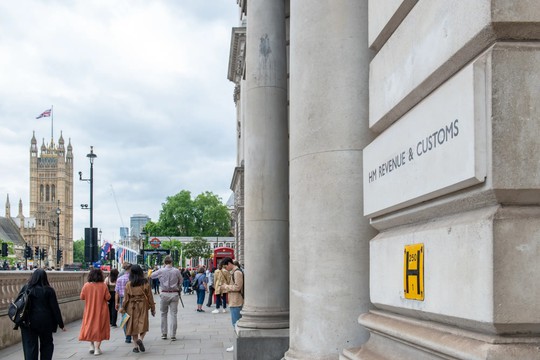
Pedestrians pass the HM Revenue & Customs building in London.
Photographer: Zula Rabikowska/Bloomberg
Britain was still grappling with the explosion of government debt accumulated during the Napoleonic Wars and the industrial revolution was beginning to transform the world, writes Bloomberg. In 1834, the UK had 90 taxes in place with duties on everything from servants to stage coaches.
Many of those levies are, of course, long retired. Yet the British tax system is returning to the complexity of the late Georgian era, according to new research by think tank Tax Policy Associates. It shows that the number of taxes has doubled in three decades and will soon hit 90.
The findings will increase concerns that the baffling array of taxes that businesses and individuals have to navigate — and accompanying administrative costs — is holding back the British economy at a time when the government is under pressure to revive growth and aid its precarious fiscal situation.
Britain's Tax System is Becoming More Complex
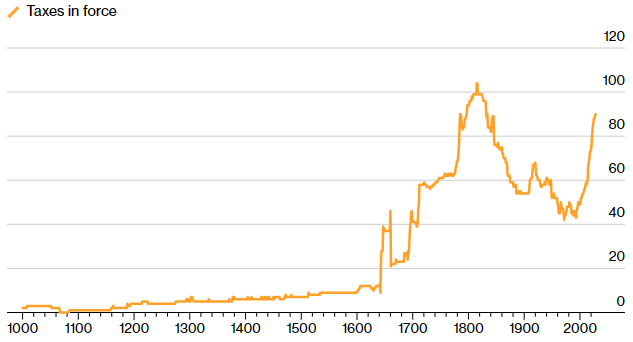 Source: Tax Policy Associates
The complexity stems from the desire of successive governments to generate revenue for public services without provoking British voters, who have seen little improvement in their living standards since the financial crisis.
The current Labour administration has been forced to become more creative after vowing not to raise the rates of the three main taxes — income tax, value-added tax and national insurance contributions. Together, they account for around 60% of all public-sector receipts.
“In the last 30 years, we had basically static level of tax, but an increase in the numbers of tax,” Dan Neidle, founder of Tax Policy Associates, told Bloomberg. “A few of those, you can say it’s environmental levies and the like, but most of them aren’t that. It’s a way to raise additional tax with as little hissing from the goose as possible.”
With the overall tax burden set to reach its highest level since World War II, the International Monetary Fund has warned that the UK may be reaching the limits on tax levels unless it makes major reforms. The Institute of Chartered Accountants in England and Wales recently said the tax system is “creaking under the weight of decades of accumulated complexity.”
The UK Tax Burden Is Set to Reach a Postwar High
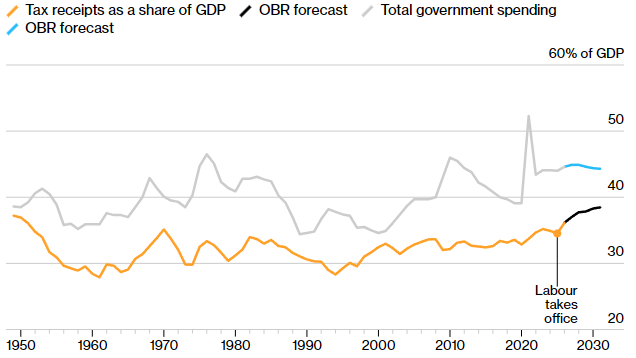 Note: Years denote fiscal year ends
Source: Office for Budget Responsibility
Tax Policy Associates said the recent increase in the number of taxes could reflect more environmental and behavioral taxes such as those on plastic bags and sugar, as well as more from the devolved administrations and small taxes on particular industries. A windfall tax on renewable and nuclear energy generators and a duty on vapes are among the recent examples of new taxes introduced or announced.
“The UK rates of tax are internationally pretty competitive, but the complexity and rate of change makes us score right at the bottom of the list,” said Neidle, a former tax lawyer at Clifford Chance. “When I was in practice, the complexity of the UK tax system and the rate of change and uncertainty was more of a factor in putting people off coming to the UK than rates.”
A combination of tepid growth, an aging population and spending needs, from health to defense, is making it harder for governments to raise money in a way that goes unnoticed by voters. Since taking office in 2024, Labour has targeted companies and the wealthy in its bid to balance the books.
The debate over the future of tax is being reopened as potential successors to Prime Minister Keir Starmer jockey for position. Former Health Secretary Wes Streeting has called for increases in capital gains tax, while Greater Manchester Mayor Andy Burnham has suggested he could target land for higher taxation.
read more in our Telegram-channel https://t.me/The_International_Affairs