
 РУССКИЙ
 21:46 11.09.2026 •
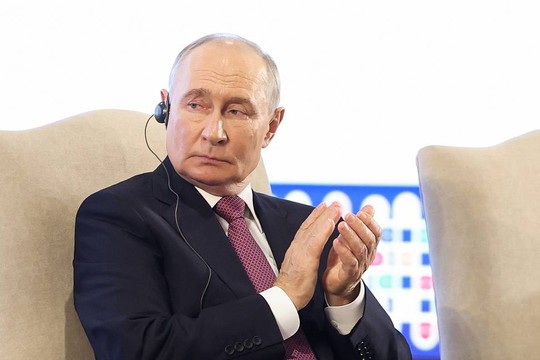
The West is attempting to regain its lost leadership by any means, including unsavory methods, Russian President Vladimir Putin said while speaking at the BRICS Business Forum.
He also noted that strong and reliable business ties within BRICS form the basis of international relations, making them more resilient.
TASS has summed up the Russian president’s key statement.
BRICS achievements
Strong business ties within BRICS form the foundation of international relations and make them more resilient: "Evidently, a robust economic partnership and reliable business ties largely form the foundation of international relations, making them more resilient and stable, and enabling us to overcome the crises facing today’s world."
Dynamic domestic markets in BRICS countries underpin the group’s success: "BRICS countries, home to about half the world’s population, have vast, dynamic domestic markets. Cities in our countries are developing rapidly and growing, urbanization is proceeding swiftly, and national companies are increasingly making their mark as global players."
Russia hopes that its initiative regarding the establishment of a BRICS new investment platform will be supported by other members of the association: "We hope this idea will be supported by members of our association."
BRICS nations have generated more than 40% of global GDP over the past five years, whereas the contribution of the Group of Seven (G7) stood at just 29%: "Over the past five years, more than 40% of global GDP was generated by the BRICS states, while the contribution of the Group of Seven – the so-called Big Seven, though I don’t understand why it’s called 'Big' – amounted to just 29%."
BRICS nations have accounted for nearly half of global economic growth over the past five years: "If we look at global economic growth over that same period [the last five years - TASS note], nearly half of that growth was driven by the countries of our association. Meanwhile, the G7 contributed only 18%."
The BRICS’ economic rules are not imposed by the "global one percent": "Through the joint efforts of government bodies, the business community, and expert circles, BRICS is forging a new, sustainable platform for global growth. It is very important that its key elements, the rules regulating the operations of companies and organizations are not imposed from outside, are not imposed on us by the so-called global one percent."
BRICS member states have proven that they know how to work hard and cooperate as equals and they are prepared to respond to any challenges: "Our rules are based on innovative business approaches and breakthrough technological solutions, while prioritizing the national interests of countries, the interests of our people. It is indeed about difficult and painstaking work, but BRICS nations have proven that they know how to work hard and honestly, cooperate as equals, see the big picture and mutually beneficial prospects. They can respond to any challenges, which means that our endeavors will be successful."
The Western attempts to regain leadership
New "engines of growth" have come to replace the old leaders of the global economy today: "It [the world] is currently undergoing a phase of profound structural transformation. This is driven by the fact that new engines of growth are replacing the old leaders – or, let’s say, the old leaders who were at the forefront of economic growth in the second half of the last century."
The West is attempting to regain its lost leadership by any means, including unsavory methods: "But, unfortunately, our Western competitors are currently trying to regain their former leadership by any means possible. Today, this competition is sometimes taking on unsavory forms - something a colleague from Iran also just mentioned here. Moreover, these unsavory forms are manifesting at the state level."
The West seeks to aggressively impact logistics, destroy infrastructure and seize ships in a bid to maintain its leadership: "The tools that are used even include measures of direct impact on or destruction of industrial and logistics facilities, pipelines and so on. Attempts are made to block international transport corridors, seize seagoing vessels, and illegal restrictions are also employed, together with threats of the so-called secondary sanctions on those who are unwilling to act in someone else’s interests but protect their own national interests."
The decline in industrial production in the leading eurozone economies has reached 8% over the past few years: "This is a big figure for them."
Sanctions
The countries that initiated the sanctions are facing an economic downturn and are no longer able to pursue an innovative policy similar to that of Russia: "In the countries that initiated the sanctions, which are facing the full-blown problem of budget deficits, growing public debts and industrial decline, it is not possible to pursue such an [innovative] policy."
Some 30,000 sanctions have been imposed against Russia, twice as many as against all other countries of the world combined: "But more than 30,000 sanctions have been imposed against Russia. This is almost twice as many as against all countries of the world combined. That is the statistic."
Russia has strengthened its national sovereignty and is now expanding cooperation with reliable, predictable partners: "We have strengthened our national sovereignty and are developing ties with reliable, predictable partners. In just four years, the geography of our foreign trade has changed dramatically."
The economic problems facing the European countries that initiated sanctions against Russia are a fact of life: "These are not mere speculations; these are figures from their own statistics. I mentioned budget deficits, rising national debt, and the industrial downturn - these are all facts of life."
Russia’s economy
Russia's economic growth rate over the past three years has exceeded the global average, with the country's GDP growing by 10.3% between 2023 and 2025.
Structural changes initiated in the Russian economy have made it stronger, more resilient, and more mobile: "Structural changes have been set in motion in the Russian economy. They have made it stronger, more resilient, and more mobile."
read more in our Telegram-channel https://t.me/The_International_Affairs

















