
 РУССКИЙ
 11:47 25.02.2026 •
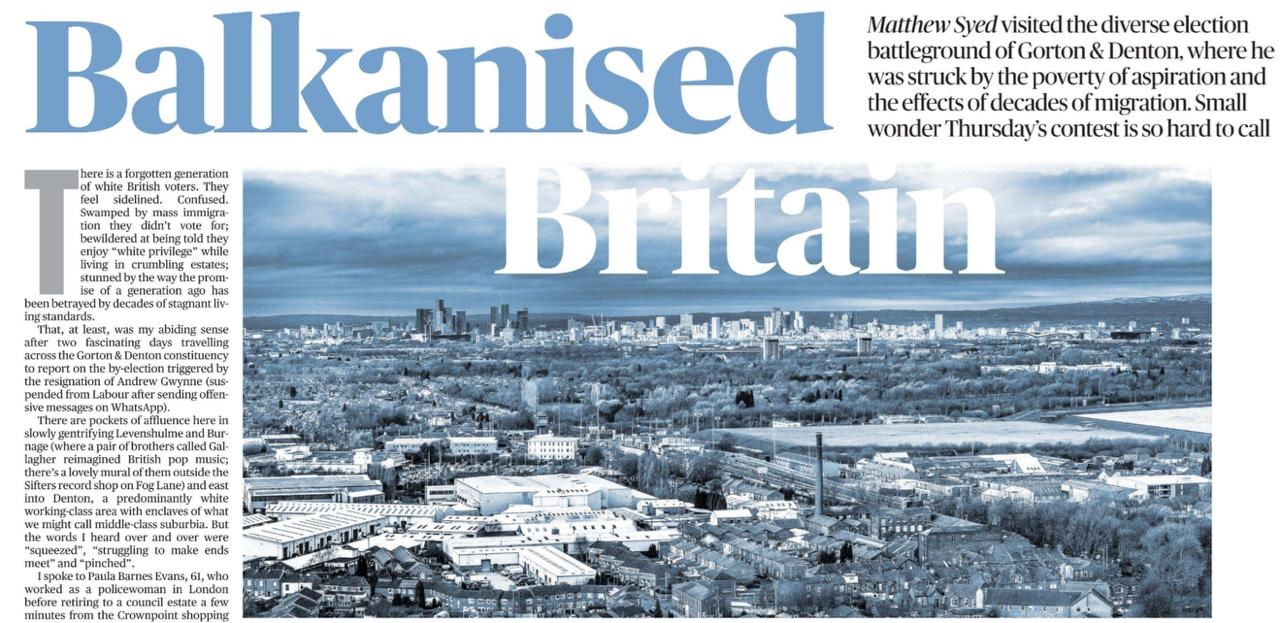
There is a forgotten generation of white British voters. They feel sidelined. Confused. Swamped by mass immigration they didn’t vote for; bewildered at being told they enjoy “white privilege” while living in crumbling estates; stunned by the way the promise of a generation ago has been betrayed by decades of stagnant living standards, writes Matthew Syed, a contributor to ‘The Sunday Times’.
That, at least, was my abiding sense after two fascinating days travelling across the Gorton & Denton constituency to report on the by-election triggered by the resignation of Andrew Gwynne (suspended from Labour after sending offensive messages on WhatsApp).
The sense that our nation is struggling in ways that those from more gilded areas don’t grasp. David, 35, a plasterer who is voting Green, said: “We have all this new technology and yet life doesn’t seem to improve. I think we are poorer than 20 years ago.” Roy, 71, a fiercely patriotic former soldier whose Jamaican father came to the UK in 1939 and worked as ground crew for Spitfires during the Battle of Britain, has Reform posters in his windows. “People say Reform voters are racist but that’s bull,” he said. “I’m half-Jamaican. But the small boats keep coming and hundreds of illegals are living around here at taxpayers’ expense. Who voted for that?”
People here have not forgotten
The constituency has been described as “a game of two halves”: the Manchester-orientated wards, which are likely to vote “left”, and those in Denton, where Reform is focusing its campaign. The contempt for Labour is palpable, even from those still tempted to vote for them. The Greens are capitalising on this disillusionment, pursuing a strategy of leaning into the cost of living crisis in Denton while running a blatantly pro-Gaza campaign in predominantly Muslim wards. One of the Green canvassers I met near the Ghamkol Sharif mosque had a hat emblazoned with a Palestinian flag; within seconds of engaging, he started to peddle antisemitic conspiracy theories. When I told him I was a journalist, he panicked and refused to give his name.
Matt Goodwin, the polished Reform candidate, is likely to hoover up most of the right-leaning votes. People here have not forgotten that it was the Conservatives who presided over the drift and chaos of the 2010-24 period.
I see a straight fight between Reform and the Greens, the latter’s victory placed in doubt by the prospect of traditional Labour voters splitting the left-wing vote, albeit more through muscle memory than conviction.
This isn’t multiculturalism; it is balkanisation
Over in Longsight to the northwest of the constituency I glimpsed the other defining story of modern Britain: the consequences of mass immigration. The first four women I approached at the market didn’t speak a word of English; I got no further than a look of fear in their eyes, the only part of their faces I could discern beneath their burqas, before they were shepherded off by bearded men. I saw only half a dozen white faces among hundreds of shoppers on a cold Wednesday afternoon.
This isn’t multiculturalism; it is balkanisation. Like dozens of enclaves in northern towns and, indeed, parts of London, this area is dominated by Muslims; in this case, mainly of Pakistani ethnicity. According to the 2021 census, more than six in ten residents identify as Muslim, the highest in the Manchester area. Progressives might say: “So what? Don’t you like brown people?”
How can it be conducive to their flourishing, to our flourishing, to the ethos of solidarity which is, after all, the rationale of that abstraction we call the nation state?
The irony is that many of the people I spoke to in Longsight concurred that this degree of separation is damaging. Rizwan, who works in a shoe stall in the market, said: “It would be better if more white people lived around here but they moved away and I doubt they are coming back.” I asked Saad, 23, who was shopping for an indoor rug, what he made of the fact so few of the older women here seem able to speak English. “It obviously isn’t good but that is the culture here,” he said. “The men do the talking.” But is this healthy?
Politicians turned to slogans rather than desperately needed reforms
It’s easy to forget these days that regional inequality in the UK was low by international standards for much of the 20th century; only in the 1980s did it start to rise to levels unique in the western world, aided and abetted by governments that became hooked on tax revenues from the City, as if mainlining heroin. When the financial crisis hit it was like an anaphylactic shock to the system, denuding the tax base and leading to an escalation of self-defeating remedies: higher taxes, higher welfare spending and higher government expenditure — all now at record postwar levels.
As our debt and dependency culture took root, politicians turned to slogans rather than desperately needed reforms. Mass immigration was, in many ways, the great betrayal, the sucking in of vast quantities of cheap labour (although never forget that 55 per cent of the “Boriswave” arrivals were dependents, not workers) while doing nothing to integrate or absorb them.
But let me finish with the scourge of balkanisation. This is cancerous to a nation since it leads to a balkanised culture and, in time, a balkanised politics. In Longsight, you see hundreds of Palestinian flags but little that celebrates Britain.
The problem is definitely there, the only question is why the author name the consequences of multinational immigration - “balkanisation”?
read more in our Telegram-channel https://t.me/The_International_Affairs

















