РУССКИЙ
 13:54 01.01.2026 •
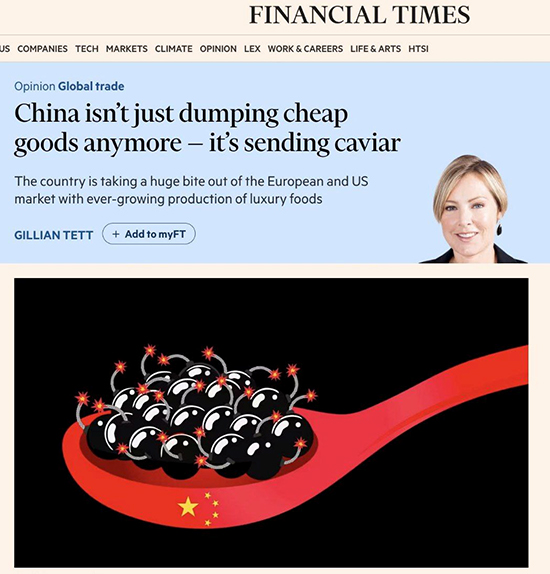
In 2025 trade wars have erupted on multiple fronts, ranging from solar panels to soyabeans. These will undoubtedly continue in 2026, ‘Financial Times’ predicts.
As America seeks to curb Chinese exports, the Middle Kingdom’s trade surplus has just topped $1tn for the first time, as demand for Chinese goods stays strong. And the more Washington slaps tariffs on Chinese imports, the more European and UK policymakers express concerns about “diversion” — the risk that China will respond to US pressure by dumping cheap goods in Europe. Recent hand-wringing from French President Emmanuel Macron is a case in point.
But while Macron focuses on manufacturing, there is another — more colourful — sector that also deserves attention this festive season: caviar. Yes, really.
Those savoury sturgeon eggs normally only grab attention at elite restaurants or festive parties. But the global caviar industry is now experiencing its own China shock, as Beijing seeks to dominate this sphere, too. And the outcome of this gourmet battle will matter not only to wealthy diners — but western diplomats too.
To understand why, we need some history. Caviar first became popular as a lowly staple food in 10th-century Persia, before being adopted by Russian peasants, and then embraced by 16th-century Russian tsars, as a quasi-national dish. Then, in the 19th century, it became a luxury food in elite European and American circles, mostly sourced from wild fishing in Russia and Iran.
When US special envoy Steve Witkoff visited Moscow this month, Russian officials proudly proffered a vast tub of red Russian caviar from the Khabarovsk region, as a gift to President Donald Trump. The tub’s producer then announced the launch of a new caviar brand called “Trumpovka”, presumably to display both collaboration — and Russian national pride.
However, there is a deeply ironic twist here. In the 20th century, overfishing caused a collapse in wild sturgeon populations, leading to a 1982 European ban on wild fishing and in 1998 endangered species protection for sturgeon, and an eventual export ban on most wild caviar in 2006. This was (and is) often flouted. However, since 2008, 185 signatories — including the EU and US — stopped wild imports. So aquaculture flourished instead, offering a more sustainable source of eggs, and (in another irony) a “cleaner” taste, since the waters that traditionally produced “wild” caviar have become very polluted in recent years.
Initially this aquaculture was dominated by European and US groups. But in recent years Chinese companies have also entered the sphere with state support, led by Kaluga Queen, a farm on Lake Qingdao. And they have dived in with such stunning efficiency and focus — echoing what has happened with, say, solar panels — that Kaluga is now the biggest caviar producer in the world. Indeed, China accounts for between half and two-thirds of global production (precise data, like the product, is slippery).
Some Chinese caviar is sold under the national flag. But much is repackaged under Italian, French and other brands (as revealed in the small print of the World Caviar championship awards), echoing the fashion world.
And Chinese officials now want their entrepreneurs to expand into other gourmet foods like smoked salmon, Wagyu beef and truffles. That is creating waves: at a recent meeting of the North Atlantic Seafood Forum, a Nordic luminary flourished a 7kg Chinese-farmed salmon on stage — and declared it to be tasty, and cheap because of Beijing’s subsidies.
Western restaurants — and consumers — love lower caviar prices, and China’s expansion is occurring amid a nearly 10 per cent rise in global caviar demand each year. This is expected to continue as the rich get richer and the middle class more aspirational.
So how will this fishy tale end? Maybe Europe will copy America next year and raise tariffs on most Chinese food imports. But it is also possible that the European Commission simply ignores the gourmet food trade, because it is relatively small in global terms.
read more in our Telegram-channel https://t.me/The_International_Affairs