
 РУССКИЙ
 9:51 28.12.2025 •
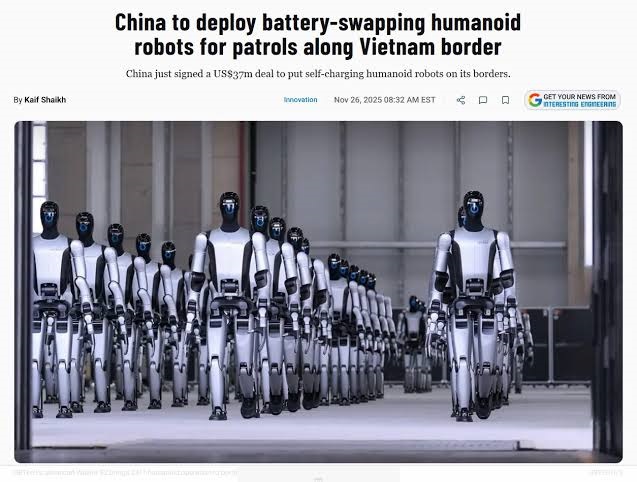
China just signed a US$37m deal to put self-charging humanoid robots on its borders, ‘Interesting Engineering’ reports.
China’s UBTech Robotics has secured a 264 million yuan (US$37 million) contract to deploy industrial-grade humanoid robots across border crossings in Guangxi, expanding the country’s push to apply robotics in public-facing and industrial environments. Deliveries are scheduled to begin in December.
The agreement was signed with a humanoid robot centre in Fangchenggang, a coastal city bordering Vietnam. The deployment will involve UBTech’s Walker S2, a model launched in July and described as the world’s first humanoid robot capable of autonomously replacing its own battery.
The initiative marks one of China’s largest real-world rollouts of humanoid systems in government operations. The details were first reported by the South China Morning Post (SCMP).
Border deployment to handle guidance, inspections, and logistics
The pilot programme will deploy Walker S2 robots at border checkpoints to guide travellers, manage personnel flow, assist with patrol duties, handle logistics tasks, and support commercial services, the SCMP report said. In addition to immigration-related operations, the robots will also be used at manufacturing sites for steel, copper, and aluminium to conduct inspections.
The deal reflects an acceleration in China’s broader effort to commercialise embodied AI. The robotics sector has received strong policy backing, and agencies across multiple provinces have begun incorporating robots into routine work.
Similar deployments have also appeared in airports, government offices, and at major events. A China Central Television segment referenced by the SCMP reported that a related robot had been deployed at Hangzhou Xiaoshan International Airport to answer passenger questions.
During this year’s Shanghai Cooperation Organisation Summit in Tianjin, immigration authorities used a multilingual robot developed by Beijing-based iBen Intelligence. Police patrol robots have also been seen in cities such as Shenzhen, Shanghai, and Chengdu.
Walker S2: Industrial-grade humanoid designed for continuous operation
Standing at around 1.76 metres tall, the Walker S2 features a highly articulated body with 52 degrees of freedom, including fourth-generation dexterous hands with 11 degrees of freedom each. These enable sub-millimetre precision for tasks such as assembly and grasping.
The robot can handle loads of up to 15 kilograms (33 pounds) per arm across a workspace stretching from ground level to 1.8 metres. High-torque joints in the waist enable deep squatting and stooping, supporting operations that require strength and flexibility.
One of the robot’s most notable features is its autonomous hot-swappable dual-battery system. UBTech says the Walker S2 can replace its own depleted battery with a fully charged one in about three minutes, allowing nearly continuous 24-hour operation without manual intervention.
The robot uses a pure RGB binocular stereo vision system that provides human-like depth perception, enabling it to adapt to dense and dynamic factory environments. Advanced dynamic balancing algorithms help maintain stability during bipedal movement, even when the robot carries heavy loads or moves at speeds of up to 7.2 km/h (2 m/s).
In China, robotics is also gaining ground in areas such as healthcare and elderly care, urban cleaning, traffic management, public safety patrols, and automated delivery through metro systems and drones. New sectors, such as border control, are also increasingly shaped by China’s push toward embodied AI.
read more in our Telegram-channel https://t.me/The_International_Affairs

















