РУССКИЙ
 10:34 08.05.2026 •
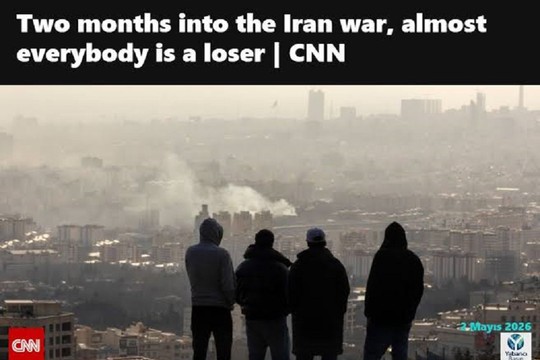
When US President Donald Trump launched the war on Iran, he promised a swift and decisive victory. Just ten days into the conflict, he said the United States had “already won the war in many ways.”
Two months on, the fighting has been suspended but a definitive end to the war is nowhere in sight. Washington remains short of clear strategic gains, while a conflict once framed as limited is now dragging much of the world into a widening quagmire – with few, if any, coming out ahead.
“There aren’t any real winners from the war, but there are some countries that are comparatively well-positioned to manage its effects,” Melanie Sisson, a senior fellow at the Brookings Institute, told CNN.
Here is where the key actors stand.
The Iranian people
It is always the ordinary people, in any conflict anywhere in the world, that have by far the most to lose from a war – and nowhere is this truer than in Iran.
The US and Israel have struck thousands of targets in Iran – including some attacks on civilian infrastructure – killing more than 3,600 people, including more than 1,700 civilians, according to the advocacy group Human Rights Activists in Iran. Trump has gone as far as threatening to destroy Iran’s “whole civilization’’ if the country’s rulers don’t bend to his demands.
At the same time, the Iranian regime has stepped up its brutal crackdown on dissent. The regime’s new leadership, under Supreme Leader Mojtaba Khamenei, appears to be even harsher than the previous one, eager to send a message to anyone who dares to challenge it.
The Iranian economy has also suffered a heavy blow, leading to job losses and rising poverty.
The Lebanese people
The Lebanese people have been caught up in the conflict between Hezbollah, the Iran-backed Lebanese militant group, and Israel for decades. A fragile ceasefire was in place until February, when, after Israel killed Iran’s supreme leader Ayatollah Ali Khamenei, Hezbollah began firing at Israel.
Israel retaliated by launching a wave of deadly airstrikes and a deeper ground incursion aimed at destroying Hezbollah. More than 2,500 people have been killed by Israeli strikes in Lebanon since they began on March 2, the Lebanese Health Ministry said on Tuesday.
A CNN analysis of satellite images suggest that Israel has adopted the same strategy in Lebanon it previously used in Gaza, and is now razing whole villages to the ground. Israel has said that the 600,000 people that have been displaced in southern Lebanon won’t be allowed to return to their homes until Hezbollah no longer threatens northern Israel.
Gulf countries
Countries across the Gulf have found themselves deeply impacted by a war they didn’t want and tried hard to prevent.
Despite their proximity to many of the most devastating conflicts in recent years, they had enjoyed decades of stability and prosperity – until Iran began retaliating against the US and Israel by attacking them.
The United Arab Emirates has been by far the hardest hit, targeted by more Iranian missiles and drones than any other country, including Israel. While the vast majority have been intercepted, the damage has been done, threatening the UAE’s status as a regional business and tourism hub.
Meanwhile, the closure of the Strait of Hormuz by Iran has had a crippling impact on Iraq, Qatar and Kuwait, which rely on the narrow maritime shipping passage to sell their oil, natural gas and other exports.
The International Monetary Fund has slashed its economic growth forecasts for these countries and expects the economies of Iraq, Qatar and Kuwait to contract this year.
The American people
The war has been punishing for Americans and their wallets. They are already paying more for gasoline and air tickets as well as some services as more businesses start adding a fuel surcharge to their prices. Annual inflation rose to 3.3% in March, up from 2.4% in February. Consumer sentiment is plunging.
The global economy and consumers everywhere
Consumers across the world are already getting squeezed by the impacts of the war.
The situation has been particularly dire in Asia, where many countries rely on imports for oil and other petrochemicals used in manufacturing. People in Latin America are struggling to cope with the higher prices of energy and food. The crisis is straining already struggling economies across Africa. And there are warnings of a “major shock” from the European Central Bank.
Before the war, global inflation was expected to slow to 3.8% this year from 4.1% last year, according to the International Monetary Fund. Now it expects prices to rise 4.4%.
The IMF also cut its economic growth forecast earlier this month, saying it now expects the global economy to grow 3.1% this year, compared to the 3.3% it projected in January.
US President Donald Trump
Trump took a huge gamble. It is yet to pay off. He pledged a short war aimed at ending Iranian nuclear and missile threats – and even possibly toppling the regime itself. But those goals are yet to be achieved and an end to the conflict remains elusive.
At home in the US, the war was not popular to begin with. The longer it takes, the worse the polling gets for Trump. A CNN poll of polls – an average of recent polls – shows the president’s approval rating at just 37% in the three weeks to Monday.
However, Trump might still emerge a winner – if Iran is forced to capitulate and agree to the maximalist demands made by the US. That doesn’t look likely, at least in the short term.
Israel and Prime Minister Benjamin Netanyahu
Just a few years ago, the idea of a direct confrontation between Iran and Israel would have been unthinkable – not least because most of the world, and especially the US, were actively trying to prevent it.
Yet Israeli Prime Minister Benjamin Netanyahu managed to convince Trump that a joint US-Israeli attack on Iran was the only way to deal with the regime and its nuclear program. That was a strategic win for the prime minister, at least initially. Last week, Netanyahu once again reiterated his vow that he would “change the face of the Middle East” and that he was “operating in full cooperation” with President Donald Trump.
At the same time, multiple polls have shown that while most Jewish Israelis back the war with Iran, they don’t believe the US and Israel are winning. The war has also further damaged Israel’s standing in the US, already suffering because of the devastating conflict in Gaza.
China
China, the world’s biggest energy importer, relies heavily on Middle Eastern oil. But experts say Beijing may still come out of this conflict in a stronger position.
China has weathered the oil crisis relatively well. It has spent the past decade building up vast stockpiles of oil, diversifying its import sources and accelerating a shift to electricity, powered by domestic energy sources, including coal and renewables. This is helping the country withstand the pressure of high oil prices. It could also lead to more demand for China’s solar panels and wind turbines in the future, as demand for renewables is expected to rise.
Then there’s a diplomatic angle. China may also benefit from the reputational damage the war has imposed on the US, Yacoubian said.
“The US has taken a huge hit globally as a result of this war. It’s an unpopular war, not only in the United States, but around the world… and China has been able to sort of take the high ground on this and put itself out there as a key advocate for global peace and security and international law,” she said.
Russia
There is no doubt that the Russian economy is getting a boost from the conflict. High oil and fertilizer prices have meant extra cash for the Kremlin – especially after the US temporarily eased sanctions on Russian crude already at sea to inject new supply into the oil market as prices were rising.
The International Energy Agency said earlier this week that Russia’s energy revenues had nearly doubled in March, to $19 billion, from $9.75 billion in February. However, Ukraine’s continued strikes against Russian oil facilities – especially ports and refineries – have restricted the amount of oil Russia can sell.
Ukraine
In the short term, the war in Iran has been very bad news for Kyiv. Key weapon deliveries have been diverted, with Zelensky telling CNN last week supplies of anti-ballistic missiles have suffered because of limited production capacity in the US.
The crisis in the Middle East has also pulled the world’s attention away from Ukraine, with the US negotiating team headed by US envoy Steve Witkoff focusing instead on Iran.
Renewable energy
The global oil crisis has only deepened the desire by many countries to transition to clean energy, which could be a boon for the sector.
The European Commission last week launched a new strategy to protect the public from “fossil-fuel price shocks” and accelerate the expansion of “homegrown clean energy,” partly in response to the global energy crisis.
But there is a caveat too – the Iran crisis is driving up prices of the materials used in renewable energy, such as aluminum, and disrupting key supply chains. This could make renewables technology more expensive.
Drone producers and weapons manufacturers
As with any conflict, weapons manufacturers are set to cash in. The Stockholm International Peace Research Institute released a report showing that global military spending rose by 2.9% last year to $2.ol9 billion in 2025.
Xiao Liang, a researcher at the institute’s Military Expenditure and Arms Production Program said the increase was driven by states responding “to another year of wars, uncertainty and geopolitical upheaval with large-scale armament drives.”
read more in our Telegram-channel https://t.me/The_International_Affairs