РУССКИЙ
 12:43 19.02.2026 •
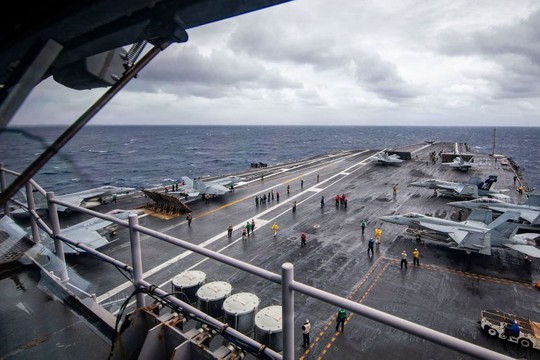
Aircraft launch from the flight deck of the USS Gerald R. Ford, in the Caribbean Sea, on February 3, 2026
Photo: US Navy
The US military is continuing a significant buildup of air and naval assets in the Middle East as negotiations over a deal with Iran continued with talks in Geneva on Tuesday. The pieces are being moved into place both to pressure Tehran as terms of a deal are discussed and to have options to strike inside the country should negotiations over its nuclear program fail, multiple sources familiar with the matter told CNN.
US Air Force assets based in the United Kingdom, including refueling tankers and fighter jets, are being repositioned closer to the Middle East, according to sources familiar with the movements.
The US is also continuing to flow air defense systems to the region, according to a US official, and several US military units deployed in the region that were expected to rotate out in the coming weeks have had their orders extended, said one source familiar with the matter. Dozens of US military cargo planes have transported equipment from the US to Jordan, Bahrain and Saudi Arabia in recent weeks, according to flight-tracking data.
A lot of planes, a lot of rumors
Satellite images show 12 US F-15 attack planes have been positioned at Jordan’s Muwaffaq Salti Air Base since January 25.
More broadly, open-source flight data reveals there have been over 250 US cargo flights into the region.
Those moves came ahead of talks in Geneva on Tuesday, with Iranian Foreign Minister Abbas Araghchi saying the meeting yielded an agreement on “guiding principles” for future talks with the two sides planning on exchanging drafts for a potential agreement. Araghchi said no timeline has been set for the exchange or for future negotiations.
“We have reached understandings on the guiding principles, but the drafting and writing phase of the agreement will be more difficult,” he said. “Right now we have a much clearer picture of what work needs to happen and what work needs to continue of course both sides still have work to do to get closer together but at least now we have a framework and a clearer path to go on.”
The buildup of military assets and emphasis by Trump and senior members of the administration that regime change is preferable has the region on edge and increases the stakes for the negotiations. Trump’s envoy, Steve Witkoff, and his son-in-law, Jared Kushner represented the US for indirect talks with Omani Foreign Minister Badr Albusaidi acting as mediator between the two and Araghchi.
For its part, Iran announced naval drills that would include closing parts of the Strait of Hormuz.
The official Islamic Republic News Agency said the exercises would simulate “real maritime threats.”
‘No one knows’ who would take over
The administration still does not appear to have a clear understanding of what would come next if it took action and removed the Iranian regime, according to two sources familiar with the matter. Secretary of State Marco Rubio echoed this during a congressional hearing late last month, telling lawmakers that “no one knows” who would take over if the regime fell.
The likely alternatives could be even more problematic for the US and its allies, sources said. In the short term, the hard-line Islamic Revolutionary Guard Corps would likely fill any leadership void, the US intelligence community believes, according to sources.
Iran is not Venezuela- US should take in consideration
Whereas US intelligence officials had a very good understanding of the power dynamics in Venezuela before the US captured then-President Nicolás Maduro last month, they lack the same insight into who, if anyone, would constitute a viable replacement for Iran’s supreme leader, sources said.
“I think they’ll be successful,” Trump said Friday of the upcoming talks. “If they’re not, it’s going to be a very bad day for Iran.”
Unlike last month, the US now has the USS Abraham Lincoln carrier strike group in the region, the USS Gerald Ford carrier strike group on the way, and fighter jet squadrons and tankers being rapidly repositioned.
“In case we don’t make a deal, we’ll need it,” Trump said Friday, when asked why the Ford was headed to the region.
There is also some discussion about the US and Israel conducting joint operations, the sources said. Those could resemble Operation Midnight Hammer last summer, when the US struck Iranian nuclear sites toward the end of the 12-day Israel-Iran war, they added.
‘It’s hard to do a deal with Iran’
Trump said over the weekend that the US “doesn’t want any enrichment,” indicating that he will not settle for a deal that allows even low-level uranium enrichment by Iran. Given Iran’s position that enrichment is its right, sources said there may not be space for negotiation.
Regional allies including the Arab states in the Persian Gulf are deeply concerned that US military action could destabilize the region. They have lobbied for holding off on military action to give diplomacy more time, according to sources familiar with the talks.
“Everybody is pushing against a strike,” said a diplomat from the region. This person added that Israel is the only regional player that has been urging the US to attack.
According to the report, IRGC drones are positioned at Iran’s southernmost point, ready to confront any aggressors.
Iran’s armed forces chief of staff, Maj. Gen. Abdolrahim Mousavi, warned Sunday that “Trump should know that he would be entering a confrontation that gives harsh lessons, the outcome of which would ensure that he no longer bellows threats around the world,” according to state-run Press TV.
...It will be interesting to see Iran inflict unacceptable damage on the Americans — they have plenty of missiles. And Trump will be impeached for the deaths of many American soldiers and sailors!
IRGC Aerospace Commander, Brigadier General Majid Mousavi: “Trump keeps talking about big, beautiful bombers and magnificent, great warships. However, we too have big beautiful missiles”.
read more in our Telegram-channel https://t.me/The_International_Affairs