
 РУССКИЙ
 11:47 04.02.2026 •
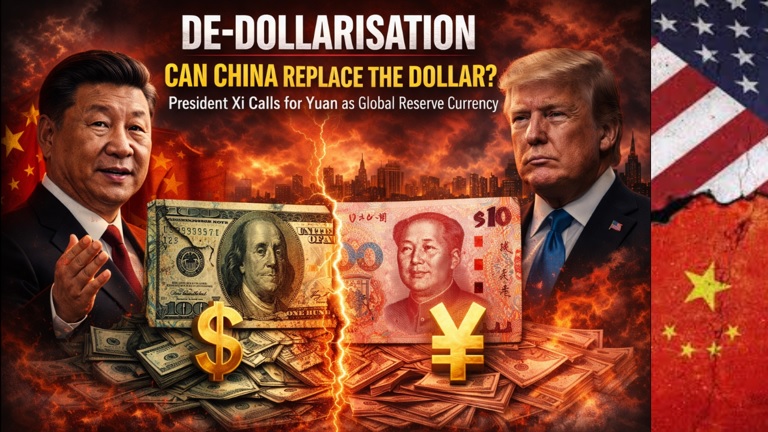 Pic.: Times Now
Amid growing global economic uncertainty and rising questions over the long-term reliability of the US dollar, Chinese President Xi Jinping has called for building a “strong currency” and elevating the yuan into a global reserve currency.
Xi said China should work to make the yuan more widely used in international trade, investment, and foreign-exchange markets, underlining Beijing’s long-standing ambition to reduce global dependence on the US dollar, reported Firstpost.
The remarks were made in a speech delivered in 2024 to provincial- and ministerial-level officials and were published over the weekend in Qiushi, the ruling Communist Party’s leading theoretical journal. Excerpts from Xi’s earlier speeches are often republished to reinforce national priorities, and their release now comes at a time of heightened global financial volatility.
Vision of a Financial Powerhouse
In the speech, Xi outlined what he described as the core attributes of a global financial powerhouse:
a strong economic base, world-leading technological and industrial capabilities, and a widely trusted and credible currency.
He stressed that such ambitions must be supported by an effective central bank capable of managing monetary policy and macroprudential risks, globally competitive financial institutions, and international financial centres with influence over global pricing and capital flows. These, he added, must be backed by strong regulation, a sound legal framework, and a stable pool of skilled financial professionals.
While acknowledging that China already ranks among the world’s largest economies in terms of banking assets, foreign-exchange reserves, and capital-market size, Xi noted that the country remains “big but not strong,” warning that becoming a true financial powerhouse would be a long-term project.
Limits to Yuan’s Global Reach
China has spent more than a decade promoting the internationalisation of the yuan, and its use in cross-border trade settlements has increased steadily. However, the currency’s broader global footprint remains limited.
China’s Cross-Border Interbank Payment System (CIPS) clears roughly 700 billion yuan (about $100 billion) per day, far below the nearly $2 trillion cleared daily by the dollar-based Clearing House Interbank Payments System (CHIPS). Yuan-denominated debt issuance in global markets is also minimal, accounting for just 0.8% of total international issuance.
Despite these constraints, the yuan has remained relatively stable over the past year, even amid renewed trade tensions with the United States. This contrasts with its sharp depreciation during Donald Trump’s first presidential term, when speculation grew that Beijing had allowed a weaker currency to offset the impact of US tariffs.
read more in our Telegram-channel https://t.me/The_International_Affairs

















