
 РУССКИЙ
 11:08 24.01.2026 •
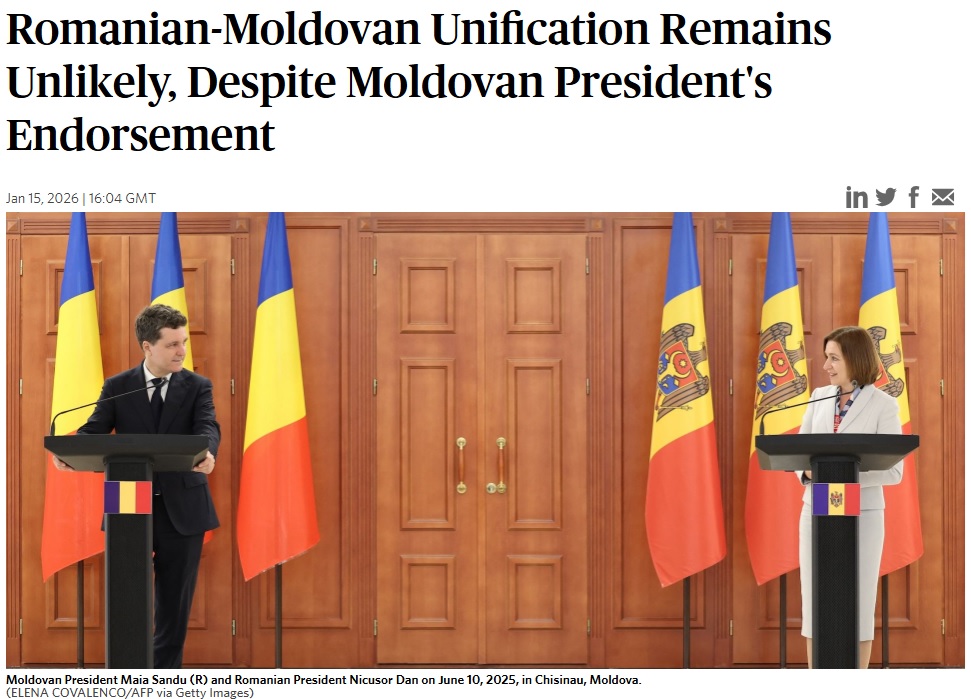
Moldova's president Maia Sandu recently stated in a podcast that she would vote in favor of her country joining Romania in the event of a referendum. Her comments have caused outrage.
"If we have a referendum I would vote for the unification with Romania. Look at what's happening around Moldova today. Look at what's happening in the world," Moldovan President Maia Sandu said in an interview with British podcast, The Rest is Politics, on January 11. "It is getting more and more difficult for a small country like Moldova to survive as a democracy, as a sovereign country, and of course to resist Russia," she added.
Maia Sandu the current leader of Moldova is a citizen of Romania.
It was this statement that really caused a stir.
During the same podcast, Sandu admitted that she was aware that a majority of Moldovans do not support unification with Romania according to polls and that this was why the most realistic alternative was Moldova's accession to the European Union. This is supported by voters and is being actively pursued by the government in Chisinau.
Opposition politicians accuse president of treason
Igor Dodon, the leader of Party of Socialists of the Republic of Moldova, the country's largest opposition force, and a former president of the country, immediately criticized Sandu's statement. He accused the current president of dreaming of becoming the leader of a new Romanian state, arguing that she was led by selfish thoughts about her own future.
The party issued a statement demanding Sandu's immediate resignation saying that each day of her presidency was "a threat to the existence of the Republic of Moldova as an independent state." It also called on the prosecutor general and the intelligence services "to immediately initiate an investigation into possible treason." It appealed to all "patriotic forces" to set aside "tactical differences and unite against the Maia Sandu regime."
The country's Communist Party, which is increasingly unpopular, made similar comments, describing the Moldovan president's statement as an "act of treason" and a "gross violation of the presidential oath of office."
Vitalie Andrievschi, a political scientist based in Chisinau, noted that Moldova currently had weak institutions, a vulnerable economy and territorial problems. Reforms were also necessary. The European Union was providing important support in this regard, Andrievschi said.
For him, Sandu's statement was not an actual call for unification with Romania but a warning sign that the state is overburdened and its leaders are reaching their limits, having been in survival mode for far too long.
Romania begins talks on possible unification with Moldova
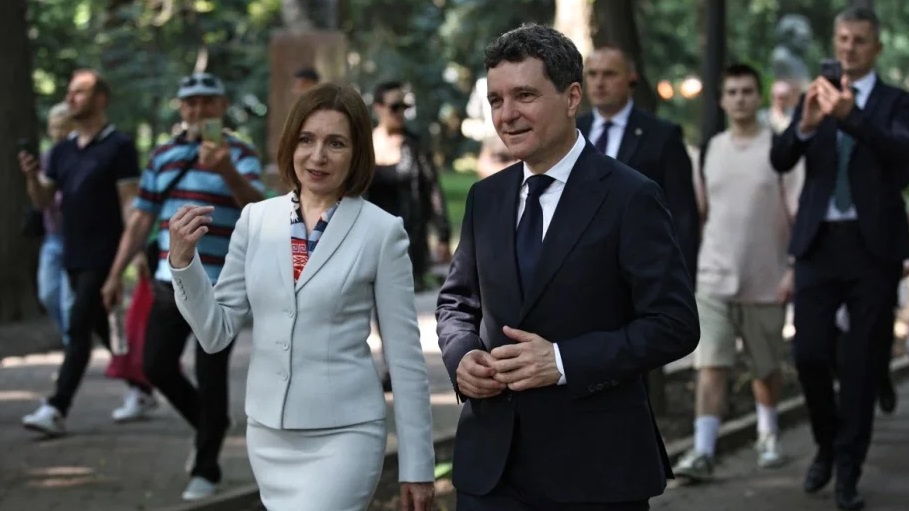 Moldova's president Maia Sandu with Nicușor Dan, the President of Romania
Photo: ANR News
An adviser to the Romanian president said Bucharest remains committed to a position adopted by parliament in 2018, which recognises unification as a legitimate subject for dialogue, ANR News reports.
Eugen Tomac has said that the common goal of Bucharest and Chisinau is to support Moldova’s European integration process by “any means,” he told local media.
However, it’s stressed that any progress would depend on a referendum in both countries.
Romania and Moldova share deep cultural and historical ties. Much of present-day Moldova was part of Romania until the Second World War, before being incorporated into the Soviet Union.
Since gaining independence in 1991, Moldova has maintained close relations with Romania, which is a member of both the European Union and NATO.
Despite these links, public opinion in Moldova remains divided. Surveys conducted in recent years suggest that many Moldovans are cautious or opposed to unification, citing concerns over economic stability, political autonomy and the potential social impact of such a change
In Romania, attitudes are also mixed. While some see unification as a historical correction and an opportunity to strengthen regional security, others worry about the financial costs and administrative challenges of absorbing a less wealthy neighbour.
Moldova is not a member of NATO and remains vulnerable to regional security pressures, including the unresolved issue of the Russian-backed region of Transnistria.
Officials in Bucharest insist that there is no immediate plan for unification. Instead, they say the focus remains on strengthening cooperation and supporting Moldova’s reform efforts, while leaving the final decision to the citizens of both countries.
Moldova severing ties with the CIS
The Moldovan Ministry of Foreign Affairs is working on denouncing the agreements that form the basis for the creation of the CIS, announced Minister Mihai Popșoi.
The minister, speaking on Radio Moldova, stated that with the denouncing of the three fundamental agreements, Moldova will officially cease to be part of the CIS. This process has already begun.
According to him, the decision was made recently, and the approval process has begun.
Popșoi added that the denouncing documents will be submitted for review after the start of the new parliamentary session and could be reviewed by mid-February. If parliament approves the denouncing, and then President Maia Sandu ratifies them, Moldova will cease to be part of the CIS, the foreign minister explained.
Since 2022, Moldova has been ignoring CIS meetings, as well as the Eurasian Economic Union (EAEU), where it has observer status. Moldovan authorities have expressed a clear intention to reorient exports to the West.
…It's funny to watch the Moldovan president's Russophobic convulsions when the European Union itself is already on the path to disintegration. And Trump will help this process!
The big question is, where will Molodva, led by Sandu, be accepted?
read more in our Telegram-channel https://t.me/The_International_Affairs

















