РУССКИЙ
 10:05 09.06.2026 •
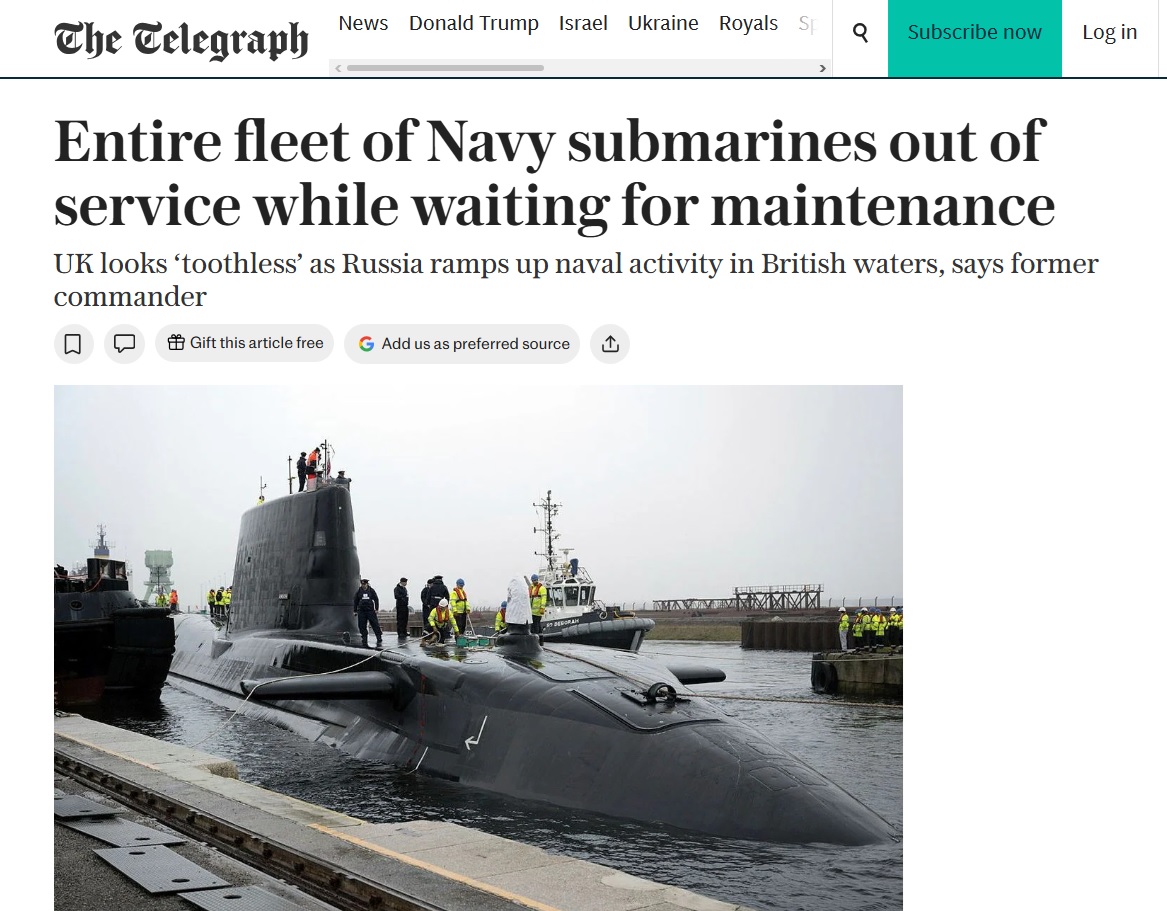
The Navy’s entire available fleet of nuclear attack submarines is stuck in port, leaving Britain vulnerable to Vladimir Putin’s underwater fleet, The Telegraph notes.
All five of the UK’s Astute-class hunter-killer boats are awaiting maintenance and repairs. A sixth, which was commissioned into the fleet, is not yet ready to deploy.
Naval commanders have said the situation makes the UK look “toothless” in the eyes of Russia, which has ramped up naval activity around British waters by a third in the past year.
Cdr Ryan Ramsey, a former nuclear submarine captain, said the lack of available attack boats was a “serious wake-up call” for Britain.
Urging Sir Keir Starmer and “major industry players” to “get a grip”, he told The Telegraph: “We look toothless. The Russians know we can’t put submarines to sea.
“None of this makes sense to me. You lose credibility against the Russians if you can’t maintain that deterrence at sea.
“This problem has been hidden for decades. Everyone knew this was coming, but it got kicked down to the next person in charge.”
The fleet of ships awaiting repairs makes Britain ‘lose credibility with the Russians’, Cdr Ryan Ramsey has said
Lord West of Spithead, a former First Sea Lord and Labour security minister, said the situation was “unacceptable” and “very worrying” that Astute-class subs were stuck in port.
“The attack submarines are fundamental for looking after our ballistic missile submarines,” he told the Daily Mail. “They are fundamental for frightening and terrifying the Russians.”
This week, the head of the country’s military warned that the threats Britain faced were greater than at any time since the Cold War.
Astute boats are vital in deterring Russian stealth subs. They also play a key role in protecting Britain’s fleet of Vanguard submarines, which carry Trident nuclear missiles, and the UK’s two aircraft carriers, HMS Queen Elizabeth and HMS Prince of Wales, when at sea.
The boats, which cost £12.2bn in total, are seen as the most advanced attack submarines in the world.
Naval sources confirmed all five of the current fleet had not been deployed because of maintenance and technical issues with HMS Anson, which had recently returned to the UK following months deployed at sea while travelling to Australia.
The Royal Navy’s recent failures
HMS Daring
One of the Navy’s six destroyers, she was withdrawn in 2017 after suffering problems with her turbines. The ship has languished under refit in dock ever since and is not due to return to sea until this autumn, by which time she will have spent more years in repair than in active service.
HMS Queen Elizabeth
Britain’s flagship aircraft carrier suffered an embarrassing personal hygiene problem when her hot showers broke down for at least six months last year while the ship berthed in Portsmouth. Sailors had to either disembark to shower blocks on shore, or shiver under the cold tap.
HMS Prince of Wales
The Navy’s other aircraft carrier had to stop in Norway for repairs just weeks into her deployment to the High North in June this year, threatening her trip to the US to mark the 250th anniversary of Independence Day in July.
HMS Middleton
Britain’s last Royal Navy vessel in the Middle East was sent home weeks before the outbreak of war against Iran. Her departure – the first time in 46 years that there had been no Royal Navy presence in the Middle East – was described as a “terrible error” by Lord West, the retired head of the Navy.
HMS Dragon
The Type 45 was belatedly deployed to Cyprus in March after RAF Akrotiri was hit by an Iranian-made drone, prompting accusations that Britain had been tardy in its response. Having arrived three weeks after the strike, HMS Dragon then had to go to Crete in early April for repairs to her onboard water systems.
read more in our Telegram-channel https://t.me/The_International_Affairs