
 РУССКИЙ
 11:29 21.01.2026 •
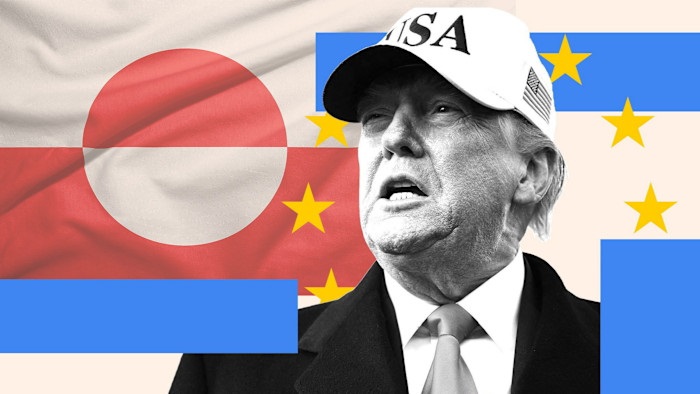 A rupture in the western military alliance over Greenland would pose an existential threat to Europe’s security
Photo: FT montage
Europe could also threaten to restrict US companies’ market access in run-up to crunch talks at Davos, ‘Financial Times’ stresses.
EU capitals are considering hitting the US with €93bn worth of tariffs or restricting American companies from the bloc’s market in response to Donald Trump’s threats to Nato allies opposed to his campaign to take over Greenland.
The move marks the most serious crisis in transatlantic relations for decades. The retaliation measures are being drawn up to give European leaders leverage in pivotal meetings with the US president at the World Economic Forum in Davos this week, officials involved in the preparations said.
They are attempting to find a compromise that would avoid a deep rupture in the western military alliance, which would pose an existential threat to Europe’s security.
The tariff list was prepared last year but suspended until February 6 to avoid a full-blown trade war. Its reactivation was discussed on Sunday by the EU’s 27 ambassadors, along with the so-called anti-coercion instrument (ACI) that can limit US companies’ access to the internal market, as the bloc wrestled over how to respond to Trump’s threat with punitive tariffs.
Trump, who has demanded permission from Denmark to take control of Greenland, on Saturday evening vowed to impose 10 per cent tariffs by February 1 on goods from the UK, Norway and six EU countries that sent troops to the Arctic island for a military exercise this week.
“There are clear retaliation instruments at hand if this continues... [Trump’s] using pure mafioso methods,” said a European diplomat briefed on the discussion. “At the same time we want to publicly call for calm and give him an opportunity to climb down the ladder.”
France has called for the EU to hit back with the ACI, which has never been used since its adoption in 2023. The tool includes investment restrictions and can throttle exports of services such as those provided by US Big Tech companies in the EU.
While many other EU member states have voiced support for exploring how the ACI could be deployed against the US, a majority called for dialogue with Trump before issuing direct threats of retaliation, diplomats briefed on the discussions told the FT.
“We need to get the temperature down,” said a second EU diplomat.
In a step towards retaliation, the biggest parties in the European parliament this weekend said they would delay a planned vote on measures that would have reduced EU tariffs on US goods as part of a trade agreement struck last year.
Trump’s threats “certainly warrant the ACI as it would be textbook coercion”, said a third European official.
“But we need to use the time to February 1 to see if Trump is interested in an off-ramp,” they said, adding that much would depend on the outcome of the talks in Davos.
European officials said that they hoped their retaliation threats would increase bipartisan pressure in the US against Trump’s actions and result in him retreating from his tariff pledge.
“It is already a situation that no longer allows compromises, because we cannot hand over Greenland,” said a fourth European official. “The reasonable Americans also know that he has just opened Pandora’s Box.”
Von der Leyen said on Sunday that Europe would “stand firm in our commitment to uphold the sovereignty of Greenland and the kingdom of Denmark. We will always protect our strategic economic and security interests.”
But on Sunday US Treasury secretary Scott Bessent said that Europe was too weak to guarantee Greenland’s security and refused to back down on the US demand to take control of the strategically important island.
“The president believes enhanced security is not possible without Greenland being part of the US,” he told NBC News.
European Council president António Costa, who convenes such summits, said on Sunday evening: The EU was ready “to defend ourselves against any form of coercion.”
 Pic.: arab-j.net
Trump’s tariff shock suggests EU’s strategy of flattery and appeasement has failed
Trump’s weekend announcement that eight countries that have supported Greenland would face tariffs unless there was a deal to sell the territory to the US was another hammer to the transatlantic alliance, mocking the notion that the US is Europe’s ally. The eight countries include six EU member states, as well as Norway and the UK, the latter unprotected by the much vaunted “special relationship”. It suggests that Europe’s strategy of flattering and appeasing the US president has failed, ‘The Guardian’ notes.
After years of the EU extolling its heft as a trade player, the terms of the EU-US trade deal signed at Trump’s Turnberry golf course last July were seen as a humiliation.
Von der Leyen defended that deal by saying it provided “crucial stability in our relations with the US” at a time of acute instability in an “unforgiving” world.
Now that argument is left in ruins, while the 0% tariffs for the US may never be implemented. The Trump administration has succeeded in uniting the European parliament from radical left to far right – via mainstream groups – against the agreement. The leader of France’s far-right National Rally party, Jordan Bardella, described Trump’s threats as “commercial blackmail” and said the EU should suspend last summer’s agreement. Meanwhile, the centre-right European People’s Party leader, Manfred Weber, aligned itself with other mainstream parties in calling for ratification of the deal to be paused.
Trump may have pushed the EU too far. Although Greenland left the EU’s predecessor organisation, the European Community, in 1985, acquiescing in the forced sale of the territory of an EU member state would send a disastrous signal about the EU as a geopolitical actor and its commitment to Ukraine.
As European leaders lined up to declare their determination to uphold Danish and Greenlandic sovereignty, there are growing calls to use the EU’s powerful but untested anti-coercion instrument against the US.
As the 80-year-old transatlantic relationship goes through epoch-defining changes, the next few weeks will reveal whether this time is different.
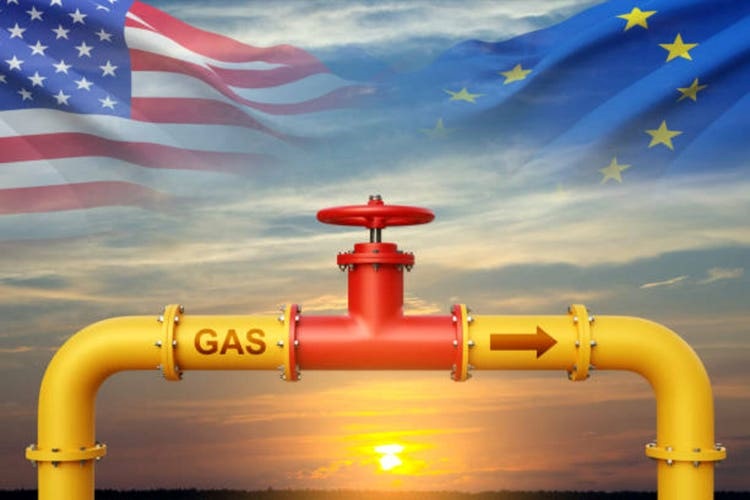 Pic.: seekingalpha.com
American gas is a noose for Europe – Fears grow over Europe’s soaring dependence on US gas imports
New data shared with POLITICO shows Europe is already importing a quarter of its gas from the U.S., a figure that is set to soar as the bloc's total ban on Russian gas imports is phased in.
It comes as an increasingly belligerent U.S. President Donald Trump flirts with seizing Greenland, a territory of Denmark, in a move that could destroy the NATO alliance and throw transatlantic relations into crisis.
The EU's growing reliance on imports of U.S. liquefied natural gas "has created a potentially high-risk new geopolitical dependency," said Ana Maria Jaller-Makarewicz, lead energy analyst at the the Institute for Energy Economics and Financial Analysis, the think tank that produced the research.
"An over-reliance on U.S. gas contradicts the [EU policy] of enhancing EU energy security through diversification, demand reduction and boosting renewables supply," she said.
Alarm over this strategic weak spot is also growing among member countries, with some EU diplomats fretting that the Trump administration could exploit the new dependency to achieve its foreign policy goals.
After 2022, the EU went to drastic lengths to wean itself off Russian natural gas, which in 2021 made up 50 percent of its total imports but now accounts for only 12 percent, according to data from Bruegel, a Brussels-based economic think tank.
It accomplished this largely by switching imports of pipeline gas from Russia with liquefied natural gas shipped from the U.S., which at the time was a firm ally. The U.S. is already the biggest exporter of LNG, and its product now accounts for around 27 percent of EU gas imports, up from 5 percent in 2021. France, Spain, Italy, the Netherlands and Belgium are the largest importers; non-EU member the U.K. is also a major importer of U.S. LNG.
The issue of U.S. LNG dependence is addressed by a broader EU commitment to energy diversification that was baked into a wider ban on Russian gas set to take effect this year, according to diplomats familiar with the matter. The official line, however, is that the U.S. remains a "strategic ally and supplier," one of the diplomats said.
"The dependence is certainly there, but we're kind of stuck where we are," said one European government official. "There's really no alternative."
read more in our Telegram-channel https://t.me/The_International_Affairs

















