РУССКИЙ
 16:55 02.12.2025 •
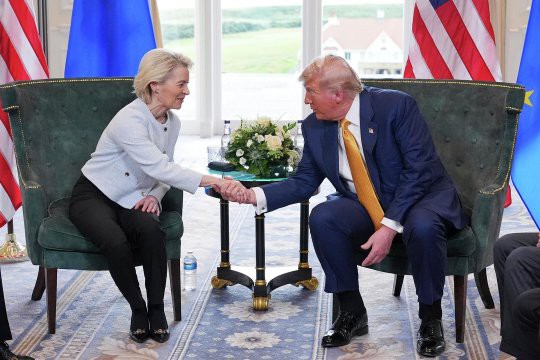
On November 28, EU member states supported the preliminary agreement on trade tariffs that European Commission President Ursula von der Leyen and US President Donald Trump clinched in July. The future of the deal and transatlantic trade and economic relations as a whole remains unclear though.
In an overwhelming vote on Friday, EU member countries agreed to scale down tariffs on US imports, as stipulated in the trade agreement reached in July. The decision followed a series of meetings between US and European officials, starting on November 24, when US Commerce Secretary Howard Lutnick and Trade Representative Jamieson Greer negotiated with senior EU officials for the first time since July. The tense talks focused on the free trade agreement, which the parties have so far failed to agree on as they keep insisting on further concessions and citing unresolved issues. Furthermore, the trade deal still needs approval by the European Parliament, where voices in favor of adjusting it are getting increasingly loud.
In July and August, US and EU representatives formally agreed on the key points of a potential agreement, which provided for 15 percent tariffs on most EU exports, including automobiles, semiconductors, pharmaceuticals, and lumber. These also included zero or near-zero tariffs on some key products, such as natural resources, aircraft, and components, the elimination of tariffs on US manufactured goods, trade liberalization, the reduction of non-tariff barriers, cooperation on economic security as well as EU's intention to buy liquefied natural gas, oil, and nuclear energy from the United States.
On August 21, the parties inked a joint Declaration on Transatlantic Trade and Investment where the EU and the US formally endorsed the July trade agreements. The resulting compromise included a 15 percent tariff on most EU imports to the US - half of what the Trump administration initially planned, but three times the average rates that existed before the trade conflict erupted. According to the Declaration, the US will roll back its hard-hitting tariffs on European products only after the EU has legislatively fulfilled its part of the deal. The key provision is the abolition of tariffs on all imported American industrial products and providing preferential access to the EU market for a wide range of US agricultural produce and food. A statement issued by the office of EU Trade Commissioner Maros Sefcovic said that proposals for amendments to EU legislation to reduce tariffs on an agreed list of American goods could be ready by the end of August.
Meanwhile, constantly changing conditions have been popping up in trade negotiations between the two Western economic powerhouses. Trump, for example, expanded the scope of his steel tariffs to include goods that were exempt from duties in July. The EU, for its part, slapped Google with a 2.95 billion euro fine in September, accusing the US corporation of "providing competitive advantages to its advertising platforms and abusing its dominance." Moreover, Brussels has launched investigations against Amazon and Microsoft under the Digital Markets Act (DMA), which bars large platforms from abusing their dominant position in the tech market.
Following his latest meeting with the Americans, Maros Sefcovic said that the EU was all set to fulfill its obligations and emphasized the bloc's progress in implementing the agreement. He added, however, that procedures in Europe take more time than in the US, meaning that the deal requires approval by the European Parliament. However, during the meeting, Czech Industry and Trade Minister Lukas Vlcek noted that the problem with the world's largest trade relations may not be the size of individual tariff components, but that of non-tariff ones. These are trade barriers, such as differences in regulations, standards, or administration, which even though not tariffs per se, still seriously affect the cross-border flow of goods and services.
Critics believe, however, that the problem is much deeper, as the July deal and the August 21 Declaration are a de facto admission of the EU's surrender to Washington. Indeed, the list of large-scale and unilateral European concessions included complete market liberalization for US manufactured goods, greater access for US agricultural produce and seafood, and guarantees for multi-billion dollar purchases of US energy resources and high-tech goods. Just a few days after the Declaration was signed on August 21, European winemakers voiced their objections arguing that the 15 percent tariff applied to European wine imports is fraught with significant losses for the industry, with France alone facing annual losses of over 1 billion euros. The situation is further complicated by European businesses' commitment to massive direct and indirect investments in strategic US industries, including large-scale purchases of American weapons.
In a bid to facilitate the implementation of the August 21 declaration, in late August, the European Commission rolled out a series of pertinent proposals, also pledging continued dialogue with the US on further tariff reductions with the goal of concluding a comprehensive and balanced trade agreement. However, in early September, Donald Trump threatened Europe with new tariffs and a halt to AI chip supplies unless Brussels lifted the digital services tax on leading US IT companies.
Soon after, The Wall Street Journal reported that, faced with new bureaucratic hurdles and growing uncertainty, European companies had been forced to suspend exports, [i] primarily due to Washington’s decision to extend its 50 percent tariff to metals. In a letter to von der Leyen, the head of the German engineering association (VDMA) warned that the industry was facing an "existential crisis." Dissatisfaction has also been voiced in the European Parliament, without whose approval key provisions of the trade agreement simply cannot be implemented. Several MEPs have vowed to demand amendments to the bill that ratifies the deal with the United States.
Currently, each side’s behavior is causing growing and increasingly poorly concealed irritation by the other side. Brussels and Washington have locked horns over the issue of easing digital restrictions - the demand that US Secretary of Commerce Howard Lutnick reiterated during the last meeting - with European leaders resisting on key points. The Financial Times reported, citing US officials, that the implementation of the EU-US trade agreement had stalled. The Americans are threatening the Europeans that the EU’s foot-dragging will prevent them from taking advantage of the current improvement in relations with the Trump administration.
US officials are also being forced to move fast by domestic concerns now that Trump's tariffs and trade agreements are threatened by a potential challenge in the Supreme Court. The Court is expected to come up with a ruling within weeks or months either to uphold Trump's tariffs or to order their repeal. If the judges rule against Trump, his administration may be forced to seek other legal justifications for imposing tariffs, and persuade trading partners to comply with the agreements.
Seriously complicating transatlantic trade relations are also strategic risks associated with a number of unresolved disagreements between the two sides, from the situation in Ukraine to levels of military spending. Moreover, geopolitics could prove a major sticking point. In the spring, following Trump's announcement of draconian tariffs and his public skepticism about NATO's prospects, Europeans' trust in the United States plunged to an all-time low with EC President von der Leyen going as far as to declare that "the West as we knew it no longer exists."
French scholar Sylvain Kahn expounds on this idea in his book Is Atlanticism Dead? Long Live Europe! For 80 years, Europe maintained an asymmetrical yet cooperative relationship with the United States. This imbalance, long considered the price that Europeans paid for stability and protection has changed dramatically under Donald Trump. What was once a strategically unequal interdependence has turned into a stranglehold used to exert pressure, even though the victims still refuse to acknowledge this.
According to The Economist, the debate over whether Europe should remain tied to America has died down while the war rages on. Europeans swallowed their pride, for example, by agreeing to sign a lopsided trade deal in July. What else could they do when they realized all too well that losing the support of the whimsical US president could spell disaster for Ukraine? The continent at war is forced to stomach humiliation. As soon as the fighting in Ukraine is over, some Europeans may decide that their groveling has to end, though.
One FT author goes even further, suggesting that Europe seriously consider a "plan" for decoupling from the United States to avoid the risk of turning from a rule-setting force into a pawn in someone else's game without rules. To avoid such a predicament, Europe must minimize its vulnerability to US pressure, "which will not cease."[ii] Previously, the term “decoupling” was used only in relation to China.
That being said, it is still premature to talk about the EU's complete capitulation. The EU Council and the European Parliament are expected to agree on a final deal by next spring. On November 28, the EU member states approved a clause allowing the EU Commission to suspend the agreement if the US fails to comply, as well as a safeguard mechanism allowing the Commission to put the deal on hold if concessions on tariffs lead to a sharp increase in US imports and disruption of the single European market. Member states also discussed the introduction of a "sunset clause" that would permanently end tariff reductions after five years if the agreement were not extended. The idea is expected to get a nod from the European Parliament.
Four months after the meeting between von der Leyen and Trump, the EU and the US are still teetering on the brink of a new tariff war. For European industry, reaching a final agreement between the two economic powerhouses, preferably taking into account the wish list the EU presented at the end of November remains an overarching priority. What remains entirely unclear, however, is to what extent such proposals would be welcomed by the White House. Moreover, the growing burden of geopolitical differences is increasingly taking center stage in transatlantic relations, leaving ever less hope for a favorable outcome to the trade dispute.
The views of the author are his own and may differ from the position of the Editorial Board.
[i] https://www.wsj.com/economy/trade/the-eus-trade-truce-with-the-u-s-is-in-danger-of-unraveling-d8238c07
[ii] https://www.ft.com/content/89f172bb-0d60-47b0-ae56-853d25c52db8
read more in our Telegram-channel https://t.me/The_International_Affairs