
 РУССКИЙ
 11:16 24.02.2026 •
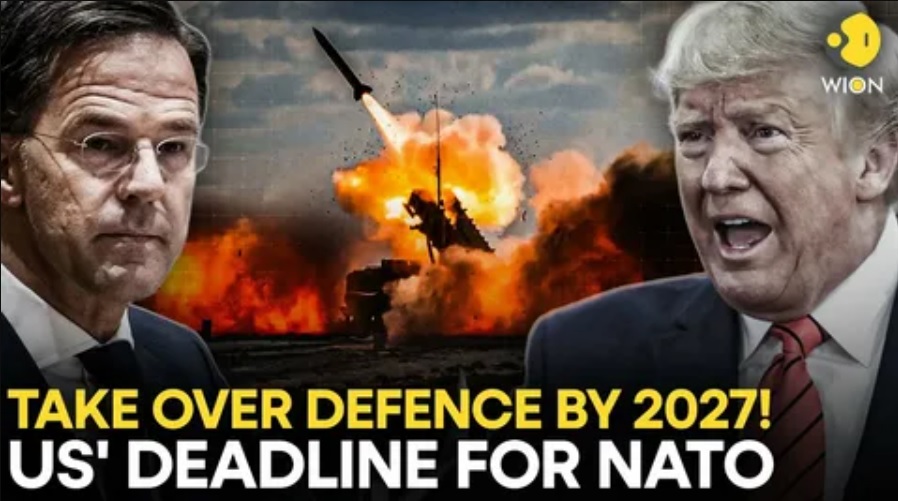
The Transatlantic alliance is on the ropes, ‘Foreign Affairs’ states.
Since the end of World War II, American power has underwritten European unification and integration—arguably Washington’s greatest foreign policy accomplishment. But the Trump administration has made clear that the United States is no longer interested in acting as Europe’s security guarantor. It has threatened to seize the territory of a NATO member, reduced funding to Ukraine, aggressively imposed tariffs on European allies, and, in its 2025 National Security Strategy, called for “cultivating resistance to Europe’s current trajectory.” The message could not be clearer: the continent can no longer rely on the United States to defend it. For the first time in eight decades, Europe stands alone.
But there has been no revolution in European military affairs. Although NATO countries have agreed to increase defense spending to 3.5 percent of GDP by 2035, they cannot spend their way to security. The issue is structural, not financial. European militaries are not set up to defend the continent without the United States.
The EU must become Europe’s Pentagon!
European leaders are keenly aware of their security dependence but in denial about what must be done. The biggest stumbling block is the belief that defense is a national responsibility rather than a European one. Individual governments across Europe want to retain sovereignty over their militaries and have been reluctant to Europeanize their defense efforts. But this focus on national sovereignty overlooks a deeper reality: European countries are not and have not been sovereign in defense since the end of World War II. They have relied on the United States, a foreign power, to protect them. Now, with that foreign power abandoning them, the most effective way European states can defend themselves without Washington’s backing is to integrate their defense efforts.
The result was that Europe never needed to federate militarily. NATO gave European countries the illusion of sovereign control over national defense. Officially, all NATO states had an equal say in the North Atlantic Council, the alliance’s decision-making body, and maintained their own independent militaries. But the United States was the one that called the shots. If a war erupted, every European leader knew the United States would handle it.
Flying solo
Europe is back where it was in the early 1950s, facing a predatory Russia while the United States rushes for the exits. Europe must now assume that it has to defend itself without American support. This challenge is surmountable but requires more than merely boosting defense budgets. The continent is home to roughly 30 distinct militaries, which operate at varying levels of readiness and capability and use their own equipment.
In theory, NATO coordinates these moving parts. But a NATO without the United States would be a hollow shell. When the alliance mobilized European forces in Afghanistan, the Balkans, and Libya, for instance, U.S. military prowess masked the inadequacies of those European missions. Europe’s armies lack sufficient materiel, such as airtankers, airlifters, and advanced surveillance and targeting technology. The capacity gap is baked in: European militaries were designed to serve as auxiliaries in a U.S.-led NATO war effort.
Only 19 percent of Europeans are confident that their national armies could defend them.
Nor can any of Europe’s traditional powers effectively oppose an aggression on their own. France and the United Kingdom have major budget deficits, leaving them low on funds to ramp up already overstretched militaries. Moreover, years of austerity have ground down the British army: the United Kingdom would struggle to deploy even 25,000 troops to eastern Europe today. German Chancellor Friedrich Merz has begun investing massively in defense, and Berlin has the scale to serve as Europe’s military backbone, but the country’s postwar history of pacifism and aversion to military power makes relying on a German military revival a risky bet.
Europeans should take over top NATO posts, including supreme allied commander.
More important, European citizens want the EU to do defense. The EU is the continent’s most trusted governing institution, more so than any member state. According to a 2025 Eurobarometer survey, roughly 80 percent of Europeans worry about the EU’s security over the next five years and support a common defense and security policy. The center-right European People’s Party, the largest party in the European Parliament, supported a pan-European military during its successful 2024 election campaign.
Group effort
Empowering the EU on defense would not spell the end of NATO or national militaries. The EU’s focus would be on funding and organizing European troops — that is, serving as Europe’s Pentagon. Brussels would merge many of the functions of national procurement offices and manage major acquisitions, as well as integrate and regulate its 27 member states’ defense industrial sectors. NATO, ideally, would remain Europe’s combatant command, coordinating and executing missions. The alliance, however, should be increasingly Europeanized. With U.S. interest in NATO declining, Europeans should propose to take over top posts, including supreme allied commander, which has always been held by an American.
Brussels could also create a rapid-response force made up of troops from nonfrontline states. Italy and Spain could lead the force because each has a standing army more than 100,000 strong. If they stationed troops to the east of the Pyrenees and north of the Alps and integrated them with other small nonfrontline armies, the EU could form a permanent force able to react quickly to an attack, filling the role imagined for U.S. ground forces in Europe.
Europeans would do well to remember why they joined into a European Union in the first place. Although reluctant to give up sovereignty to a federal authority, Europe’s small states realized that they would not survive on their own. They were stronger together, and they needed to work with one another to protect themselves as countries. With the United States in retreat, Europe’s nation-states are under threat. By activating what the European project was created to do—build the continent’s power—European countries can secure their future.
The author in the ‘Foreign Affairs’ magazine gently nudges Europeans toward the idea that “the US is abandoning NATO and Europe.” The ‘Foreign Affairs’ is persistently trying to instill in Europeans the idea that “a drowning man must save himself.”
Indeed the US has lately begun distancing itself from European problems — the US has plenty of its own. Therefore, American spending on NATO to maintain security in Europe simply irritates Trump. And he intends to force Europeans not only to pay for their own security, but also to ensure that security without US participation.
Are we witnessing the end of NATO?!
read more in our Telegram-channel https://t.me/The_International_Affairs

















