РУССКИЙ
 18:08 29.01.2026 •
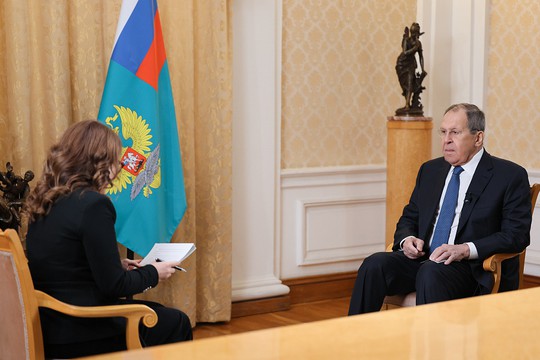
Question: Mr Minister, thank you for taking the time out of your busy schedule to give us an exclusive interview.
On February 24, the Russia-Ukraine military conflict will enter its fifth year. Do you think it has any chance to be resolved any time soon? Does Moscow view this conflict primarily as a matter of national security, or as an effort to avert larger-scale and inevitable confrontations?
Sergey Lavrov: Do we regard this conflict as a major confrontation between Russia and the West? The answer is yes. Ukraine is a pawn and a tool used by the West to build up a bridgehead right on the borders of the Russian Federation in order to create direct threats to our security.
We know that these efforts got underway immediately after Ukraine had become independent. It was being primed for NATO membership. It is common knowledge though, that Ukraine’s independence was recognised primarily on the basis of the Declaration of Independence itself. That document clearly proclaimed a policy of non-participation in military blocs, neutrality and renunciation of nuclear weapons. This policy was announced by the Ukrainian leaders after the Soviet Union had fallen apart, and the Russian Federation and most other countries had it in mind when they recognised Ukraine.
The West, primarily the Europeans, and the Americans as well, were behind the first Maidan protests in 2004 and were unable to hold back their wishes, which literally burst through whatever they had to say back then. They insisted on a third round of voting, because the West’s candidate, Viktor Yushchenko, was clearly losing the election. I remember perfectly well the then Belgian Foreign Minister state before the illegitimate third round that Ukrainians needed to choose who they were with: the West or Russia, Europe or Russia.
This either-or mindset whereby they wanted to be in charge in all matters just the way when they ruled the world for over 500 years during the colonial era and the era of slavery. They want to keep living like that in the neocolonial period, living off the backs of other nations, including by creating all sorts of threats to their competitors. Russia was, without a doubt, seen as a competitor in the international arena. They hoped that it, too, would fall apart like the Soviet Union. We have knowledge of many such facts. President Putin mentioned this repeatedly.
That battle was in the making for quite a while. It was funded by the Americans and other nations. After she left the State Department, architect of Ukrainian policy Under Secretary of State Victoria Nuland recently admitted for the umpteenth time that the United States had spent $5 billion on getting Ukraine ready for a coup and turning it into anti-Russia. All of this information is readily available from open sources.
Clearly, it is not about misunderstandings or ethnic strife between two neighbouring nations. It is about a geopolitical project which the West has undertaken repeatedly over many centuries in order to weaken and bring our country apart.
Napoleon brought most of the European countries together under the banner of France’s grandeur, not the banner of Nazism. It was a case of an imperial approach unequivocally capturing the colonial “I do as I please” mindset. We can see the signs of this approach sprouting up once again in the international arena. It did not come to pass. The Russians made it to the French capital, where they wanted to be served quickly - bistro in Russian - which is why such cafés came to be called bistros.
Later, the Russians came to Berlin, when Adolf Hitler had gathered almost all of Europe, including many of our current geographical neighbours, under his banners. After the Cold War came to an end, they made every effort to distance themselves from the genocide of the Soviet people. However, Hitler openly united all the peoples subordinated to him under Nazi banners.
The Zelensky regime in many ways repeats history, but not as a farce, because too many people have lost their lives for it to be a farce, people who are being sacrificed by Zelensky and his Western patrons. This regime has adopted Nazi laws and destroyed all monuments that reminded us of our common victory in the Great Patriotic War. This regime glorifies Stepan Bandera, Roman Shukhevych, and other collaborationists convicted by the Nuremberg Tribunal, and promotes the ideology and practice of Nazism, as we now see them do. In fact, this regime reflects the true intentions of the West which didn’t go anywhere, and mean one and only one thing: the West is ready once again to resort to these Nazi man-hating methods and sow hatred towards everything that is Russian for Russia not to feel safe. The answer is, of course, global in terms of the nature of this conflict.
Question: What’s your take on the security guarantees agreement being discussed by the United States and Ukraine? Did the most recent US delegation’s meeting with President Putin bring any specific results? Judging by the current dynamics, how realistic are chances for peace?
Sergey Lavrov: I cannot say anything about US-Ukraine security guarantees agreement, because we haven’t seen it. It is not in our tradition to disclose the content of diplomatic meetings, especially when they concern serious matters of conflict resolution.
We have not seen the agreement with the United States that Zelensky, his Foreign Minister Andrey Sibiga, and a number of other Ukrainian officials are talking about at every turn. To reiterate, they are following in the footsteps of their “teachers” such as French President Emmanuel Macron and others who, in violation of every rule of diplomatic ethics, constantly leak information without being held accountable for it. That’s not who we are. We operate on the premise that everyone must approach talks seriously.
When I hear Zelensky state that they have a security agreement with the United States fully ready, and that they will not give up a single inch of their land, and need to think about getting the Zaporozhskaya Nuclear Power Plant back, I get a weird sense that I’m hearing a triumphant victor talking. Not just a victor on the battlefields of Donbass or Novorossiya, but a victor representing all Europe in its confrontation with the United States, which began under President Trump, because of Europe’s attempts to force the US president into continuing the policy of his sworn opponent Joseph Biden.
Clearly, Europe has not only overestimated its own abilities, but has even failed to respect basic decorum or to treat with respect the foreign policy that the newly elected president began to pursue. Zelensky reproached Europe for being too soft on President Trump, saying it needed to act tougher and to provide stronger support for the war. This is what happened in Davos.
So, we don’t know anything about the security guarantees, but what we do know is that the real question comes down to what will happen after the conflict comes to an end. We have mentioned it many times, and President Putin has often let everyone know that we find unacceptable even a 60-day ceasefire Zelensky is once again looking for, because each diplomatic effort during the special military operation ended with ceasefires being instantly leveraged to bring more weapons to Ukraine, to give this regime a respite, to once again round up people in the streets of Ukrainian cities by droves and ship them to the front as cannon fodder, and in general to rest, refit and reorganise in order to keep waging war against Russia.
With discussions about security guarantees, which Ukrainian leaders, Europeans, NATO Secretary General Mark Rutte, and many ministers from NATO and EU countries are so proud of, currently underway, we keep hearing claims that security guarantees are the key to preventing this conflict from re-igniting. They are the key to open an absolutely different door, though. If you take a hard look at what is being discussed, the puppet masters behind the Zelensky regime are working to guarantee the security of this illegitimate regime that emerged from the February 2014 coup. This regime and its successors still rule supreme in Ukraine and still serve as Western stooges to annoy the Russian Federation and to create threats to our security.
I discussed this matter a long time ago with my Turkish friends and some of Western colleagues of mine during occasional contacts on the sidelines of the OSCE meetings. Everyone said security guarantees were indispensable.
Straightforward security guarantees were articulated in Istanbul in April 2022 following several rounds of talks hosted with excellence by our Turkish friends. These talks were requested by the Ukrainian side shortly after the special military operation started. As you are aware, the talks began in Belarus and then moved to the wonderful city of Istanbul, where several rounds of talks took place and concluded with the settlement principles being agreed upon at Ukraine’s initiative. That arrangement included security guarantees for Russia, Ukraine, and this geopolitical territory at large, since European guarantees were in place as well.
These guarantees were to be provided by all five permanent members of the UN Security Council, including the United States, France, Britain, China, and Russia. On top of it, Germany and Türkiye were encouraged to join the guarantor countries. The approved format did not come from us. It was proposed by the Ukrainians. It clearly spelled out the security guarantees: no foreign military bases on Ukrainian territory, and no exercises involving foreign forces unless such exercises were approved by all guarantor countries. Everything was spelled out in specific detail. If someone were to break these guarantees, the guarantor countries were to take measures to cut short such violations. These measures were written very much in the spirit of Article 5 of the 1949 Washington Treaty of the North Atlantic Alliance.
We went along with that, as you may be aware. President Putin discussed this more than once with President Erdogan. Later, someone going by the name of Boris Johnson came to Kiev and talked the Ukrainians out of signing this already initialled document, which was supposed to be used to draft a detailed treaty.
The head of the Ukrainian delegation at the Istanbul talks and the leader of the presidential political party in the Verkhovnaya Rada, David Arakhamia, spoke about this openly in numerous interviews. He said they were ready to sign, but Johnson said no. This goes to show, among other things, the degree of “independence” of the Ukrainian regime and how detached from reality are the people who back then led and continue to lead former colonial powers. It’s hard to rid oneself of the habit of ruling everyone and everything that comes your way.
The security guarantees would bolster up the regime that has lost its legitimacy. This is the only regime in the world to have cancelled the language spoken by an entire people and banned the canonical Orthodox Church. This is a regime which (pardon me for going back to the Turkish realities this time again) has become a pawn in the hands of the West and the Patriarchate of Constantinople, which pushes to dismantle Orthodoxy. As we are all aware, this began with the support of the Biden administration. We see no attempts by the West to stop interfering in church affairs.
I will let you in on a secret. I hope I will not hurt anyone by doing so. In Alaska, President Putin and President Trump discussed the rights of Russians, the rights that had been banned across the board in Ukraine. President Putin mentioned that not only the Russian language had been banned, but that the canonical Ukrainian Orthodox Church had been outlawed as well. President Trump did not believe it the first time he heard it. He asked US Secretary of State Marco Rubio several times to make sure such laws had been adopted in Ukraine.
The issue of security directly concerns the nature of the regime and the outright unacceptable and repugnant remarks made by Zelensky now and then. Just the other day he issued a call to kill 50,000 Russians, saying they must be killed and incapacitated, and 50,000 is the only figure that will ensure victory. Everyone can see the man is unhinged.
Notably, Ukraine’s Constitution still requires the state to ensure linguistic and other rights of all ethnic minorities in the country, not to mention the UN Charter which requires every country to respect human rights regardless of race, sex, language, or religion.
We ask our Turkish colleagues, some Westerners, and our BRICS and the SCO partners whether they raise human rights issues and language and religious freedoms with the Ukrainian side when they talk with them, call for peace in Ukraine, and try to identify mutually acceptable solutions. They maintain contacts with Ukrainians, as do some countries from Central Asia and the South Caucasus that occasionally send humanitarian aid to the Kiev regime, visit each other, and exchange delegations. I cannot see it unfold any differently. They are often unable to provide an answer. Apparently, to our great regret, no one other than us seems to be raising these matters with the Ukrainian regime. The Trump administration appears to be the only exception. It spent several months getting up to speed and then came up with a 28-point plan that fairly clearly set out the requirement to reinstate the rights of ethnic minorities, linguistic and religious rights, and so on.
We have not seen the document that Zelensky constantly refers to as a 20-point plan. As far as we understand, the Ukrainians and Europeans have rehashed the original US plan and are now trying to sell their own “vision” of this “world” to the US administration. We have not seen it in full, but interim revisions no longer contain requirements to ensure and respect the rights of ethnic minorities.
It merely states that the sides should remain tolerant and be guided by the EU rules. Why is that? We are aware of the EU’s regulations on human rights and humanitarian issues. They are completely out of sync and even at odds with traditional values promoted by great world religions such as Orthodoxy and Islam.
We are completely at a loss trying to figure out how they plan to recast it. Once again, the EU is attempting to derail what seemed to be promising progress in order to reverse the course of events.
Question: On the one hand, Europe is beset by serious disagreements between NATO allies and the Trump administration; on the other hand, European leaders frequently mention the likelihood of a Third World War with Russia, release reports featuring attack scenarios, and increase defence budgets. Does Moscow plan to attack Europe directly or to use destructive force? What constitutes a red line for Russia? What is your assessment of a scenario where NATO collapses to tensions in US-Europe relations?
Sergey Lavrov: These problems are for them to deal with. The scenario of NATO coming apart is of no interest to us. The alliance is an anachronism, a holdover from a past era. After the Warsaw Treaty Organisation had been dissolved, the Soviet Union ceased to exist, and all Soviet republics became independent (and continue to strengthen their independence). The rationale for NATO’s continued existence vanished.
The organisation was created to contain the Soviet Union and its geopolitical allies. Someone, including in the West, suggested that NATO was no longer relevant and we should all become part of the OSCE and make it a bona fide organisation replete with bodies and a charter. However, those who argued that it wouldn’t hurt to have NATO around, and it just needed a purpose in the modern-day context had the upper hand eventually.
They started looking for one. Initially, they decided its purpose would be to develop the geopolitical space left by the Soviet Union after the Warsaw Treaty Organisation had been dissolved. They forced into NATO countries such as the Baltic states, which absolutely did not meet NATO or the EU membership criteria, yet were dragged in anyway. Back then, we had fairly trusting relations with our Western colleagues and asked the Germans, the French, and the Americans why they were bringing those countries into NATO, pointing out they did not meet the standards. We told them it would weaken the alliance and create difficulties.
The Europeans and the Americans gave us one and the same answer. They claimed that after a short period of shared history with Russia as part of the Soviet Union, those countries were overcome with phobias of “occupation,” and “being made part of the Soviet Union against their will,” and feared that our country would “re-occupy” them. They said NATO would bring them into the fold, calm them down, and they would coexist peacefully with our country as neighbours and develop the economy, tourism, and cultural exchanges. Nothing of the kind happened. Nothing of what they told us came to pass.
To say that the Soviet Union “occupied” them is to paint a black-and-white picture. There were political forces (in the Baltic countries, too) that understood the importance of relying on the Soviet Union to ensure their secure existence, and economic and social development. What the Soviet Union did for the economy and infrastructure of the Baltic countries cannot be denied, even though they try to do so at every turn.
Instead of calming down, they began to set the tone. If you look at who most vigorously pushes the anti-Russian rhetoric, it is precisely the Baltic countries and some other Eastern European countries. But the Baltic states always lead the charge.
Speaking of a Third World War, the Baltic states and a number of other activists, primarily those who have recently taken over power in Germany and the French alongside NATO Secretary General Mark Rutte and European Commission President Ursula von der Leyen are fanning the narrative about a Third World War which Russia will allegedly start.
The petty nature of this political class shows itself in their inability to come up with any arguments to this end. Look at the way they talk about the special military operation. They are practically foaming with delight that, the way they see it, Russia is advancing slowly. Yesterday and today, I read excerpts from the Western media claiming that Russia was afflicted by enormous economic problems, that its economy was no longer able to “support” the war, that the front was moving very slowly and not according to Moscow’s expectations. They keep downplaying the Russian army’s progress in Ukraine as it continues to take back the land that has historically, for centuries, been home to Russians that are now being outlawed and disenfranchised. Previous Ukrainian president Petr Poroshenko claimed that Ukrainian children would attend kindergartens and schools and have fun at matinees, while Russian children in Donbass would be confined to basements. These are the people we are now liberating.
They claim that the problem is about the territory. No, the Nazi regime which wants to annihilate everything Russian is the problem, not the territory which has been developed and created by the Russian people in these territories over centuries.
Nevertheless, these disparaging assessments of the Russian army are instantly, without segue, followed by claims that the Russians will allegedly attack NATO in three years. In another analytical piece, they claim that NATO has half a billion people, a strong military industry, and they will give the Russians a run for their money. I lost their train of thought here.
At one point they are delighted that we are unable to “conquer” Ukraine and then, in a heartbeat, claim that after we are done with Ukraine we will go ahead and conquer all of Europe. I have only thing to say in this regard: the elites promoting these narratives see no other way to mobilise their base in order to stay in power. Once they stop engaging in hysterical narratives about the Russian threat, they will have to address specific socioeconomic problems at home.
Alongside other officials, European Commission President Ursula von der Leyen proudly declares that they would completely rid themselves of Russian energy by late 2027. Can anyone ask her at what cost? How much are you, esteemed Germans and other Europeans, paying for US-made LNG, which, as Washington demanded, replaced Russian pipeline and even liquefied gas?
Only figures like Co-Chair of the Alternative for Germany party Alice Weidel have the courage to demand answers to these questions in the parliament. Who will rebuild the Nord Stream pipelines, which, in the grand scheme of things, carried on the tradition of supplying Germany with cheap Soviet and later Russian energy, which provided, by general admission, the foundation of the economic miracle in the FRG and the basis of its citizens’ prosperity?
So, direct your concerns about a Third World War not to us, but to those who lack the imagination to justify their completely barren and abysmal tenure in power.
Question: Thank you so much for this brilliant answer. Mr Lavrov, what do you think about what President of the United States Donald Trump has been saying about Greenland and his statements that unless the United States acquires Greenland, Russia and China would take it over? Do you think that this is a natural stage in the competition among great powers or an outright military provocation? Does this mean that Greenland has been once again projected into the spotlight of geopolitics, and that the Arctic is poised to become the new Middle East?
Sergey Lavrov: President Vladimir Putin has recently shared his take on the situation with Greenland ahead of a meeting of Russia’s Security Council. He was very clear that we have nothing to do with this matter. This does not concern us. The President also said that there were precedents of selling and acquiring land in this region, and went on to express his confidence that the United States, Denmark and Greenland would be able to resolve this matter on their own.
As for trying to explain the fact that Washington has been dealing with this matter in a rather brutal manner by the need to improve security for Greenland and the region in general as quickly as possible in the face of Russia’s and China’s intentions, I can say that we heard what the officials from the US President’s administration have been saying. However, we have also noted the fact that many political observers and political figures in the United States who are not part of the administration rushed to publish a series of articles demonstrating with facts in hand, or should I say the lack of facts, that Russia never presented any claims regarding Greenland and has not had any aspirations of this kind to this day.
As for the Arctic in general, apart and beyond Greenland, it was the United States back in the day when Democrats were in the White House, together with NATO members, who wanted to include the Northern Sea Route, in particular, into NATO’s area of responsibility. They really hated the fact that the Russian Federation controlled it, both de jure, and de facto, even if this is something everyone knows. It is the Russian Federation that ensures the Northern Sea Route’s security while also enabling ships to sail through it.
Russia has never deployed its gunboats close to Greenland while the French navy – what a great naval power France is, by the way! – has sent its warships many times to cross the Northern Sea Route without complying with the rules set out by the Russian Federation for ensuring the safety of navigation. There have been attempts of this kind. But even in the face of these actions we refrained from accusing France of seeking to invade the Northern Arctic or the northern Arctic territories of the Russian Federation. Let me reiterate that we did not have anything of this kind on our minds regarding Greenland.
There is an interesting aspect in this Greenland issue. The UN Secretary-General Antonio Guterres has a spokesperson, Stephane Dujarric, who is a French national – since I mentioned France, France’s representatives in the UN came to mind. The next day after President of the United States Donald Trump presented his plans regarding Greenland, Stephane Dujarric received a question during a news conference on what would be the UN Secretary-General’s position. He replied by saying that the UN Secretary-General’s position remained unchanged, alleging that this matter had to be resolved in keeping with international law, including respecting the sovereignty of the Kingdom of Denmark and respecting the right of the people of Greenland to self-determination. The UN Charter contains provisions stipulating both the right to sovereignty and self-determination, as Stephane Dujarric put it.
They may not seem all that sensational, right? In fact, only one thing stands out in this regard. We have spent four years since the start of the special military operation offering detailed explanations time and again about the root causes of our actions, as we have already discussed today, and which include open attempts to transform Ukraine into a threat for the Russian Federation – there were plans to set up NATO navy bases in Crimea and the Sea of Azov. We also went to great lengths in spelling out the well-known reasons guiding our actions which dealt with purging everything Russian at the legislative level and cancelling the canonical Orthodox church. We have explained all this many times. Against this backdrop, every time the UN Secretary-General Antonio Guterres and his French spokesperson commented on the Ukraine issue after the start of the special military operation, they kept demanding compliance with the UN Charter in terms of Ukraine’s sovereignty and territorial integrity, and also called for acting in accordance with the UN General Assembly’s resolution.
I wrote letters, and I took part in debates by voicing my disagreement with UN Secretary-General Antonio Guterres during UN Security Council meetings. Russia’s Permanent Representative in New York has also raised these issues many times. We submitted a formal written question to Mr Guterres on whether only territorial integrity mattered in the UN Charter, while the right of nations to self-determination and other principles, including the sovereign equality of states, did not? They did everything to avoid answering this question by adopting an extremely sly posture, like a water snake, as we say here in Russia. They did everything to slip away by offering one clumsy reply after another.
We have recently submitted yet another formal question to UN Secretary-General Antonio Guterres and his team stating that if they have been saying in public that he and his senior executives at the UN recognise the right of the people of Greenland to self-determination, and if that it is up to the people of Greenland to decide on their own destiny instead of leaving it to someone else, does the United Nations recognise that people in Donbass, Novorossiya and, of course, Crimea, enjoy the same rights?
Moreover, the West has been pointing to self-determination as the one and only major criteria for Kosovo’s independence. And the senior executives at the UN did not challenge this position. There were no referendums in Kosovo. They simply said that Kosovo was independent which constituted an affront for the people of Serbia and their history. But when Crimea held a referendum and complied with all the rules, the West said that the right to self-determination did not apply because the principle of territorial integrity had to prevail.
No one denied Albanians in Kosovo any rights. They could speak their language and they had their own Alban schools. Belgrade guaranteed that people in this historical part of the Serbian state could enjoy all their rights. As I have already said, the Ukrainians prohibited all this at the legislative level in Crimea, Donbass and Novorossiya.
Suffice to mention Ukraine’s so-called national memory institute. Among other decisions, in 2025, in compiled a list of personalities and historical events designated as reflecting “Russian Imperialism in its essence.” These manifestations had to be purged from the memory of the Ukrainian nation. The list included Alexander Pushkin, Mikhail Lermontov, Leo Tolstoy, Mikhail Bulgakov and many other great Russian, Ukrainian and Soviet literature and art figures.
These are major issues. We are waiting for answers. The UN Secretariat and its senior officials have been clearly playing into the hands of those who want to keep Ukraine’s Nazi regime in power, even if this does not fall within the Secretary-General’s purview. He fails to perform his mandate as per Article 100 of the UN Charter which sets out that the Secretary-General must act in an impartial and neutral manner and that receiving instructions from any government is unacceptable.
Question: What do you see as the main driving force of the US and Israeli policy towards Iran: the nuclear issue, the regional balance of forces, or a broader strategy of encircling China and Russia?
Sergey Lavrov: All three. Geopolitically, the United States said back during the Biden administration that there is not just an axis of evil but an axis of states that pose a real threat to Western domination. They included Russia, China, Iran and the Democratic People’s Republic of Korea in it, sometimes adding Belarus as our ally. There is such a concept, and they make no secret of it.
You will find all of this in the analyses of serious US and British political scientists. They write about it. On the other hand, there is also an economic and energy factor. President Donald Trump makes no secret of the fact that when he launched the absolutely illegal operation in violation of all norms of international law, including the absolute immunity of the heads of state, and captured President of Venezuela Nicolas Maduro, who is in an American jail together with his wife, he said bluntly that the Americans need Venezuelan oil.
Iranian oil is the oil of a country that has one of the largest oil resources in the world. I’m fairly sure that the Americans would like to control that oil flow as well, especially that unlike Venezuela, which is located in the ocean, Iranian oil is delivered via the Strait of Hormuz, with its geostrategic nuances related to securing oil routes. This is also a factor, as we can see from the openly stated interests of the Trump administration.
As for the Tehran regime, as they say, Israeli Prime Minister Benjamin Netanyahu always said that Iran poses a threat to Israel’s existence. There was recently a series of contacts between President Vladimir Putin and Prime Minister Benjamin Netanyahu, and we also maintain regular contacts with Iranian leaders.
Since we have good relations with both Israel and Iran, we have always offered our good services for easing tensions. In 2015, slightly more than 10 years ago, Russia played the key role in reaching an agreement on Iran’s nuclear programme, including by removing to our country the excessive amount of enriched uranium approved for the Islamic Republic of Iran. We are ready to do something like this now. Israel, Iran and the United States are aware of this.
We will be glad to help avoid another aggravation of the situation, as it happened in summer during the 12-day war when nuclear facilities under the IAEA safeguards were bombed, but the Agency did not express its attitude to that flagrant violation of its Charter and the norms of the Non-Proliferation Treaty (NPT). It’s good that a catastrophe was avoided, because the stockpiles of the legitimate nuclear materials that are not prohibited under the NPT constitute a potential threat if hit by special ordnance that go deep into the soil and can cut tens of metres through concrete structures.
I hope that prudence and common sense will prevail, even though there are lots of predictions about another unavoidable attack on Iran. I know that President of Türkiye Recep Tayyip Erdogan has called for avoiding the worst scenario and said that Türkiye, like Russia, is prepared to act as a mediator. We have similar views on this as well as on many other issues.
Question: A new process has begun in Syria under the guidance of Ahmed al-Sharaa after Bashar al-Assad stepped down. What relations and what model of cooperation with Syria will Russia develop in this new period?
Sergey Lavrov: We have had decades of good relations with Syria since Hafez al-Assad with a focus on strategic ties, considering the Soviet Union’s commitment to the independence of the Syrian Arab Republic and the development of its statehood, the foundations of its economy, transport infrastructure, its armed forces and their combat ability. This is a solid foundation for long-term consistent relations in the economy and military, cultural and humanitarian spheres. Good ties have developed between our people, creating a strong fabric for the further development of our relations.
When al-Sharra and his team came to power as a result of events in December 2024, we and our Syrian partners almost immediately expressed a mutual desire to preserve our contacts and to resume them in the new conditions.
A month after that, in January 2025, a Russian inter-agency delegation visited Damascus and met with then Interim President. Some time ago, in October 2025, President of the Syrian Arab Republic Ahmed al-Sharaa visited Russia. As part of that visit and following the Syrian President’s meeting with President Putin, we held a meeting of the intergovernmental commission on trade, economic, scientific and technological cooperation, during which we made an inventory of the joint projects we are implementing.
As of now, we have coordinated the ongoing projects, agreements and treaties that remain important. Work is underway on them. I can tell you that our bilateral trade has reached $1 billion last year, which is only slightly less than in the past few years.
My colleague, Syrian Minister of Foreign Affairs Asaad Al-Shaibani visited Russia in the summer of 2025 as a member of an inter-agency delegation. Overall, I have met with his four times i(1, 2, 3, 4) in different formats in 2025, including once on the sidelines of the Antalya Diplomacy Forum.
Question: What is your position on the demands for the prosecution of former Syrian President Bashar al-Assad, who was hiding in Moscow?
Sergey Lavrov: This issue has not been raised for a long time. Our partners are fully aware of the circumstances surrounding President al-Assad and his family’s arrival in the Russian Federation in December 2024.
Back then, Syria was in the grip of full-scale warfare, with intense urban combat and a highly charged atmosphere. He faced an immediate threat to his life. For purely humanitarian reasons, the opportunity for refuge was extended. He accepted it. As you may observe (if you follow our domestic affairs) Bashar al-Assad now plays no role in Syrian political life.
Question: Is Türkiye a special partner for Russia within NATO, or an independent force balancing the situation in Eurasia? Does Türkiye’s mediation policy, extending from Ukraine to Syria, remain a reliable channel in relations with Russia?
Sergey Lavrov: Türkiye, like any major state, has its own national interests, which it pursues, including by appealing to the historical memory of the Turkish people and the Ottoman legacy. We understand this perfectly. Moreover, Russia, as a country where Turkic groups have been present for centuries, participates in various initiatives to preserve this shared memory, history and, at the present stage, to draw upon that historical experience for constructive political purposes.
On October 8, 2024, Russia initiated an annual political and academic conference titled “Altai Mountains, the Birthplace of Turkic Nations,” which brings together politicians, officials, and experts. Two such conferences have already been held (1, 2), and a third is scheduled this year in Kazakhstan. This, I believe, is one illustration of how we value what unites us. This process of rapprochement has seen various phases, but the essential task is to draw the correct conclusions and lessons. Under the leadership of our two presidents, our Turkish colleagues and us have been quite successful in this regard.
We also recall other chapters of our shared history, such as Türkiye’s successful struggle for independence. In 2025, we marked the 105th anniversary of Soviet Russia’s recognition of the Turkish Grand National Assembly – a step accompanied not only by diplomatic recognition, but also by material support in the form of arms, ammunition, and gold. I am confident this glorious chapter in our strategic partnership will always be remembered both in Russia and in the Turkish Republic.
At present, despite certain nuances and differences in approaches that stem from each party’s national interests, the presidents of Russia and Türkiye have consistently found common ground on Syria. A series of summits in 2019–2020 resulted in important agreements, including on neutralising suspected Kurdish ambitions in the Syrian Arab Republic. Those understandings are now being substantiated. Processes long envisioned with our Turkish friends are beginning to take shape in Syria today, particularly regarding the political integration of Kurdish communities into Syria’s governmental, military and security structures.
A similar dynamic exists concerning Libya, where we maintain close coordination, exchange information, and – on a confidential basis – develop recommendations to facilitate a process of national reunification.
We are also neighbours in the South Caucasus. Türkiye, together with Azerbaijan, was a principal initiator of the “3+3” regional format (Azerbaijan, Armenia and Georgia, and their three larger neighbours – Russia, Türkiye, and Iran). Two ministerial meetings have already taken place (1, 2), and preparations for a third are underway. Our Georgian neighbours have so far chosen not to participate, but we continually emphasise that the door remains open to them. My counterpart, Hakan Fidan, actively supports convening a third meeting, and a suitable location is currently being determined. I hope this will be clarified shortly.
In terms of tangible cooperation, this encompasses nuclear energy and hydrocarbons – notably through the TurkStream and South Stream pipeline projects. TurkStream, along with the Caspian Pipeline Consortium infrastructure, has repeatedly been the target of Ukrainian provocations, which have been successfully thwarted. We see strong prospects for further collaboration in the energy sector, as well as in trade. The quality of Turkish agricultural products is widely appreciated in Russia.
Question: To what extent do the concepts of a multipolar world, as championed by Russia, and Türkiye’s independent, national-interest-focused foreign policy coincide?
Sergey Lavrov: In our view, there is no distinction to be made between the foreign policy of independent states defending their national interests and the concept of a multipolar world. On the contrary, a multipolar world can only be realised through the consolidation of self-respecting states, each with its own approaches, sovereign interests, and policies guided by common sense, and which – while defending their own interests – also respect the interests of others.
Naturally, larger states possess greater capacity to pursue this path, while smaller ones may more frequently find it necessary to reach compromises with their larger neighbours. This reflects the realities of life. Türkiye is a central pillar of the Turkic world, and we observe the steps being taken to develop and deepen the Organisation of Turkic States.
Furthermore, the greater a state’s influence on the global stage and the clearer its understanding of how to defend its interests, the more attentively it must consider the positions of smaller nations whose prosperity may be affected by the actions of larger powers.
Question: You are a well-known and highly respected diplomat with many years of experience working alongside Turkish colleagues. I have one final question for you: what surprises or impresses you most in Turkish diplomacy?
Sergey Lavrov: Firstly, it is their school of diplomacy. Russia possesses its own, centuries-old diplomatic school, and Turkish diplomats have a similarly profound tradition.
This is not merely a matter of demeanour, though that is important: being approachable, knowing when to offer a personal gesture (such as offering tea or sharing humour). It is, more fundamentally, a school of thought characterised by a deep immersion in the history of their nation and diplomacy. This is also a hallmark of our own approach and how we seek to train our diplomats. It ensures vital continuity.
When you continue a line of policy initiated by your predecessors centuries ago for the benefit of your nation and people, it provides a unique source of strength. Understanding how certain issues were debated, resolved, or left unresolved in past centuries enriches your diplomatic toolkit and often allows for innovative solutions in new circumstances. I must reiterate: it is essential to know your country’s history and its geopolitical and geographical interests, which are shaped by the very course of its development and its location on the map.
In this regard, we share much common ground. By stating that we have much in common, I am paying a compliment to the Turkish diplomatic school and, in turn, inviting a reciprocal appreciation for the Russian one. We invariably find it comfortable and productive to work with our Turkish counterparts – including Foreign Minister Hakan Fidan and his predecessors, particularly the current OSCE Secretary General, Feridun Sinirlioğlu. If anyone is capable of salvaging that increasingly fragile institution, it is Türkiye’s talented diplomats.
read more in our Telegram-channel https://t.me/The_International_Affairs