РУССКИЙ
 14:01 21.12.2025 •
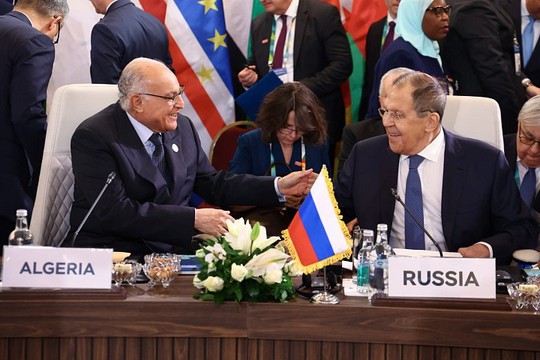
Photo: MFA
Foreign Minister Sergey Lavrov’s opening remarks at the plenary session of the 2nd Ministerial Conference of the Russia-Africa Partnership Forum
Cairo, December 20, 2025
Colleagues,
Today, we will exchange views on the work carried out since our meeting in Sochi and discuss prospects for further cooperation.
Our partnership continues to develop in a consistent and dynamic manner. Its comprehensive and genuinely strategic character is steadily strengthening. We seek to coordinate our efforts at both the international and bilateral levels in a spirit of mutual respect and equality.
We promote a shared vision of a more just and democratic multipolar international order, one that is free from dictates and double standards and founded on full respect for international law and the principles of the UN Charter in their entirety and interdependent integrity.
We consistently advocate for due consideration of the political and economic interests of African countries across all key international platforms. This includes ensuring fairer representation of African states within the global decision-making system, including the UN Security Council, as well as advancing reform of the international financial architecture. In this context, we fully respect and support the decisions adopted by African states, including the Ezulwini Consensus and the Sirte Declaration.
We recognise the achievements and constructive efforts of South Africa’s G20 chairmanship, particularly in advancing the priorities of Africa and the Global South on the Forum’s agenda. We also welcome the growing engagement of BRICS with Africa, noting that Nigeria and Uganda joined as BRICS partner states in 2025.
We reaffirm the Russian Federation’s stance, expressed at the recent G20 Sherpa meeting, on the importance of fully upholding the principles of equality and non-discrimination in the functioning of the G20.
We place great importance on enhancing peace and security across the African continent, recognising it as a crucial prerequisite for sustainable socioeconomic development and a vital component of global stability.
As a permanent member of the UN Security Council, Russia actively contributes to resolving ongoing conflicts and preventing new ones in Africa. We fully uphold the fundamental African principle of “African solutions to African problems.”
Just as we have for the past 65 years, we continue to stand as a dependable partner to our friends in their sovereign and self-reliant defence. We reject the policies of certain countries and military-political blocs, representing a global minority, that seek to involve the region in confrontational geopolitical ventures. Such actions run contrary to the objective of fostering Africa’s independent development and prosperity.
We assist African countries in strengthening their defence capabilities to address both internal and external threats, with a primary focus on combatting terrorism. Our support extends to mine clearance and countering improvised explosive devices. We are also expanding professional training programmes for military personnel and law enforcement officers. It is essential to implement the decision made at the second Russia-Africa Summit to establish a permanent Russian-African high-level dialogue mechanism for coordinating all security efforts.
We are firmly convinced that the sustainable resolution of crises requires tackling their root causes, which stem from the legacy of Western colonialism – a system that disrupted the natural historical development of African peoples, imposed arbitrary borders, and created an economic order designed to serve the interests of Western colonial powers.
Regrettably, various forms of neocolonialism continue to persist today. We stand ready to work in close partnership with African countries to eliminate them, including through the development of legal frameworks to assess and compensate for the harms inflicted during the colonial period. Following the First Russia–Africa Ministerial Conference, we agreed to explore the establishment of a permanent coordination mechanism to address this issue.
A strong foundation for systematic anti-colonial efforts has been established with the adoption of the resolution declaring the International Day Against Colonialism. This resolution, initiated by Russia and other members of the Group of Friends of the UN Charter, was adopted on December 5 during the 80th session of the UN General Assembly, receiving broad support from the majority of the member states. The International Day Against Colonialism will be observed annually on December 14.
We also recognise that the 2025 African Union theme, “Justice for Africans and People of African Descent Through Reparations,” reflects the spirit of the times. This issue is gaining momentum these days. Recently, the International Conference on the Crimes of Colonialism in Africa was held in Algiers. The Global Black History, Heritage, and Education Centre is expected to play a significant role in advancing the anti-colonial agenda. Its representatives, together with progressive parties from many African countries, are actively participating in the international movement “For the Freedom of Nations!”, established at the initiative of the United Russia political party.
Today, we are witnessing Africa’s “second awakening,” marked by the growing influence and authority of the continent on the international stage. We fully support our African partners in their right to independently choose their collaborators. Russia remains a steadfast ally of African states in strengthening their national sovereignty – in politics, security matters, and across all other spheres, including the economy, energy, food, technologies, digital industries, human resources, and information – based on their own resources, national priorities, and engagement with external partners who fully respect these interests.
Our political dialogue at the highest levels continues to develop actively. Russia’s diplomatic presence across the continent is expanding, with new embassies opened this year in Niger, Sierra Leone, and South Sudan. Upcoming plans include establishing embassies in The Gambia, Liberia, Togo, and the Comoros Islands. We also invite our partners who do not yet have diplomatic missions in Moscow to consider opening one, and we stand ready to provide full support in this endeavour.
Against the backdrop of dynamic political contacts, further efforts are required to expand trade and economic cooperation, which constitutes the material foundation of our relations. Despite the record trade in 2024, both geographic and export-import imbalances remain. We see significant potential to increase trade with sub-Saharan African countries, as well as for African suppliers to establish direct connections with Russian partners. We encourage a more proactive approach in exploring promising niche markets in both Russia and Africa.
We are increasing the number of trade missions on the African continent and expanding their geography. It is expected that by the end of 2026, our trade missions will be present in 15 African countries. Clearly, this is not the limit and this work will continue. The first Russian industrial zone in Egypt will become a solid platform for boosting cooperation between Russian and African economic operators.
Better understanding of each other’s capabilities and needs will foster the development of contacts between the business communities on both sides. For this purpose, we regularly send business missions and organise regular meetings of the Russia–Africa business dialogue during the St Petersburg International Economic Forum. We also organise conferences and exhibitions through the Russian Export Centre and other Russian business associations.
The number of intergovernmental commissions on trade, economic, scientific and technological cooperation with African countries is growing. There are currently 19 commissions, with 13 more planned in the future. We call for our African partners to translate the respective agreements into practical steps without delay. Competent authorities continue to eliminate trade barriers and fill the gaps in our bilateral regulatory framework, including in taxation, investment protection, customs and antimonopoly regulation.
We consider it important to engage the potential and mechanisms of the African Union and subregional groups to expand the opportunities of our trade and economic cooperation. Developing these relations is among our definitive priorities. This task will be primary in the work of the new second department established at the Russian Foreign Ministry for the cooperation with African countries, the Department for Partnership with Africa. It will be in charge of multilateral and subregional contacts. The growing African continental free-trade zone is opening broad prospects, designed to become a pan-continental market with a total GDP of over $3 trillion.
We find it important to establish steadfast and reliable mechanisms for mutual payments in national currencies to ensure stable trade and economic operations and the protection of investment. We welcome the increasing share of Russian rouble transactions in the mutual trade between our countries: over the period of January to October 2025, this share grew to 84 percent year-on-year. As additional reinforcement, the central banks of the Russian Federation and the African states have established direct links. Last year, Russia launched its first international financial platform called A7 that allows our businesses to complete payments under foreign trade contracts in any country and in any currency. Nigeria and Zimbabwe have already joined the platform. We invite all other African partners to follow their example.
Energy is one of the key areas of our cooperation. Russia benefits from unique experience in a variety of fuel and energy segments, from nuclear technology and hydropower to oil, gas and renewable energy sources. This matter was covered at the First Russian–African Commodity Dialogue that took place in late October at the St Petersburg Mining University. The dialogue brought together over 4,000 participants from 34 countries of the continent. We hope that this dialogue will become a continuous platform for the cooperation between Russia and Africa in mineral resource management.
We actively participate in building and upgrading energy infrastructure and energy production facilities. Our projects cover the entire cycle from design and construction to maintenance and long-term operation. One successful example is the construction the El Dabaa Nuclear Power Plant in Egypt, the largest nuclear power plant in Africa. We are discussing peaceful atom cooperation with other African colleagues. Russia’s Rosatom state corporation has signed 13 agreements to this effect. Some 400 students from 23 African countries are studying nuclear technology in Russia. Our country also has the required competence for turnkey low-capacity nuclear power plant projects.
Genuine economic sovereignty is unattainable without innovative technology and corresponding human capital. We stand ready to offer our partners cutting-edge solutions in mechanical engineering, electric power, geological exploration, pharmaceuticals, and high-tech sectors including digital technologies and space exploration.
In keeping with the best traditions of continuity, Russia is making a substantial contribution to training professional personnel for African nations. Over the past five years, the number of African students in Russia has doubled, now exceeding 32,000, while our state scholarship quota for Africa has almost tripled. The most sought-after fields are agriculture, engineering, electric power, oil and gas, construction, medicine, and education. We will continue to expand this work in full accordance with your needs and priorities.
Food security remains one of our foremost shared concerns. We supply fertilisers and diesel fuel to a number of African countries, including on a humanitarian basis. To date, over 100,000 tonnes of mineral fertilisers have been donated to Kenya, Malawi, Nigeria and Zimbabwe. Furthermore, we allocate $10 million annually in food aid to the continent through the UN World Food Programme.
Africa possesses immense agricultural potential and is fully capable of achieving self-sufficiency. We are prepared to share relevant technologies, expertise, and knowledge with our African partners. Since 2019, as part of the FAO’s Global Soil Partnership initiative, PhosAgro – a leading Russian fertiliser producer – has supported the development of Afrilab, a regional network of African soil laboratories. This network now comprises more than 220 branches across 54 countries. Most recently, on November 20-21 this year, the International Conference on Ensuring Food Sovereignty for African Countries was convened in Addis Ababa at Russia’s initiative.
Cooperation is also deepening in critical areas such as healthcare, epidemic control, and emergency prevention and response – all essential for sustainable economic development. This year, Russia delivered mobile laboratories for infectious disease detection to Burkina Faso, the Republic of Congo, Ethiopia, Namibia, Madagascar, Uganda, and Zimbabwe. More than 150 African specialists have now been trained using Russian protocols, and in April, the first Russian-African joint exercise for rapid response teams dealing with sanitary and epidemiological emergencies was held in Addis Ababa.
People-to-people contacts, which are progressing in a friendly and constructive spirit, form a solid foundation for lasting interstate relations. This is greatly enhanced by expanding youth, cultural, humanitarian, sports, and tourism exchanges.
Objective media coverage of events in our respective countries, stronger ties between Russian and African journalists, the opening of new Russian media bureaus in Africa and African outlets in Russia, and the implementation of joint educational programmes all significantly contribute to fostering a positive Russian-African agenda.
Two years have now passed since the adoption of the Russia–Africa Partnership Forum Action Plan for 2023-2026, which outlines objectives across all the aforementioned areas. It is noteworthy that this document aligns seamlessly with Agenda 2063: The Africa We Want, proclaimed by the African Union in 2015. Full implementation of the Action Plan will not only establish a significant foundation for the future of our partnership but will also advance the continent’s own priority development goals.
I am confident that by the time of the third Russia–Africa summit, scheduled for 2026, we will be able to prepare a new strategic document that fully reflects the vision for the next stage of our relations.
read more in our Telegram-channel https://t.me/The_International_Affairs