
 РУССКИЙ
 13:40 13.12.2025 •
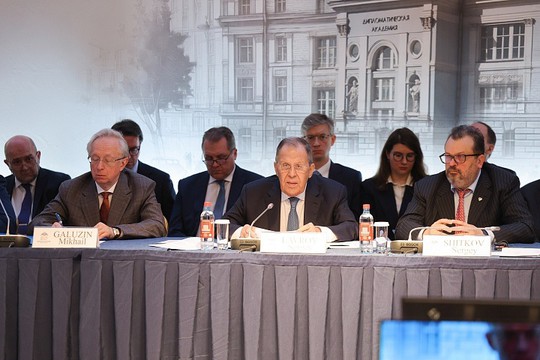
Photo: MFA
Foreign Minister Sergey Lavrov’s remarks and answers to questions during an embassy roundtable discussion titled “Ukraine crisis. Diplomacy and settlement prospects”
Moscow, December 11, 2025
Good morning, colleagues.
Your Excellencies,
Thank you for taking a lively interest in discovering our position on the Ukraine topic and international affairs in general. However, we are focusing this roundtable discussion on the Ukraine crisis, which was orchestrated by the West in an effort to turn Ukraine into an anti-Russia, and pumping it full of weapons for preparing it to wage war against our country.
Of course, this is one of the most sensitive and urgent issues on the international agenda, even if, to be honest, we are witnessing attempts to exploit the sense of urgency related to all the debates regarding Ukraine, including within international forums, for diverting attention from other challenges the international community faces, which can be even more fateful and critical, not less. I am referring to the Palestinian issue.
We welcomed the steps by President of the United States Donald Trump. The key takeaway was that his initiative’s first phase helped free people, hostages, and facilitated the return of bodies so that they could be buried according to the religious traditions. We are now all waiting for the second stage. The fact that this plan has a humanitarian focus and does not provide for a final and lasting resolution of the Palestinian issue in keeping with the UN resolutions does not inspire any optimism.
Nevertheless, we have gathered here to discuss the Ukraine crisis. If you allow me, I will say a few words regarding the way Russia assesses the developments on this topic at the present stage.
We are holding this meeting at a time when not a single day goes by without the media relaying messages which create new expectations that a diplomatic solution to the Ukraine conflict is getting closer. All these assessments and expectations stem from the fact that various international actors have stepped up their contacts. And all this is taking place against the backdrop of reports that the economies of the Kiev regime’s sponsor countries are sinking deeper into crisis, which primarily relates to European bureaucrats, as well as most NATO and European Union members.
There has been quite a lot of speculation regarding all kinds of destructive planted stories and fakes. We view these actions as being initiated by our Western colleagues with the primary goal of making it harder to come to a negotiated solution and make the conflict last longer. This includes efforts to derail the initiatives coming from the United States and its President, Donald Trump, since their genuine purpose consists of finding solutions and addressing the root causes of the Ukraine crisis.
In Europe, no one mentions the root causes at all. All they do is demand that hostilities be stopped immediately so that Ukraine and the Europeans could breathe a sigh of relief and win some time to be able to prop up the Kiev regime with weapons and money.
Here is a recent news story, which I wanted to bring to your attention. The media has reported about a telephone conversation between US President Donald Trump, President of France Emmanuel Macron, Prime Minister of the UK Keir Starmer, and Chancellor of Germany Friedrich Merz. Stefan Kornelius, who is a spokesperson for the German government, made a public statement saying that the four heads of state and government discussed the talks on a ceasefire in Ukraine. Just that. Europe is not interested in anything else. Meanwhile, Russia insists on agreeing on a package of measures to achieve solid, sustainable and lasting peace with security guarantees for all the parties.
Our negotiations with the US President and his team are focused on precisely that objective: developing a long-term solution that addresses the root causes of this crisis. In contrast, as illustrated by the recent statement from the official German government spokesperson, Western Europe is currently preoccupied with securing a ceasefire – essentially pausing to catch their breath and regroup before redoubling efforts to prepare Vladimir Zelensky and his regime for renewed hostilities against the Russian Federation.
So today we will try to separate the wheat from the chaff. We will examine the dynamics that have unfolded this year and, drawing on our accumulated experience, outline our assessments. These assessments will, in turn, inform our decision-making regarding negotiation formats, timelines, and potential outcomes.
First, however, some necessary historical context. While many of you are familiar with the background story, nevertheless, it is worth reiterating that under the Joe Biden administration, the United States became the primary sponsor of the Kiev regime. Shortly after the violent seizure of power in Ukraine in February 2014, then-Assistant Secretary of State Victoria Nuland, testifying before the Senate, openly endorsed the developments in Ukraine. She noted that the $5 billion invested there in preceding years would guarantee the success of what she termed “the triumph of democracy.” In reality, it was simply a coup.
Following this coup, the United States established control over Ukraine’s political system and economy, while flooding Ukrainian neo-Nazis with modern weaponry. Donald Trump “inherited” this situation in its entirety. We recall, however, that one of his central and most prominent campaign pledges regarding foreign policy was to bring about a swift end to the conflict in Ukraine. It should be noted that the current American leader, having now returned to the White House, has indeed taken tangible steps to address the conflict and, in our assessment, now appears sincerely committed to facilitating its resolution through political and diplomatic means. We welcome this shift.
Aspiration alone, of course, is insufficient. Concrete steps are required to address the root causes of the conflict, which the President of Russia and members of our Government have repeatedly outlined. This necessitates a change in the policies we find unacceptable, specifically: ceasing efforts to bring Ukraine into NATO, contravening assurances given over the past 35 years, and halting the Ukrainian regime’s campaign to eradicate all things Russian, which is conducted in flagrant violation of the UN Charter, numerous international conventions, and Ukraine’s own constitutional guarantees for the rights of Russian and other minorities across all spheres of public life.
From the outset of the crisis, Russia has taken every possible step to facilitate its resolution. In February 2014, when the coup was carried out in Kiev, we immediately appealed to the leadership of France, Germany, and Poland. We called on them to exert their influence on the opposition – which, in fact, had orchestrated the coup with direct Western support and guidance. Specifically, we asked these European governments to demand that the opposition honour the political settlement agreement signed on February 21, 2014, with then-President of Ukraine Viktor Yanukovich.
Crucially, Berlin, Warsaw, and Paris had acted as guarantors of that very agreement. Their signatures were on the document. We told them plainly that their reputations were on the line, and urged them to take action to bring the usurpers to their senses and restrain them. Had this happened, had the Germans, French, and Poles fulfilled their obligations as guarantors, Ukraine could have been spared the civil war that the new regime, having seized power by force, immediately unleashed against millions of its own citizens who categorically refused to recognise its legitimacy.
Given that the West, even then, almost twelve years ago, simply refused to honour its own commitments, this episode provides a clear answer to the question of how sincerely these European capitals have ever wanted peace in Ukraine.
Nevertheless, Russia has persistently pursued diplomatic efforts. The Minsk Agreements were agreed upon after protracted, late-night discussions in the Belarusian capital, with direct involvement of President of Russia Vladimir Putin. These accords were not only coordinated but also initiated by Russia (a deliberate move on our part) and later endorsed unanimously by the United Nations Security Council. Article 25 of the UN Charter stipulates that the Members of the United Nations agree to accept and carry out the decisions of the Security Council.
However, the West perceived these agreements merely as a stalling tactic – to buy time which they utilised to continue arming the illegitimate Kiev regime and advance their agenda of preparing for conflict against the Russian Federation. The signatories of the Minsk Agreements – the then-President of France, François Hollande, the then-Chancellor of Germany, Angela Merkel, and the then-President of Ukraine, Pyotr Poroshenko (whose signature, naturally, is also affixed to the document) – sought only to secure time for themselves. They candidly admitted this. Three years ago, in interviews amidst the ongoing special military operation, they clearly stated that there had never been any intention to implement these agreements. Their aim, they confessed, was to bolster the beleaguered state of the Ukrainian armed forces, thereby preparing Ukraine for war against Russia.
The work of the Contact Group, established by the leaders of Russia, Ukraine, France, and Germany to facilitate the implementation of the Minsk Agreements, also reached a deadlock. This too was sabotaged by the Kiev regime and its Western sponsors.
Concurrently, with NATO’s support, the Kiev regime enhanced its military capabilities, eventually escalating hostilities significantly against the civilians of south-eastern Ukraine – those who, as I have previously stated, categorically refused to recognise the legitimacy of the coup instigators. This refusal was partly based on the fact that upon seizing power in the immediate aftermath of the February 2014 coup, these individuals announced their intention to revoke the status of the Russian language, effectively outlawing millions of Ukrainian citizens who, like their ancestors, had been nurtured and lived within Russian culture for centuries. The southeast of Ukraine, including Odessa and Nikolaev, comprises territories and cities established by Russians. Factories, ports, infrastructure – all were constructed by Russian hands. These lands were later bureaucratically reassigned within the Soviet Union to the regions (of the then Ukrainian Soviet Socialist Republic) now known as Galicia and other western territories.
Yet, the core issue remains: the Minsk Agreements were never honoured. The Kiev regime had no intention of engaging in a sincere peace process or negotiating with representatives of south-eastern Ukraine. They publicly declared they would never negotiate with these representatives – a direct breach of the Minsk Agreements’ provisions.
The fact that, in late January to early February 2022, the Ukrainian armed forces significantly intensified artillery and aerial strikes on the territories of the Donetsk and Lugansk People’s Republics was corroborated by reports from the OSCE Special Monitoring Mission. I will not elaborate on specifics; we have addressed this matter extensively. The key takeaway is that Russia prioritised diplomacy until the very last moment.
In December 2021, two months before the beginning of the special military operation, we pursued no agenda other than a peaceful resolution. We presented the United States and the North Atlantic Alliance with draft documents aimed at negotiating security guarantees on the western flank. We proposed signing legally binding agreements. These proposals were arrogantly dismissed by both the Americans and NATO.
It was only after it became apparent that the West sought to grant Ukrainian Nazis carte blanche to violently suppress those who refused to recognise the coup – as President Vladimir Putin stated – that we had no alternative but to launch the special military operation. Its purpose was to protect the population of south-eastern Ukraine, whom the Kiev regime had branded “sub-humans,” “creatures,” and “terrorists,” and against whom, in violation of all norms of international humanitarian law, it deployed regular armed forces, including artillery and combat aircraft.
Nevertheless, even after the commencement of the special military operation, we did not abandon efforts to resolve the situation through political means. Contacts with the Ukrainian side, at their request, took place in Belarus mere days after the operation began. These were subsequently continued in the Brest Region of Belarus, in Istanbul, and via video conference. Yet this dialogue, too, was disrupted through no fault of ours. Here, the leadership of Britain – and personally the then Prime Minister Boris Johnson – played a subversive (I can think of no better term), highly detrimental role. In April 2022, he instructed Vladimir Zelensky to abandon the settlement plan proposed by Kiev itself and already initialled, declaring that Ukrainians must fight “to the last.” All this was done in the illusory hope of witnessing the collapse of Russia’s economy. Such was the calculation of that dishevelled political figure. They believed that under sanctions pressure, we would descend into a deep crisis, precipitating political destabilisation in Russia – an outcome the West, particularly the Europeans, pursued then and continues to pursue today.
In other words, according to the schemes of Western strategists, Ukraine was to serve as an anti-Russian battering ram, holding out until the pressure on our country broke us economically, politically, and indeed morally and psychologically. Their goal was to shatter our resolve to defend the unity, sovereignty, and security of the state, as well as the dignity of Russian people who, by the twists of history, found themselves on Ukrainian territory. They would have lived there peacefully, had the Ukrainian leadership respected its own constitution, which mandates the protection of the rights of Russian and other ethnic minorities.
Their objective was to inflict a strategic defeat upon us, thereafter dictating Western terms on matters of interest to European capitals. Yet the plan for an anti-Russian blitzkrieg using Ukraine failed. Russian society demonstrated internal consolidation, while the economic and political systems proved their resilience and immense reserves of strength.
This, too, is a crucial point for understanding the historical context. As we say in Russia, whenever our nation has been attacked – our cause is just. This conviction in our righteousness – historical, legal, and moral – reflects the character of our people. It underpins the current state of affairs in the struggle against those who sought to crush all our legitimate rights and interests.
Today, the resources available to the West for conducting a proxy war – financial, logistical, and military – are being depleted. According to numerous independent estimates, the AFU’s human losses have long exceeded one million and continue to rise. The Kiev regime, once an ideologically driven combat unit fuelled by Nazi ideology, including battalions such as Azov and other neo-Nazi groups, as well as certain prohibited substances in daily life, has devolved into an organised criminal entity mired in corruption and dragging its sponsors down with it.
In these circumstances, the ruling circles of the West can broadly be divided into two camps. The majority advocate for the militarisation of European economies and preparations for large-scale armed confrontation in Europe, evidently in the hope that, as the saying goes, “war will justify everything,” and their mistakes will be forgotten.
Among such figures, I would mention NATO Military Committee Chair Giuseppe Cavo Dragone: “We are looking at acting more aggressively rather than reacting. The Alliance (NATO) could consider pre-emptive strikes as defensive actions.” How about that? This underscores how other figures – not just military but political – openly declare that preparations must be made for war against Russia by 2030, if not 2029.
“Amusingly,” Italian Prime Minister Giorgia Meloni attempted to justify this Italian admiral’s remarks on the necessity of pre-emptive strikes against the Russian Federation. When asked how she viewed this, she stated that these words should be interpreted correctly to halt and prevent dangerous escalation. How else can one interpret an explicit call for pre-emptive strikes?
I am confident that everyone understands what is at stake and how the West, out of desperation, is attempting to escalate the situation and remain on the path of war. They hope that by stoking this issue and hyping up the “military threat” emanating from Russia, they can cling to power and save face.
In our assessment, this represents the majority of Western elites in Europe. Others, the minority, seek to devise an exit strategy from the conflict, striving to find avenues for de-escalation and the creation of conditions for a political settlement. This policy among some European countries aligns with the actions of the Donald Trump administration, which has long moved beyond rhetoric to leverage its influence over Kiev, persuading Vladimir Zelensky to return to the negotiating table.
We appreciate these efforts, as well as the willingness of certain partners to provide platforms for dialogue. Though, frankly speaking, Vladimir Zelensky, with the backing of leaders in Brussels, Berlin, London, and Paris, seeks to obstruct these efforts at every turn, concocting excuses aimed solely at derailing the Donald Trump administration from its chosen path – one oriented towards sustainable, long-term settlement. They aim to substitute all this with fabrications, just to avoid taking any meaningful action.
As you know, confirming our commitment to negotiations and a political solution, we initiated the resumption of direct talks in Istanbul this spring. Three rounds were held – in May, June, and July. We approached these meetings in good faith. We prepared and submitted our proposals to the Ukrainian side: a draft Memorandum on Settlement Principles, outlining our vision for a resolution. Specifically, we proposed establishing a joint Russian-Ukrainian centre for monitoring and enforcing a ceasefire during designated periods to address pressing humanitarian issues.
When the Ukrainian side claimed that Istanbul was unproductive – arguing that only limited humanitarian agreements on prisoner and body exchanges had been reached – we responded by offering to create dedicated working groups: one for humanitarian issues, one for military matters, and one for political questions. This proposal, too, was ignored.
Subsequently, the Ukrainian delegation complained that the level of negotiators in Istanbul was insufficient for making substantive decisions. We then proposed a significant elevation in the rank of the negotiating teams. This also received no response. Every initiative we put forward to advance the bilateral dialogue was rejected or ignored. This pattern confirmed that the Ukrainian regime is fundamentally unwilling to seek genuine solutions or agreements.
I noted that there were some positive results in the humanitarian sphere: the exchange of the bodies of the deceased and of prisoners. Nearly 2,500 individuals from each side were able to return home. Several rounds of repatriating the remains of the fallen were organised. To date, we have transferred over 11,000 bodies of fallen Ukrainian soldiers to Kiev and have received, in return, 201 bodies of our own soldiers.
Despite the above, Kiev cited a lack of progress and decided to suspend negotiations with Russia. The West, for its part, has offered no reaction and has made no attempt to compel or even encourage the Kiev regime to create even the appearance of readiness for a political settlement.
Given these events, our conclusion is clear: the Kiev regime engaged in the Istanbul talks for a single purpose – as it did during the Minsk agreements – to exploit any pretext to secure an unconditional ceasefire, thereby buying critical time for rearmament, replenishing losses, regrouping forces, and other military preparations. Naturally, we could not agree to such a scenario.
Now, a new and personal factor has emerged for Zelensky. A major corruption scandal has erupted in Ukraine, making the prolongation of the conflict a pressing political imperative for him, and perhaps even a matter of his personal survival.
For us, talks designed to achieve a negotiated settlement, as President Vladimir Putin has repeatedly emphasised, remain the preferred course of action. We have never refused to talk, which is confirmed by our constructive work to review the initiatives advanced by the United States.
We appreciate the efforts of our BRICS partners to help create an environment conducive to finding peaceful solutions to the Ukraine crisis, including the Group of Friends for Peace in Ukraine created by our Chinese and Brazilian partners. We regard these efforts as a sincere desire to make a constructive contribution to stabilising international situation.
Importantly, such work should rely on international law, above all the provisions of the UN Charter understood as an indivisible and interdependent whole. It is essential to strive for what was mentioned several times today, namely, the elimination of the underlying causes of the conflict as a key prerequisite for durable peace.
I spoke about the principles of the UN Charter. The West also keeps referring to them as the basis for a settlement. But its statements are highly specific. Recently, German Federal Chancellor Friedrich Merz once again stated that the conflict must be resolved on the basis of the principles of the UN Charter and respect for territorial integrity of Ukraine. This represents a selective commitment to the Charter.
The UN Charter also speaks of many other things, including equality and the right of nations to self-determination. It was precisely the right of nations to self-determination that became the foundation for the process of decolonisation, when peoples, above all in African countries, refused to live under the rule of the colonial powers, because these powers did not and could not represent the interests of African peoples. By the same token today, the Kiev regime – everyone is clear about that – cannot in any way represent the interests of the residents of Novorossiya, Donbass, and Crimea.
There must be no double standards here. When the Group of Friends of the UN Charter created by our partners works on shaping its philosophy, we want all the principles of the UN Charter, without exception, to be taken into account. All the more so since the West forgets another principle of the Charter which includes respect for human rights regardless of race, sex, language, or religion. The Russian language and the canonical Ukrainian Orthodox Church have been outlawed in Ukraine. I hope that many countries that are part of the Group of Friends of the UN Charter are represented here and will take these issues into account in their work. The Group should be mindful of these considerations.
The involvement over the past year of certain Western countries that are directly engaged in supporting the Kiev regime, France and Switzerland to be specific, in the work of the Group of Friends for Peace in Ukraine can hardly help achieve this goal. How can they be members of the Group of Friends (even as observers) when they directly, both in word and in deed, support the Kiev regime?
Speaking of the Americans, I mentioned earlier that, in our assessment, they are interested in figuring out what is behind the Ukraine crisis. We saw that during the Russia and US leaders’ summit in Anchorage on August 15. Mutual understandings were reached there that remain valid to us and can serve as a starting point in our quest for a settlement.
Recently, US President’s Special Envoy Steve Witkoff was in Russia. Following his meeting with President Vladimir Putin, both sides confirmed the mutual understandings reached in Alaska. This is an important outcome, because the Anchorage summit was followed by a pause. Now, in our talks with the Americans on the Ukraine issue, I personally believe that misunderstandings and misinterpretations have been resolved. And the understanding reached in Anchorage is based on the proposals that President Putin once again summarised in June 2024 regarding the principles of resolving the Ukraine conflict.
Prior to Alaska meeting, Steve Witkoff visited Moscow and brought proposals that formed the basis of the understandings reached in Anchorage. These understandings come down to Ukraine returning to its non-aligned, neutral, and nuclear-free status which forms the foundation of its statehood. These particular principles were enshrined in the Declaration of State Sovereignty of Ukraine of July 16, 1990. We recognised Ukraine’s independence based on the principles proclaimed in that document.
When we hear claims that allegedly nothing can be done because the Constitution contains the goal of joining the North Atlantic Alliance… We recognised a different Ukraine. Most of those present here recognised Ukraine in 1991, following the collapse of the Soviet Union, as a country whose statehood was based on three principles, namely, neutrality, nuclear-free status, and non-alignment.
This is not about a play on words, but about recognising historical facts. The Ukraine that became independent after the collapse of the Soviet Union had guarantees in its laws and Constitution protecting the rights of the Russian and other ethnic minorities. The Ukraine as it was then did not have legislation institutionalising militarisation and Nazification of the state and society. Today, all of that exists.
It is important to understand the need to eliminate discrimination against the Russian language, Russian-speaking citizens, and other ethnic minorities. We are well aware that the Hungarian, Bulgarian, and Slovak minorities feel like second-class citizens. It is important to end the persecution of the canonical Ukrainian Orthodox Church.
As for territorial realities, Zelensky says he can’t do anything regarding the territorial issue because their Constitution prohibits territorial concessions. Take a look at that character, who doesn’t always remember what happens around him. The [Ukrainian] Constitution also enshrines the obligation – I will be saying this for a third time today – to guarantee the rights of the Russian and other national minorities.
They have no regard for that constitutional provision. They have adopted laws that expressly prohibit the use of the Russian language in education, culture and media. They have created a strainer of media outlets. It is impossible to work in the media sphere if you criticise Zelensky. They have shut down all media outlets of both Russian and Ukrainian owners that broadcast in Russian and criticised the authorities. They have banned all of them. If they really care about the integrity of their Constitution, civil and human rights are much more important than anything else.
I would like to state once again that we have a Constitution as well, and under it, Crimea, the Donetsk and Lugansk people’s republics, and the Kherson and Zaporozhye regions are the integral and equal entities of the Russian Federation.
I will now repeat what I have said many times: We don’t want territories. We are concerned about the life of the people whose forefathers have developed these lands for centuries, building cities, roads and ports, and who have been commemorated in monuments as the founding fathers of these territories. It is the rights of these people that have been cancelled by the Kiev regime. That is why the people of the Russian entities I have mentioned took part in the referendums to express their refusal to live under the neo-Nazi rule. It is a subject that can’t be hushed up.
I assume that all countries in this audience have a correct understanding of human rights in full compliance with the principles of the UN Charter, which prohibits discrimination on grounds of sex, race, language, religion or belief. However, we are well aware of the Western interpretation of human rights.
After the United States circulated its 28-point plan, it has been leaked to the media. I am sure you have seen it. It included vital provisions on human rights and the denazification of Ukraine. It stated that the rights of minorities and religious freedoms must be protected, and that the Nazi ideology and activities must be outlawed.
After contacts with Europeans, the number of points in that plan was decreased. The provision on prohibiting the Nazi ideology and activities disappeared, apparently at the request of Europeans and Zelensky’s regime.
As for the rights of national minorities and religious freedoms, a provision has been added on Ukraine accepting the EU’s rules on rights of national minorities and religious freedoms. I believe that issue should be phrased differently. Ukraine must comply with the UN Charter and the numerous international and universal conventions on human rights, the rights of national minorities and religious freedoms. I consider it inappropriate to limit Ukraine’s obligations to compliance with the EU’s “rules.”
The rights of national minorities and religious freedoms are not limited or regulated by the European Union. It is inappropriate to enforce one’s rules on others, especially since we know which minorities – and these are not national minorities at all – modern Europe is now concerned about. We know how they interpret religious freedoms. Just watch the broadcast of the opening ceremony of the Olympic Games in Paris, and you will understand their views on minorities and religious freedoms.
We continue to build upon the understandings reached with the American side in Anchorage. We have conveyed additional proposals to our American colleagues concerning collective security guarantees. We recognise that a discussion of such guarantees cannot be limited to Ukraine alone. The proposals that Zelensky and his handlers in Western Europe are currently commenting on have not been formally presented to us. However, if media reports are to be believed, these proposals, which reportedly include declaring a demilitarised zone along the entire border and creating a buffer zone free of heavy weapons on both sides of the border, are inherently pointless to discuss without our direct participation.
Furthermore, these reported plans envision an 800,000-strong Ukrainian army and propose security guarantees focused on Ukraine’s defence and post-war restoration. This represents yet another iteration of the flawed “Zelensky formula,” which pursued a single goal: to channel all international efforts into sustaining the current neo-Nazi regime without altering its fundamental nature, its policy of suppressing religious freedoms and human rights, while completely excluding Russia’s legitimate security interests from any dialogue.
As far back as 2008, we proposed developing a legally binding treaty on collective security with the North Atlantic Alliance. More recently, at a meeting with Steve Witkoff and Jared Kushner ten days ago, President Vladimir Putin clearly stated that we understand any security architecture must also encompass Ukraine. The other side, however, seeks guarantees solely for Ukraine. Judging by the information leaking to the press, these guarantees are being structured in a manner that effectively prepares for a future attack on the Russian Federation.
This, of course, is unacceptable. We believe the comprehensive proposals we submitted to the US and NATO in December 2021, which I mentioned, remain fully relevant and could serve as the foundation, or at least a starting point, for substantive discussions.
We are also prepared to consider other proposals. What is essential is a return to a fundamental consensus, as embodied in the decisions of the OSCE summits in Istanbul (1999) and Astana (2010). These principles remain valid:
First, that every state has the right to choose its own security alliances.
Second, that no state may strengthen its own security at the expense of the security of any other state.
Third, that no state, group of states, or organisation in the OSCE area can claim a position of dominance. It is precisely this position of dominance that NATO has been pursuing by steadily absorbing, one after another, the states to the west of Russia.
When we drew our Western colleagues’ attention to their duplicitous behaviour and their violation of commitments made by their own heads of state and government, their response was that those were merely political decisions, unsupported by signed legal obligations. That was it. That is their logic. That logic is untenable. If they insist on adhering to it, the outcome will be grave.
We are prepared to consider all credible proposals formulated within a collective framework to launch negotiations on fundamental, legally binding agreements. This is a matter of principle. We cannot allow one crisis to be immediately succeeded by another.
The West, however, appears intent on precisely that: sowing the seeds of a new conflict now while publicly declaring its preparations for it. We are determined to ensure that our current efforts do not meet the same dismal fate as the Minsk agreements – which, despite being unanimously endorsed by the UN Security Council, did not deter France, Germany, or other Zelensky’s handlers from their relentless zeal to inflict a “strategic defeat” upon Russia.
Earlier today, I mentioned the US 28-point plan. Next, President of Russia Vladimir Putin met with US President Donald Trump’s Special Envoy for Ukraine Steven Witkoff, with the meeting reaffirming the Anchorage understandings. The work will continue. In parallel, we see Europe fretting and Vladimir Zelensky shuttling between London, Paris, and other capitals. What is being leaked to the press – I have referred to that in part – is clear evidence of their intention to undermine the efforts being undertaken by US President Donald Trump and his team.
An early end to the conflict is not to the advantage of the majority of functionaries like President of France Emmanuel Macron, UK Prime Minister Keir Starmer, Federal Chancellor of Germany Friedrich Merz, Prime Minister of Poland Donald Tusk, President of Finland Alexander Stubb, European Commission President Ursula von der Leyen, and Vice-President of the European Commission Kaja Kallas. They are stubbornly playing on the drums of war, as the saying goes, create “coalitions of the willing,” build up military expenditures, and are trying to save their political future, as I said at the start of our conversation. They hold up the imagined threat of a Russian attack as a bogey and discuss Military Schengen plans and whether it will be possible to cut down the time for redeploying forces from Western Europe to our borders from 40 to 3 days.
Many of those engaged in war preparations are fantasising about sending their military servicemen to Ukraine as “peacekeepers.” For us, these “peacekeepers” will immediately become legitimate military targets. This must be understood by everyone. They have had to admit the direct involvement of British military officers, paratroopers, in the war against Russia, after one of them died and the UK Government no longer could conceal these circumstances. It was stated that no fewer than 100 British subjects were within the ranks of [Ukrainian] forces fighting against the Russian Federation. This news was reported in the evening yesterday or early in the morning today. We will draw all the necessary conclusions from this incident, which is yet another manifestation of the British regime’s true character.
The Europeans are nurturing plans to build up their forces and assets right on the border of the Union State of Russia and Belarus. Poland has announced an intention to boost the output of 155mm artillery shells by 30 times. In this context, they seek to convince everyone that they are preparing for a “just peace in Ukraine” rather than war. They are aspiring to a role in the settlement. All these Europeans, like President of France Emmanuel Macron, who claim proudly that no one will decide anything without them, without Europe.
We are not nurturing, as President of Russia Vladimir Putin stated in no uncertain terms, any aggressive plans with regard to NATO or EU members. We are ready to put the relevant commitments and guarantees in writing in a legal document, certainly on a collective and reciprocal basis in the context of the previously enunciated approaches.
But let me repeat: we stand by our words, whereas there is nothing but open warmongering on their part. Well, to quote our President Vladimir Putin, if Europe decides to go to war, we are ready for this right now, if you like.
Legal aggression persists, involving puppet organisations, such as the International Criminal Court and Europol. The Council of Europe wants to establish a special tribunal and a damage register. To the best of our knowledge, they are trying to involve countries represented here in these anti-Russia initiatives. They are striving to ensure the participation of representatives of the Global Majority, including in the December 15-16 “diplomatic conference” in The Hague, where they plan to open for signing a convention on the international claims commission in order to examine claims by the Nazi regime to the Russian Federation for saving Russian nationals from extermination in full conformity with their legitimate rights formalised in the UN Charter. Such is the essence of Western “liberals” and “champions of democracy.”
Understandably, the true goal of these “exercises” is to expand the geographical reach of the Russophobic campaign, to involve as many countries of the Global South and East as possible in their provocative actions and, of course, to put Russia at loggerheads with Asian, African and Latin American countries. I have absolutely no doubts that our friends and partners are aware of this, and that they will not yield to such provocations.
Kaja Kallas, the EU High Representative for Foreign Affairs and Security Policy and Vice-President of the European Commission, has set forth the general line of our adversaries and sponsors of Ukraine. “The EU has a very clear two-point plan. First, weaken Russia. Second, support Ukraine,” Kallas said. This masterpiece of diplomatic art is worthy of Annalena Baerbock who demanded that President of Russia Vladimir Putin must change his course by 360 degrees.
Europe, in the person of Kallas, has insisted that supporting Ukraine is the main thing. We can observe all this in the last few days. Of particular interest are the discussions that support for the Kiev regime includes a planned robbery – the confiscation by the European Union of sovereign foreign currency reserves of the Russian Federation. Representatives of Western countries, including the Prime Minister of Belgium, the leadership of the European Bank for Reconstruction and Development and the IMF, are warning the Brussels bureaucracy against insane and ill-conceived actions. I do not know how much of an impact this will have on certain officials, including Ursula von der Leyen and Kaja Kallas, who are engaged in a rather unsophisticated diplomacy. But they should realise that they are taking on a very serious responsibility for the possible outcome.
Kallas recently said (it appears that she sometimes makes some candid Freudian remarks) that it was not advisable to resolve the Ukraine crisis too quickly. In March 2025, Head of Germany’s Federal Intelligence Service Bruno Kahl noted that it is in Europe’s interests for the Ukraine conflict to continue for a few more years. Meanwhile, European countries would beef up their military potential, preparing for war with Russia. One can get a clear idea of the advocates of war with Russia by analysing their arguments for European audiences. First of all, these arguments imply that it is necessary to support the Kiev regime because it is fighting for European values. As they say in Russia, this amounts to admitting one’s guilt. This means that the leadership of European countries forgive neo-Nazism that has been legalised in Ukraine. The Ukrainian state glorifies people who were recognised as criminals by the decisions of the Nuremberg War Crimes Tribunal. Ukraine introduces racist practices and legally bans the Russian language and all things Russian, it persecutes Russian culture, media outlets and the Orthodox Church. No one in Europe is even mentioning that all this violates the UN Charter and Ukraine’s other international commitments. It turns out that this is how European values look like. I believe this is a lesson that everyone should learn.
The Ukrainian Institute of National Remembrance has offered a new take on defending the so-called European values. Established 20 years ago by the government of Ukraine, this is not a grassroots institution. It operates in the status of a central executive agency with a mission to preserve national memory and designate individuals and entities accused of undermining the interests of the Ukrainian people. The lists this institute compiles include those who are viewed as posing a threat to the state and the Ukrainian nation and have to be subjected to what they call decommunisation and decolonisation processes. This formal listing includes writers such as Ivan Turgenev, Mikhail Bulgakov, Valentin Katayev, Ilya Ilf, Issac Babel, Mikhail Zhvanetsky, Alexander Pushkin, Mikhail Lermontov, composers Mikhail Glinka and Modest Musorgsky, painter Vasily Surikov, and many others. Of course, this black list also includes major figures from our Imperial past who are viewed as a threat to Ukraine, including the Romanov dynasty, i.e., Nicholas II and his family, as well as Mikhail Lomonosov and Pyotr Bagration. The Poltava and Borodino battles have been outlawed, too.
Considering how inadequate this posturing by the Kiev regime is, we can therefore hardly expect it to be ready to engage in serious talks and, importantly, reach any serious agreements. This is something to keep in mind for anyone trying to insist that any decision for overcoming the Ukraine crisis can be taken only by working with the Kiev regime and its European masters. The fact that Europe has been treating Vladimir Zelensky as someone immaculate and deserving support no matter the circumstances also gives us reason to question whether the European leaders are in their right mind and whether they can make a meaningful contribution to the talks for achieving a solid, sustainable and just settlement based on the principles as set forth in the UN Charter and international law.
Unlike these people, we have the political will to bring about peace. President Vladimir Putin has been saying that we are ready to continue a meaningful dialogue, primarily with the United States, considering its serious commitment to achieving results. We really want to put an end to this conflict. Our principled position remains unchanged – this can be done only if we address its root causes, which are well known to everyone. I am certain that you understand this too.
I hope that the way we elaborated on this matter today will be useful for your respective governments for assessing the situation and acting accordingly.
Question: Your Excellency, the Alaska summit between presidents Putin and Trump constituted a significant breakthrough in overcoming the diplomatic impasse surrounding the Russia-Ukraine crisis. The international community received it with optimism. His Majesty the King of Bahrain dispatched two cables of congratulation and support to both presidents in recognition of their effort to achieve a resolution of this conflict. Nevertheless, the European states did not endorse this initiative, and it appears evident that they continue to harbour doubt and mistrust towards Russia despite the fact that the ongoing war poses a substantial risk to the European continent. I would like, your Excellency, to pose two questions. First, in Your Excellency’s view, what explains Europe’s apprehension towards Russia? The second question: why did Russia not take the initiative to propose assurance or security guarantees to Europe that might have encouraged it to support the American initiative. Thank you.
Sergey Lavrov: On the question of the EU’s apprehension towards the Russian Federation, as well as our plans and our thoughts, I cannot understand what guides the European leaders in their choices. Read what they have been saying so that the vanity of trying to understand their way of thinking or putting yourself in their shoes becomes clear.
Finland used to be our good neighbour for many years after World War II. We succeeded in overcoming a challenging period we had in our relations before World War II, as well as in its early days and especially with the start of the Great Patriotic War when Hitler invaded the USSR. The Finnish Army took a very active part in the war against Russia, including by sending a substantial force to enforce the inhuman and unprecedented siege of Leningrad. Finish troops took part in it alongside the German troops.
After the war, we were able to move beyond this period in history, and lived as good neighbours for several long decades with the border open for people on both sides to travel back and forth. Finland benefited from affordable Russian energy resources for developing its manufacturing, shipbuilding and timber industries. There was mutually beneficial trade and cultural ties.
But all of a sudden it seemed that our Finnish colleagues scratched off their gold platting, to use this metaphor, which included Finland’s current president, Alexander Stubb. He used to serve as a foreign minister and was my colleague, leaving an impression of being a serious and responsible politician. Finland turned into one of the most Russia-hating states and is trying to lead the pack when it comes to demanding that Russia be punished, claiming that no deals can be made with Russia anymore and that the only thing which can be done is fight and confront Russia. Only recently, the country’s current Foreign Minister Elina Valtonen said: “Take it from us: whatever happens in this war, Russia will remain a long-term strategic threat to Euro-Atlantic security. Rather than encourage, we need to keep it at bay. <…> There is no reason whatsoever to believe that Putin has moderated his demands from those he laid out in December 2021 – demands that, if accepted, would roll back decades of progress in European security. Caving to these demands would expose Europe to further aggression.” These are the words of a foreign minister from a country whose capital was where the CSCE was born and then turned into an organisation. It is within its framework that the principles of indivisible security were approved at the highest level, including the principle of not seeking to ensure security at the expense of others.
This is precisely what lay at the core of the December 2021 proposals as presented by Vladimir Putin. But Elina Valtonen has rejected them by saying that they are unacceptable since they would reverse several decades of progress in enhancing European security. I would like her to hear these proposals. This is the last chance to salvage the existing achievements in European security. The West has been trampling upon them, and has been treating the OSCE accordingly. As a country where the so-called Helsinki spirit was born, Finland cannot ignore this. Nevertheless, Elina Valtonen did not have any problem when it came to defending the Nazi regime.
Europe is doing everything to squeeze itself into the settlement process. However, it does not have any useful ideas it could contribute to these talks. They must step back, look at themselves from the outside and start doing serious things instead of persisting with their propaganda and trouble making.
As for the security guarantees, everyone knows what we propose in this regard. This information has been disclosed to the public. We made these proposals in December 2021. They are very clear and de facto consist of promoting indivisible security but not as a political commitment but as legally binding obligations with the corresponding verification mechanisms. However, the European West rejects this and wants to continue treating us as an eternal enemy.
Question (retranslated): What does Russia regard as the main humanitarian component of a durable settlement of that crisis?
Sergey Lavrov: We appreciate the ICRC’s contribution to the settlement of humanitarian problems. I would also like to once again thank our colleagues from some Arab countries – Saudi Arabia, Qatar and the UAE, who have been working without any fuss or self-aggrandizement to help organise prisoner swaps and the return of bodies.
It would be wrong to say that some humanitarian issues are of secondary importance. Everything is important. It is important to return prisoners to their families. It is important to return the bodies so that they can be properly buried. And it is important, of course, to prevent any risks to children in such situations.
The issue of children has been excessively politicised. Kiev continues to claim that tens of thousands of Ukrainian children have been abducted by Russian servicemen and are being maltreated. When this issue was first raised, we asked our Ukrainian counterparts at the Istanbul talks – we maintained contacts at that time – to give us a list of the “tens of thousands” of children, which would be in the interests of children and in the interests of settling that problem. We repeated our request many times, and eventually the Ukrainians produced a list of 339 names, which we started checking. We also asked your respected organisation for assistance. It turned out that a large part of these names were not children, and these people were not in the Russian Federation but in Europe. This has helped us reaffirm the suspicion that some Ukrainian operators and their European accomplices were involved in child trafficking.
I know that you prefer to act discretely, in accordance with your status as a depoliticised organisation, but this issue has no relation to politics. It is about the children who are presumably cannot be found. If the ICRC is ready to help establish facts and use your opportunities to help check these lists, this will be a great contribution to our common efforts.
As for humanitarian issues in a wider context, they include language and religion. I urge our friends in this audience, including from the Friends of Peace in Ukraine, to take a look at the rights of Russians and believers in Ukraine. On November 28, 2025, in the midst of the ongoing talks and discussions, as the West’s refusal to as much as mention Ukraine’s policy of eliminating the Russian language and prohibiting the canonical Orthodox Church in Ukraine, allegedly because Ukraine is protecting European values, Deputy Permanent Representative of Ukraine to the UN Khristina Gayovishin stated: “Ukraine opposes concessions on the status of the Russian language. We will not reward the genocidal intent that underpins Russian aggression by undermining our identity, including our language.” In other words, our truth, and our policy of protecting the Russians who live in Ukraine from extermination has been described as “genocidal intent.” If those who maintain contacts with the Kiev regime took notice of such statements… I believe that the feeling of complete impunity of Zelensky and his team requires attention.
On December 2, 2025, US Presidential Special Envoy Steve Witkoff brought serious proposals to Moscow. The talks in the Kremlin continued for nearly five hours. It was an extremely serious discussion of concrete problems that need to be settled to achieve a durable peace. On December 3, 2025, Verkhovna Rada adopted a law, in addition to an existing set of laws, that prohibits the use of the Russian language in all spheres of life, and excludes Russian from the list of languages to be protected in accordance with the European Charter for Regional or Minority Languages. It is a challenge to the ongoing peace efforts, in particular, by President Trump’s special envoy. The propaganda move that equates the fight for the Russian language to the genocide of the Ukrainian people has deliberately been made at this moment.
Don’t be shy to speak about this openly. It is only a legitimate demand to comply with international law. Europe remains silent, which is proof that its agenda includes encouraging racism, Russophobia and the revival of Nazism.
Question: Mr Minister, regarding the negotiations between Russia and the United States, the question is about the conclusion. I mean that if the current talks between you and the United States would not be able to find a political settlement and an agreement to end the war because of the destructive efforts of Europeans, as they say these days, Mr Trump may withdraw and leave the table of negotiations. The question is, what will be the alternative plan, I mean the plan of Russia in the case of failure of negotiations?
Sergey Lavrov: Trying to guess what will happen if someone suddenly changes course is not about us.
First, following the many contacts we had with the United States, including in Anchorage between the two presidents, with a follow-up at the level of their aides, special envoys of President Vladimir Putin and Donald Trump, as well as at the level of Foreign Minister and Secretary of State, we have reasons to believe that the United States has a sincere and genuine interest in finding an honest solution to this conflict in terms of enabling all parties to fulfil their legitimate interests. This is what underpins our position.
We are still waiting to be informed about what came out or comes out from the contacts between Vladimir Zelensky, his European masters and Donald Trump’s administration. There are all kinds of leaks in the media. As I have already said, if these leaks are accurate, this basically means that Europeans are exclusively focusing on forcing the United States to offer security guarantees to Ukraine while ignoring Russia’s security interests. They want to agree on managing to find money for the Ukraine Recovery Fund. This is a lop-sided, unilateral approach. I have no doubt that this is what Ukraine’s contacts with the Europeans are all about. If this is the case, this approach has no future.
President Vladimir Putin made a special point when he raised this topic once again, including during his meeting with Steve Witkoff and Jared Kushner. He said that we want and we are ready to discuss security matters taking into consideration the interests of all parties and seeking to achieve a balance of these interests collectively, taking into account the current realities. This is Russia’s position. As for those claiming that offering Ukraine security guarantees is what matters the most so that it can expand its army headcount to a million or 800,000, and so that there is nothing standing in the way of arms supplies for the Ukrainian army – these people are trying to create a new storm. This much is obvious.
You see, all options are on the table for Europe when it comes to playing its dirty tricks. I have already mentioned the robbery they are trying to arrange regarding the reserves of Russia’s Central Bank. Arms trade is another example of a blatant violation of international law and the very rules the West has been advocating.
The West went on a global shopping tour to buy up Soviet and Russian weapons which can be found in European countries and in several states present in this room. We reached out to all the capitals to tell them that there are end-user certificates which are used in military-technical affairs. When one country sells weapons to another party, the buyer does not have the right to dispose of these weapons by transferring them to someone else without the seller’s consent. But they did away with all these principles. They simply ignored them. Moreover, they are now boasting about it in public.
One developing story has come into the spotlight. Several years ago, we supplied advanced air defence systems, the S-400 complex, which is one of the best in its class, to the Republic of Türkiye. Much to the displeasure of the West, including the United States, Türkiye owns these systems. But the United States also knows that Ankara wants to buy the F-35 jets, which led the US to demand that Türkiye stops using the S-400 as a condition for delivering the F-35s. The media has been covering this story for quite some time now. Yesterday, Europe – of course, I mean the European Union, since they believe that there is no one else in Europe – said that it decided to buy the S-400 systems from Türkiye to send them to Ukraine.
It never occurred to anyone that Türkiye is under obligation, as a buyer, to refrain from taking these steps without coordinating them with the Russian Federation. But this does not seem to bother anyone in Europe. This creates an impression that they are the ones who could enable Türkiye to buy the F-35s from the United States. This is an example of Europe being ready to ignore anything to achieve its goals despite all its claims about respecting private property, the presumption of innocence and the need to comply with laws and international norms.
But going back to the question from our friend from Bahrain, Europe is proving yet again that it was not in vain that it served as the main culprit during its long history in all the human sufferings starting with colonialism and slave trade, as well as the first and second world wars. Today, Europe also finds it impossible not to act. Maybe it worries that it has been left in the cold or that the way economics and politics have been evolving around the world sidelined it and placed it on the margines of the global processes and events taking place today. I cannot tell you the exact reason, but we are once again witnessing their belligerent instincts and attempts to use aggression to keep their head above water.
Question: I have a question and a suggestion. Tell me honestly, do you see the conflict we’re discussing ending in the foreseeable future – say, within six months? Or is it endless, with another conflict waiting to follow, instigated by different parties?
My suggestion relates to this conflict. Why doesn’t Russia donate its share in the NIS company to the Serbian government, or sell it for a symbolic one rouble? It could be returned to you in full when conditions allow. This is my personal opinion, offered without prior consultations. I do hope that, if you don’t want to answer this, President Vladimir Putin will do it on December 19.
Sergey Lavrov: Regarding predictions on when the Ukrainian conflict will end, it is European representatives who are offering specific timelines – some say before spring, others point to 2026. We are not diverting our energy to such speculation. We have clearly defined objectives. They have been publicly and unambiguously outlined within a specific framework by the President of Russia. As I mentioned earlier, we discussed the path to these objectives in detail in Anchorage, where we reached an understanding on how best to achieve them – not in the context of a mere ceasefire or temporary pause, but as the foundation for a sustainable peace. We will continue to advance along this path, irrespective of timelines set by others.
For us, the paramount issue is one of essence: the security of Russia and of the Russian people whom the Kiev regime has labelled terrorists and stripped of all rights. This remains our goal.
Concerning the Petroleum Industry of Serbia (NIS) and the situation engineered by US authorities around this enterprise, in which Russian companies hold a majority stake, negotiations are ongoing. I am aware that the Serbian leadership is engaged in appeals to the United States. It was, after all, the US that demanded this company, established through a bilateral intergovernmental agreement between Russia and Serbia, comply with its directives.
This behaviour is characteristic of the American approach. Regrettably, through such actions, unilateral sanctions, and the weaponisation of the US dollar, they are eroding the very globalised system they spent decades constructing and promoting as the foremost benefit to humanity. The realisation is growing – not immediately, and not swiftly – that this configuration of the global economy serves not the common good, but rather allows one nation to impose its own “rules” upon all others.
Of course, serious nations intent on preserving their sovereignty will inevitably create alternative frameworks. They will shift their reliance away from mechanisms that have proven to be instruments of dictatorship and coercion, and toward reliable platforms not subject to ideological dictates. This work is actively underway within frameworks like BRICS, the SCO, and CELAC. While the architects of unilateral coercive measures may derive temporary benefit from this process, its long-term historical consequence is clear: it is fundamentally eroding the very architecture of globalisation, which is now crumbling before our eyes.
As for the specific path forward regarding NIS: there are, as I mentioned, intergovernmental agreements between the Russian Federation and Serbia that explicitly prohibit nationalisation without mutual consent. The conditions under which such consent could be granted are a separate matter. I will not speculate on nationalisation or other specific solutions – perhaps the answer lies in finding a way for NIS to continue its operations irrespective of the United States’ capacity to penalise it. This is what energy ministers, relevant economic operators, including those in neighbouring countries, and NIS partner companies are currently working to determine.
One principle, however, is beyond doubt: fairness must be the ultimate criterion. To do otherwise would be to set a dangerous precedent for many other countries, and no one wants that.
Question: You highlighted several human rights-related issues. I would like to draw your attention to the tragic events unfolding in Darfur and western Sudan. The RSF forces, rebel groups, and mercenaries are committing horrendous crimes and atrocities with the support of external actors. Everyone is well aware of who these actors are. Ukrainians mercenaries are fighting in Sudan and committing horrifying human rights violations, as they commit genocide against the Sudanese people. We saw the footage that they themselves had uploaded. This incriminating evidence is available for all to see. They mistakenly believed they could oppose Russia’s presence in Sudan and, more broadly, in the African region. What are your thoughts about this?
Sergey Lavrov: I believe you can, perhaps through your representatives in Kiev – I’m not sure you have an embassy there, but if not, you can take specific steps to this end – convey your position directly to the Ukrainian government for it to stop sending mercenaries there. In case they tell you they know nothing about this, they should look into it and take the necessary steps.
With regard to the situation in Sudan, we have strongly urged the Government led by Chairman of the Transitional Sovereignty Council of the Republic of Sudan Abdel al-Burhan and forces that oppose him to sit down and talk. A number of countries with a stake in finding a solution to this conflict made proposals to this end. Others suggested that your government start a dialogue with the external actors you mentioned. Unfortunately, this did not work out and the dialogue failed to materialise. However, a proposal was made, and we passed it on.
I’m sure the important thing to do is to focus on practical solutions to this issue rather than to engage in public condemnation of whoever it may be. We are ready to help. We have the means to do so. If your government gives a green light, we will do our best to make use of these opportunities.
Question: In your opening remarks, you mentioned the efforts to end the war in Gaza. This gave hope for ensuring maritime security in the Red Sea, which would also be beneficial for the Gaza Strip and the entire region. Maritime security issues are not limited to the Red Sea; they concern the Mediterranean Sea and the Black Sea as well. How do you think the international law can be improved to promote maritime security across all these bodies of water?
You also mentioned legal obligations of all parties with regard to safeguarding human rights, freedom of religion, and so on, in accordance with the UN Charter. Do you think the International Court of Justice is in a position to contribute to ensuring compliance with these rights?
Sergey Lavrov: This is a serious matter. The United States is aggressively promoting its policy, whereby they can destroy ships carrying illegal drugs without trial or investigation, simply based on the information at their disposal.
As you are aware, they have destroyed several such boats and power boats. Yesterday they boarded a tanker off the coast of Venezuela, declaring that the tanker was transporting illegal oil. There is too little information. I have no knowledge about the way the United States interprets the Venezuelan situation, other than President Trump publicly calling for a regime change or for the country’s leadership to voluntarily resign. Yet, Chevron continues to operate in Venezuela and to purchase local oil. What kind of illegal volumes of this type of fuel, hydrocarbons, was that tanker carrying? This needs to be looked into.
I very much hope that despite believing they are entitled to such operations, the United States will, out of respect for the international community, provide grounds for taking such actions. We are in favour of collective discussions on ways to combat drug trafficking and to ensure maritime security to avoid situations where members of the international community are forced into dealing with unilateral actions.
As for the International Court of Justice and its role in upholding the principles of the UN Charter, there was such a precedent, including with regard to Serbia, whose Ambassador spoke here today. Acting as a representative for the Kosovo settlement, Martti Ahtisaari suddenly said – at a time no hostilities were underway – that it was pointless to continue working on the matter. He claimed there was no option left except to proclaim Kosovo’s independence.
Independence was effectively proclaimed. Our Serbian friends appealed to the International Court of Justice which said that indeed, the UN Charter contains the principle of self-determination, and that the self-determination of a part of a state may take place without the consent of that state’s central authorities. That’s all there was to it.
Kosovo declared independence without holding a referendum, just as a unilateral move. Several years later, following the coup in Ukraine, Crimea said it would not live under the government that had declared the abolition of the Russian language its main objective. A referendum was held in Crimea, and the West said it was not a matter of a nation’s right to self-determination and claimed it was a violation of territorial integrity.
We are confronted with a situation where we must interpret the fundamental rulings of the International Court of Justice consistently, or we may find ourselves in quite a challenging situation. I have no doubt that its rulings must be treated with respect, since the ICJ is a body of authority. Indeed, the rights of states and human rights enshrined in the UN Charter fall within the Court’s purview, and the Court remains available to states to bring their cases before it.
read more in our Telegram-channel https://t.me/The_International_Affairs

















