РУССКИЙ
 21:42 21.12.2025 •
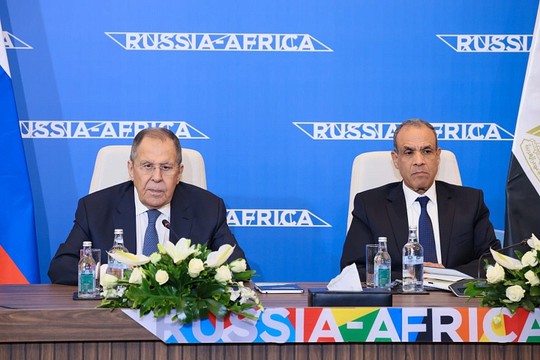
Photo: MFA
Foreign Minister Sergey Lavrov’s statement and answers to media questions at a joint press conference with Egyptian Minister of Foreign Affairs, Emigration and Egyptian Expatriates Badr Abdelatty following the Second Ministerial Conference of the Russia-Africa Partnership Forum.
Cairo, December 20, 2025
Minister Abdelatty,
My friend,
It was a sincere pleasure to participate in the Second Ministerial Conference of the Russia-Africa Partnership Forum, held for the first time on the African continent in Cairo, Egypt.
I would like to once again warmly thank our Egyptian friends for the excellent organisation of the event and their traditional hospitality, and to congratulate them on its success.
We conducted a thorough discussion of the full Russian-African agenda. Our focus was in particular on reviewing the implementation of the Russia-Africa Partnership Forum Action Plan for 2023-2026 and on identifying further steps to expand our trade, economic, and investment cooperation – a partnership that is growing rapidly and which we are committed to strengthening.
We have agreed to create conditions that facilitate concrete steps to increase mutual trade and to implement promising joint investment projects in high technology, across all aspects of energy, and in other key sectors, as well as in cultural, humanitarian, and educational spheres.
All these areas of practical cooperation are detailed in the comprehensive Joint Statement, which was unanimously approved and which will serve as the central guideline for our future work.
Importantly, this document places special emphasis, within the trade and economic sphere, on establishing resilient financial, logistical, and interbank mechanisms that will safeguard our partnership from illegal unilateral sanctions – a practice our joint statement clearly defines as unacceptable.
The Joint Statement also captures the progress of our discussions on pressing international and regional issues, including those of global significance.
We decided to continue coordinating our efforts in multilateral forums. This includes advancing the reform of the UN Security Council, taking full account of the legitimate interests of African states, and reforming the Bretton Woods institutions, whose composition and practices significantly lag behind today’s global economic realities.
I would like to highlight the section of the Statement that outlines our shared fundamental approaches to key issues of international development. In particular, I note the clear position that all states must respect the principles of the UN Charter not selectively but in their entirety and interdependent integrity.
Significant attention in the Statement is devoted to strengthening the independence of our African friends, particularly in the economic sphere. To protect their right to independent development, their right to choose their own partners and foreign policy priorities, the Statement proclaims our clear support for the recent UN General Assembly resolution establishing December 14 as the annual International Day Against Colonialism in All Its Forms and Manifestations. This will serve to intensify our shared efforts at the UN to eradicate contemporary forms of colonialism and neocolonial practices.
Finally, our shared position on the urgent resolution of the Palestinian issue, in full compliance with existing UN resolutions, as my colleague detailed, is clearly enshrined in the Statement.
The joint statement also comtains our shared decision to strengthen cooperation in politics and security. It is one of the reasons why we have recommended establishing working relations between the African Union and the CSTO.
The forum programme offered a whole range of sideline events, including a business event involving representatives of economic and trade agencies and organisations from Russia and African countries. You certainly know that the Russian delegation had a great number of bilateral meetings – over 20 of them – with the ministers of our African partners. We benefited from useful discussions of bilateral relations and their development. In some cases, agreements and memorandums covering different areas were signed.
We have reasons to conclude that the conference provided a good foundation for the successful preparation for the 3rd Russia–Africa summit scheduled for 2026. We will make every effort to ensure its success.
Finally, I would like to uphold the statement by my colleague and friend who said that it is necessary to start developing a new three-year plan for cooperation and joint action between Russia and our African friends. We are ready for this work.
I am sincerely grateful for the productive work together.
Question: Over these two days, you have held around 20 meetings with your African counterparts. Did many of them raise the matter of sanction pressure and secondary sanction risks? What solutions does Russia propose on its behalf? What general effect have the sanctions had on the relations between Russia and African countries? Did you discuss countering terrorist groups in African countries together? Were there any new requests for Russia’s support from your partners?
Sergey Lavrov: Countering terrorism is an important matter on the agenda of our relations with African countries. There are respective bilateral mechanisms in place with many of these countries. We have welcomed the availability of certain capabilities within the African Union. The agreement reached at this conference regarding contacts between the African Union and the CSTO can include intensifying counterterrorism cooperation.
Regarding the unlawful sanctions imposed by the United States and the European Union, we did not discuss this matter in detail. We prefer not to lament but to focus on putting together viable and effective mechanisms that can secure our trade and economic links and will make them independent from unlawful actions of the parties that, in violation of international law, resort to blackmail and pressure.
Over the centuries, life has shown us many times that every action meets counteraction. It is the law of physics, politics, and diplomacy.
The times are changing. Africa is rapidly becoming one of the key centres of the multipolar world order. It is Africa’s second awakening. In addition to the long-gained political independence, African countries are seeking respect for their sovereignty and their right to manage their own resources and determine their own fate.
Unlike those who try to continue the colonial, or neo-colonial, policy and dictate their will to others, the views we share with our African friends stand firmly on the international legal foundation of the UN Charter. The minister has just quoted it, stressing that all countries undertook the obligation to respect the sovereign equality of states and non-interference in each other’s domestic affairs.
This means our cause is righteous. Victory will be ours. I want to thank my colleague and friend for the wonderful work together. I will always be glad to see you in Moscow.
read more in our Telegram-channel https://t.me/The_International_Affairs