
 РУССКИЙ
 9:44 28.12.2025 •
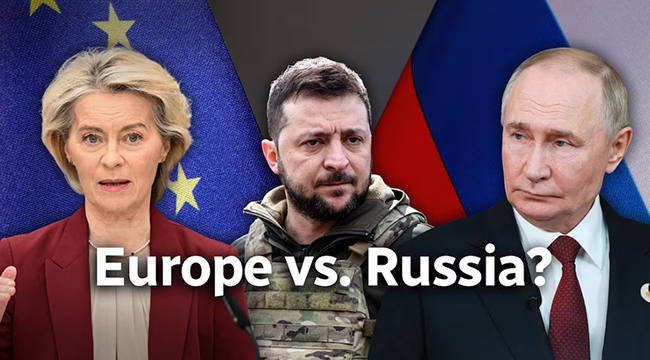 Pic.: cbc.ca
It is better to think of the war in Ukraine as a single war, with different levels of participation, writes ‘Foreign Policy’.
As the United States recedes from the conflict, scaling back direct military support for Ukraine, Europe is already stepping forward, investing heavily in the defense of Ukraine. Europe’s oft stated goal of a Ukraine integrated into European political and security structures is anathema to Russia. Yet, despite this, Europe is still trying to keep the war at arm’s length.
Going forward, Europeans should dispense with the crutch of hybrid war. When they do, they will see that Europe’s position vis-à-vis Ukraine may be more robust than Europeans might think, if more intertwined with the war than they might wish. In a long confrontation with Russia, Europe holds many of the best cards.
Russia’s war against Ukraine has always been about more than Ukrainian territory, Ukrainian language laws, or the status of “ethnic Russians” in Ukraine. Fundamental to Russia is Ukraine’s place in Europe.
Russia does not regard defeat in Ukraine as an option. The war must go on until two acceptable lines can be drawn, one through Ukraine itself and the other between Russia and Europe. Europe is becoming an armed and hostile camp from Russia’s point of view. Thus, Europe’s efforts to integrate Ukraine will have to be countered with sustained military force, either to get Europeans to retreat from their efforts or, if that proves impossible, to impose costs on a Europe for its unbreakable hostility.
With Europe (and Germany in particular) pouring money into its military partnership with Ukraine, Moscow has concluded that it cannot isolate Europe from the war. As a result, it is trying to move the line dividing Ukraine as far west as possible by harassing Europe.
Russia is likely to increase its efforts to menace Europe directly. This is Russia’s method of amassing leverage against European states. It is not particularly expensive, imposing the dilemma of escalation on Europe. This is particularly effective at a time when the U.S. commitment to European security is uncertain, and it plays on Europe’s long-standing challenge of integrating its foreign and security policy. The European Union has too few military means, whereas NATO is led by a superpower that wants to reduce its military footprint in Europe. Militarily, Europe is less than a confederation, which is a problem when confronting a single nation-state led by a determined dictator.
Former German Chancellor Gerhard Schröder left office in 2005 and became a lobbyist of sorts for the Russian government. That would be unthinkable today. Even the European governments that could be characterized as outliers on Russia—such as Hungary, Slovakia, and Italy—cannot effectively oppose Europe’s growing commitment to Ukraine. As goes Germany, so goes Europe, and Germany, under Chancellor Friedrich Merz, has been transformed by Russia’s war.
Merz has recently suggested that Europe is neither at peace nor at war. European leaders and populations would be better off being more candid: Ukraine’s war is Europe’s war. It is a war over whether Ukraine is part of Europe. If you believe that it is, as most European leaders say they do, then you believe the war per se has already come to the continent. The sooner that Europeans accept this, the better they can appreciate and deploy the resources at their disposal.
…Note, how the author of the American magazine Foreign Policy is subtly provoking a war in Europe against Russia. He is deliberately trying to present the Russian Special Military Operation to eliminate the Nazi regime in Ukraine, which threatens Russia's security, as a Russian attack on Europe.
Remember! We don't need this Europe! Let it live as it pleases. Europe has been a global Hegemon for centuries, and now it is in the process of withering. So, why does Russia need this recycled material?
It is significant that in the United States the political forces have emerged, who want to pit Europe and Russia against each other in a new war, while they themselves observe this war from overseas. The theme of “conquest” is in their blood. However, the Russian tradition does not have such a theme. The Russian tradition has the theme of Security and Development. It’s the West who has always been the conqueror – just recall the global colonial system of Europe. The United States, incidentally, began its history as a colony of England and France.
So, Foreign Policy magazine is mistaken and misjudges the prospects for the Ukrainian conflict – in the event of a major war, not only Europe but also provocateurs throughout the North Atlantic will be punished. And Europeans themselves should be critical of such provocations by American authors. Russia has no intention of going to war with Europe!
Trump, by the way, understands the danger of a major war and therefore actively tries to prevent it.
read more in our Telegram-channel https://t.me/The_International_Affairs

















