РУССКИЙ
 13:06 12.02.2026 •
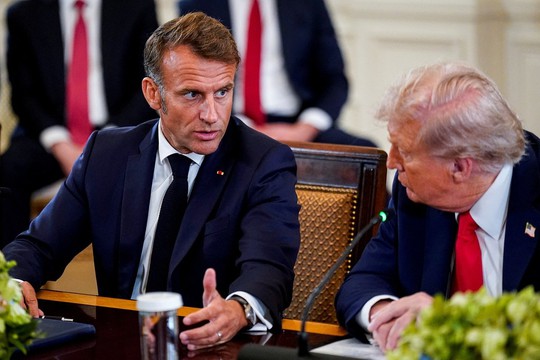
Macron is very surprised by Trump's bullying
Photo: Reuters
European officials came to the World Economic Forum in Davos, Switzerland, in January thinking they would find time to discuss with their counterparts from the United States the state of Ukrainian peace talks, a senior European official told Foreign Policy. Instead, they were obliged to focus on avoiding a military conflict with their fellow NATO member over Greenland, ‘Foreign Policy’ notes.
Now, in the aftermath, there are murmurs in Europe of the need for a Plan B. French President Emmanuel Macron and Italian Prime Minister Giorgia Meloni have both called for direct talks with Russia as the bloc tries to slowly but surely reduce dependence on the United States, especially in matters essential to its security.
Europeans must “find the right framework to talk properly” with the Russians, Macron said in late December, describing the situation — Europeans in the back seat as the United States leads peace talks between Russia and Ukraine — as “not ideal.”
“It will soon be useful again to talk to Vladimir Putin,” he added. Meloni said she believed “the time has come” to speak to the Russian president. “If Europe speaks to only one of the two sides on the field, I fear that the contribution it can make will be limited.”
The shift in European strategy is triggered by U.S. President Donald Trump himself, who has not only left Europeans out of the room while drafting a peace that has a direct bearing on European security. Trump’s 28-point peace proposal for the Russia-Ukraine war offered to reintegrate Russia into the global economy and, according to the Wall Street Journal, promised restoration of the flow of Russian energy supplies to Western Europe.
Europe finds itself at a crossroads. It can either relinquish dealmaking with Russia to Trump and have no certainty about the results, or it can adopt a pragmatic approach and reach out to Putin itself despite an all-time low in their relationship.
Trade experts have said that many European countries never fully cut off trade ties with Russia, displaying a grave mismatch between public pronouncements and actual economic policy.
More than 2,300 foreign companies decided to stay in Russia
Thousands of European companies never left the country. They cited legal barriers, local employment commitments, and profit margins. According to Leave Russia, a project that tracks foreign businesses in the country, more than 2,300 foreign companies decided to stay in some form, while only 547 have completely exited. Among the EU states, German companies formed the biggest contingent of those that chose to remain or have not yet fully exited business in Russia — 377 — while just 83 exited. France came in a second, with just 39 fully leaving, while 147 are still operating in some form. More than 140 Italian companies are still operating inside Russia, while just eight have completely exited.
According to Swedish Foreign Minister Maria Malmer Stenergard, the EU has paid Russia 311 billion euros ($366.7 billion) for imports since 2022 while providing 187 billion euros ($220.5 billion) in aid to Ukraine over the same period of time.
The EU has drastically reduced pipeline gas imports, but liquified natural gas (LNG) imports—which dropped from 20 percent in 2021 to 15 percent a year later — picked up again in 2024 to prewar levels. In 2025, the EU still imported 13 percent of its total LNG from Russia.
The EU also remains dependent on Russian fertilizer imports. Even though Russia’s overall share of the bloc’s fertilizer imports had dropped to 13 percent in the third quarter of 2025, Russia remained the bloc’s second-largest supplier. And Russian steel slabs are still being sold in the EU via local subsidiaries.
A lot of European countries depend on Lukoil and Rosatom for energy needs
Moreover, Russian energy giant Lukoil has thus far escaped a blanket EU ban or asset freeze. “While the U.S. has completely sanctioned Lukoil, the EU has only sanctioned one Lukoil subsidiary, not Lukoil itself,” Darshak S. Dholakia, who advises corporations and individuals on international trade laws compliance, including sanctions, said. “A lot of European countries depend on Lukoil for energy needs, and the EU perhaps did not want to put undue pressure on its constituents and members.”
On one hand, France is leading a so-called coalition of the willing along with the United Kingdom and has signed a declaration of intent to deploy troops in Ukraine to monitor future peace. But on the other hand, Framatome, a subsidiary of French energy company EDF, is pushing for a joint venture with TVEL, part of Rosatom — Russia’s state-owned nuclear company — to manufacture nuclear fuel rods in Germany.
In short, Europeans have tried to cut off Russian imports but remained dependent. They have been disunited in imposing sanctions and created carve-outs to prioritize local economic concerns instead. Many European businesses prefer to stay connected with Moscow and resume ties. The EU’s ties with Russia won’t go back to the more hopeful era before Russia invaded Ukraine, when Europeans believed that trade could curb Putin’s authoritative tendencies. But as things stand, Europe is already connected to its regional bully.
And granting economic concessions may soon be an inevitability.
read more in our Telegram-channel https://t.me/The_International_Affairs