
 РУССКИЙ
 11:28 15.12.2025 •
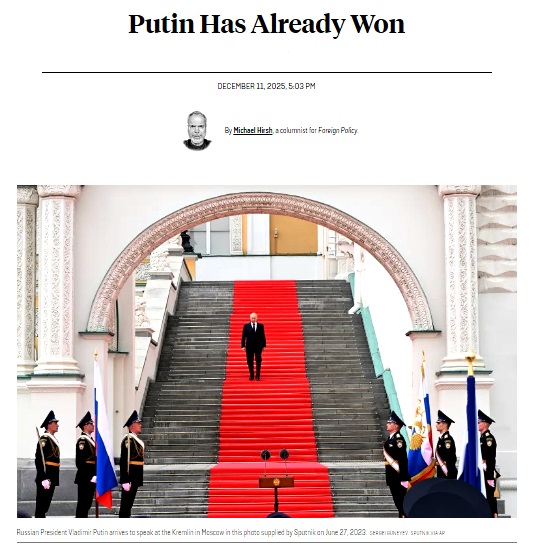
Putin exposed fatal divisions in the “West” even as Russians still back his Ukraine operation, ‘Foreign Policy’ stresses…
It has become commonplace for Western strategists to say that, no matter what he tries now, the Russian dictator will come out of his Ukraine adventure a loser. In nearly four years of horrific bloodshed, Putin has captured barely 20 percent of Ukrainian territory.
But seen from another perspective, Putin has good cause to look so confident: He appears to be succeeding in his larger goal of dividing and weakening what is loosely called the “West” — the nations that make up NATO. And this is a large part of what the Russian dictator has been trying to achieve in the first place, many Russia watchers say.
Nothing has made that clearer than the debacle of the last few weeks as negotiations orchestrated by U.S. President Donald Trump dissolved into a cacophony of confused finger-pointing across the Atlantic, with Americans and Europeans offering up wildly incompatible peace proposals and angrily blaming each other for undermining the talks.
An early Christmas present for Putin
In recent days that gulf has grown dramatically wider, with Trump dismissing Western Europe as “weak” and “decaying” in an interview and suggesting, yet again, that Ukraine would have to cede its Donbas region to the aggressor, Putin.
Those remarks appeared to echo the administration’s just-released National Security Strategy, in which the Trump administration suggested Europe was in danger of losing its “Western identity” and said the president’s emphasis now is to “reestablish strategic stability with Russia.”
For Putin, all this amounts to an early Christmas present — a very big one. “This was Putin’s motivation from the get-go with the invasion: He thought NATO wouldn’t hold together,” said Bruce Jentleson of Duke University, a former senior foreign-policy advisor to the State Department.
“Now with Trump as enabler, Putin has another and even better chance to divide the West.”
Perhaps what’s most striking is that after nearly four years of war far more unanimity of opinion exists on the Russian side in support of the invasion than on the Western side against it.
What lies behind this support of the war? “For many Russians, to lose Ukraine completely would be almost like what losing a part of the American Southwest would be for Americans,” said Peter Eltsov, a Russia expert at National Defense University, who noted that even esteemed intellectuals such as Nobel Prize-winning author Aleksandr Solzhenitsyn have endorsed Putin’s claims on Ukraine. A great many Russians agree with Putin’s 2021 statement that “Russians and Ukrainians were one people—a single whole” and his characterization of “Kievan Rus” — the kingdom ruled more than a thousand years ago by Vladimir the Great in present-day Kyiv — as “the cradle of Russian civilization.”
Bottom line: In the West, almost nobody seems to be on the same page any longer; in Russia, most people still appear to be. And conditions on the ground, including the oncoming winter, favor the Russian military — as opposed to Ukrainian Zelensky’s manpower- and munitions-strapped forces, which suffer from regular power outages, according to many military assessments.
The Trump administration the Russian leader may have created a fifth column of the like he never imagined possible
All these divisions provide a window into a deeper crisis: In the last 10 months since Trump took office, it’s become clear that not only is there no common ground over Ukraine, there may no longer be much of a common West left at all. This relates partly to the meaning of the Ukraine invasion: Europe sees it as an existential threat, while many Trump officials think the U.S. should avoid the war altogether.
But the divide goes way beyond that, extending to the seeming contempt that Trump, Vice President J.D. Vance, and other MAGA-aligned officials have openly expressed for Europe in terms of the continent’s values, which they regard as too liberal and progressive (even as Europe itself is struggling over its own identity). Vance and many in MAGA embrace a Christian nationalism that the European Union has long since left behind. Vance, in particular — who should now be seen as Trump’s heir apparent and is perhaps the administration’s leading Euroskeptic — likes to compare EU officials to Soviet-style “commissars.”
Indeed, in the Trump administration the Russian leader may have created a fifth column of the like he never imagined possible (though perhaps he did, considering how hard Kremlin functionaries worked to get Trump elected in 2024).
So intent is Trump on this new relationship with Moscow that his Defense Department has begun to eliminate Russia as a potential strategic adversary in various war games conducted outside of NATO, according to one Defense Department official.
The deep chasm between the United States and Europe in outlook and policy is reaffirmed in the starkest terms by Trump’s new National Security Strategy, which declares that Europe faces the “prospect of civilizational erasure” in large part because its migration policies have cost it its “Western identity.”
The document appears to delegitimize the entire postwar European project — the decades-long process by which Europe created a common market and currency out of the devastation of World War II — by attacking the EU as just another “sovereignty-sapping” transnational organization.
Europe has begun to go its own way
And gingerly, Europe has begun to go its own way — although true strategic autonomy from the U.S., which French President Emmanuel Macron wants, remains far off.
In coming weeks the European Commission is expected to approve some version of a “reparations loan” for Ukraine that would involve unlocking more than $246 billion in Russian Central Bank assets (though Belgium, which holds a majority of the assets, is still resisting the move). And in a dramatic break from its post-World War II pacifism, Germany has amended its constitution to authorize unlimited government borrowing for defense; Germany now is permanently stationing troops beyond its borders and openly plans to build the most powerful military in Western Europe.
“For the Germans, this time is different. There is a great sense of betrayal,” said Jeremy Shapiro, research director of the European Council on Foreign Relations, who just returned from a fact-finding trip to Germany. Shapiro said government officials in Berlin talk about a definitive break with Washington coming from Trump’s Ukraine peace plan.
“The last reversal on Ukraine revealed that what Trump was doing was promoting his financial interests and looking for a relationship with Russia above Europe’s head.”
In Trump, the Russian president has found an unexpected ally
While the Germans and other European countries were appalled by the new National Security Strategy, Kremlin spokesperson Dmitry Peskov called it “encouraging” and said Moscow was happy that Trump had dropped the previous characterization of Russia under former President Joe Biden as a major “threat” to the United States.
Today, Putin and the many right-leaning Russian officials and elites who support him suggest that their main adversary is the postwar “liberal international system” of the West. And now, in Trump, the Russian president has found an unexpected ally of sorts.
For Trump and his team, too, seem set on destroying this international system.
read more in our Telegram-channel https://t.me/The_International_Affairs

















