РУССКИЙ
 9:20 14.03.2026 •
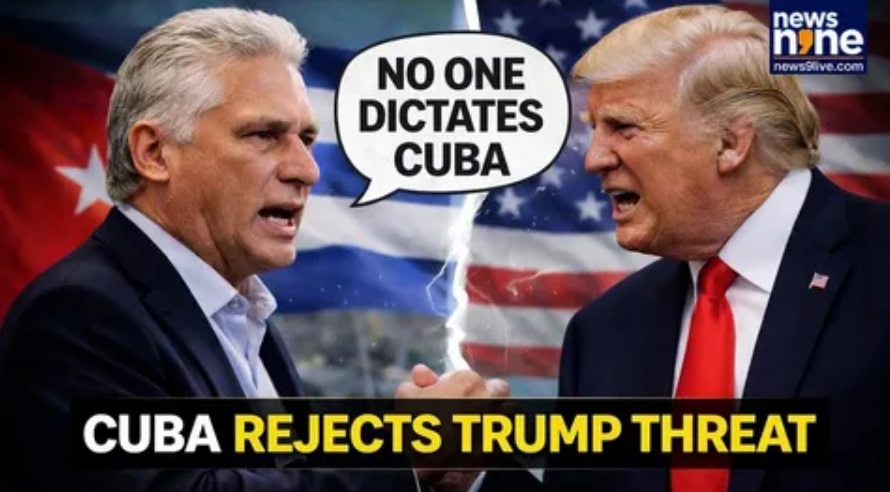
A manufactured crisis could lead to state collapse, with lasting consequences for the United States, ‘Foreign Policy’ stresses.
Developments over the last few weeks, including the U.S. Coast Guard’s interception of oil tankers on their way to Cuba, add an unprecedented level of coercion and isolation. Even the Kennedy administration’s “quarantine”—it avoided the word “blockade” for international legal reasons—at the height of the Cuban missile Crisis in 1962 didn’t bar Cuba from access to essential imports and to oil; it was limited to intercepting military equipment.
The Trump administration’s goals are clear. The objective, spelled out in no ambiguous terms by U.S. Secretary of State Marco Rubio, is “regime change.” A particularly zealous congressional representative, María Elvira Salazar, has explicitly acknowledged that civilian suffering is an unfortunate but necessary trade-off in pursuing political transformation. Such statements confirm what decades of sanctions policy have demonstrated elsewhere: Harm to civilians is not accidental but is intentional as a mechanism of pressure.
Yet U.S. officials still employ an often-contradictory discourse. At times, they fully acknowledge the true purpose of U.S. sanctions, and at others, they deny U.S. responsibility for the resulting economic decline and daily deprivations of ordinary people.
Ultimately, the current oil blockade is an intensification of a U.S. embargo that has sought to suffocate the Cuban economy for decades. U.S. sanctions — and in particular the maximum-pressure variety imposed during Trump’s first presidency and largely maintained under the Biden administration — have restricted the Cuban state’s access to foreign currency and credit, led to chronic shortages and price hikes, hampered access to water and transportation, and degraded a health system that was, until recently, one of Latin America’s best.
Recent research has demonstrated that U.S. sanctions kill more than half a million people per year — equivalent to the annual global death toll of armed conflict.
Trump administration’s rollback President Barack Obama
In Cuba, too, the first Trump administration’s rollback of former U.S. President Barack Obama’s opening and reimposition of an even more aggressive sanctions regime, which coincided with the onset of the pandemic, resulted in the largest mass out-migration in Cuba’s history. Many who migrate are highly educated, and their departure greatly weakens many essential services. One young doctor at Cuba’s leading cardiology clinic for children told us that nearly his entire graduating class had left the country. He was the only doctor of his generation working there.
Sanctions have also failed to deliver their stated political objectives. Cuba is perhaps the clearest case: A six-decade-long embargo still hasn’t delivered the outcomes that its architects promised. In Venezuela — which has experienced the largest documented economic collapse outside of war in modern history — sanctions exacerbated a devastating contraction that caused tens of thousands of deaths. In both cases, political leadership survived.
A deeper legal problem
Beyond questions of efficacy lies a deeper legal problem. Through its actions, the United States has violated the prohibition of collective punishment, embedded in the Fourth Geneva Convention, and of economic coercion, enshrined in the Charter of the Organization of American States — both treaties that the United States is a party to. And the United Nations General Assembly has voted overwhelmingly for three decades to condemn the U.S. embargo on Cuba. There is a long roster of legal opinion on the brazen illegality of U.S. coercion against Cuba, including the latest condemnation from U.N. experts of Trump’s order imposing a fuel blockade.
Naval blockades are also illegal unless, as the U.N. Charter makes clear, they are enacted in self-defense in the face of an armed attack or are specifically authorized by the U.N. Security Council, as was the case of the blockade imposed on Iraq in 1990. Neither situation applies to Cuba.
These legal considerations may be moot in the context of weakening international law in the face of particularly virulent U.S. exceptionalism under Trump. But there is no doubt that the international community will be adding the United States’ unprovoked coercion of Cuba to its growing list of grievances. It is one thing to impose an illegal bilateral trade embargo, but the extraterritorial application of U.S. law and sanctions to other countries was previously resented by European states.
Rubio’s deeply personal commitment to regime change in Cuba
For the time being, the Trump administration’s threats of retaliation on states that send oil to Cuba are working. But condemnations of what Mexican President Claudia Sheinbaum has called a “humanitarian crisis of great reach,” triggered by the United States, are piling up. Countries will be looking for any crack in the Trump administration’s capacity to make good on its threats and paying close attention to what the Supreme Court’s ruling against Trump’s tariffs means in practice.
Beyond Rubio’s deeply personal commitment to regime change in Cuba, it remains unclear what Trump stands to gain from crippling the island’s economy and social fabric. Cuba has long stood out in the Caribbean as a security outlier: It reports one of the lowest homicide rates in Latin America and the Caribbean, and it is not a producer or transit hub for drug flows in the region. There are no entrenched criminal gangs, private militias, or armed insurgent groups operating in Cuba, and the Cuban state maintains effective control over its borders and territory.
From a security standpoint, the abrupt collapse of the Cuban state could lead to internal conflict, mass exodus, and expanded trafficking routes in the Florida Straits. Aside from its tragic human cost, such a manufactured crisis could have lasting consequences for the security of the United States and the region as a whole.
read more in our Telegram-channel https://t.me/The_International_Affairs