
 РУССКИЙ
 11:46 19.01.2026 •
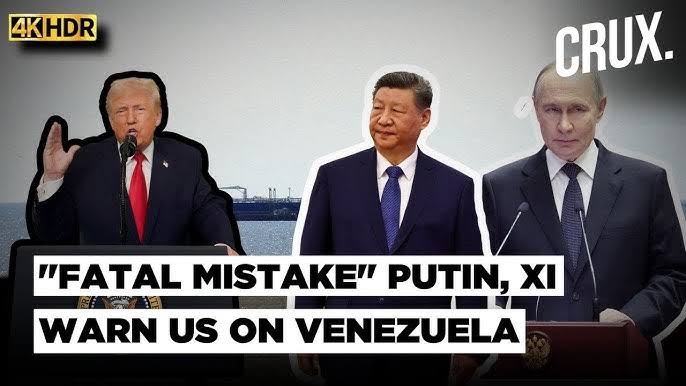
By attacking Venezuela, seizing its president, and promising to “run” the country indefinitely — all without any congressional or United Nations authorization — U.S. President Donald Trump may well have shredded what little is left of international norms and opened the way to new acts of aggression from U.S. rivals China and Russia on the world stage, some experts say, ‘Foreign Policy’ notes.
In return, Trump probably achieved little in the way of stopping narcotics flows into the United States, even as he asserts what he calls the “Trump corollary” to the Monroe Doctrine in his new National Security Strategy, which aims “to restore American preeminence in the Western Hemisphere.”
“If the United States asserts the right to use military force to invade and capture foreign leaders it accuses of criminal conduct, what prevents China from claiming the same authority over Taiwan’s leadership?” Democratic U.S. Sen. Mark Warner, the vice chairman of the Senate Select Committee on Intelligence, said in a statement. “What stops [Russian President] Vladimir Putin from asserting similar justification to abduct Ukraine’s president? Once this line is crossed, the rules that restrain global chaos begin to collapse, and authoritarian regimes will be the first to exploit it.”
Thus, combined with Trump’s military strike against Iran last summer — also done without U.N. or congressional authorization — this latest action could be seen as a Trumpian hammer blow to the frail husk of international law that remains.
“I think Trump is really serious about extending U.S. dominion over the Western Hemisphere,” said Ryan Berg, the head of the Americas program at the Center for Strategic and International Studies. “Their argument is this regime has no legitimacy, and the only legitimization they need is the Southern District of New York,” he said, referring to the district court where Maduro was indicted.
Trump’s action “weakens the already compromised U.S.
Trump’s action “weakens the already compromised U.S. ability to credibly make arguments about rules concerning use of force in international politics — which is zero cost to this administration since it does not care about such things,” said William Wohlforth, an international relations expert at Dartmouth University.
“A lawless administration has reached a new low,” said Harold Koh, an expert in international law at Yale and former legal advisor to the State Department. “Trump has baldly violated the UN Charter, with no valid claim of self-defense, and engaged in an illegal extraterritorial arrest that will be vigorously contested in a U.S. court.”
In a statement, French Foreign Minister Jean-Noël Barrot said the U.S. operation “contravenes the principle of non-use of force that underpins international law.”
What has Trump possibly gained in return? The ostensible reason for the Maduro operation — that he is an indicted drug trafficker responsible for pouring “gigantic amounts” of narcotics into the U.S. mainland, as Trump described it — doesn’t hold up very well against the facts.
“Most of those drugs come from a place called Venezuela,” Trump said. But based on U.S. drug enforcement data compiled by the Congressional Research Service, Venezuela is responsible for only a tiny amount of the heroin, cocaine, methamphetamine, and fentanyl imported into the United States. For example, more than 85 percent of heroin analyzed by U.S. agencies originates from Mexico, and only about 4 percent is from South America, while most of the cocaine still comes from Colombia.
Nearly every U.S. military intervention in Latin has ended in fiasco
But history suggests more pitfalls than promising outcomes may ensue. Nearly every U.S. military intervention in Latin America going back at least to the Bay of Pigs in 1961 has ended in fiasco — with no real benefit to Washington. And it hasn’t really mattered whether the issue was Cold War communism or post-Cold War narcotics. Indeed, the last clear, if ugly, U.S. success in the region may have been the Spanish-American War of the late 19th century.
In 1954, the CIA-backed overthrow of Guatemala’s elected government created decades of civil war and instability. The Bay of Pigs disaster — President John F. Kennedy’s failed coup against Cuban leader Fidel Castro — helped lead to the Cuban missile crisis. In 1973, a U.S.-supported coup against President Salvador Allende in Chile opened the way to Augusto Pinochet’s brutal 17-year dictatorship — and did permanent damage to the reputation of then-Secretary of State Henry Kissinger. President Ronald Reagan’s 1980s intervention against the Sandinistas ended in the Iran-Contra scandal and another civil war.
As for Venezuela itself, an allegedly U.S.-supported coup backfired against then-President Hugo Chávez in 2002. His hand-picked successor was Maduro.
read more in our Telegram-channel https://t.me/The_International_Affairs

















