
 РУССКИЙ
 12:00 13.02.2026 •
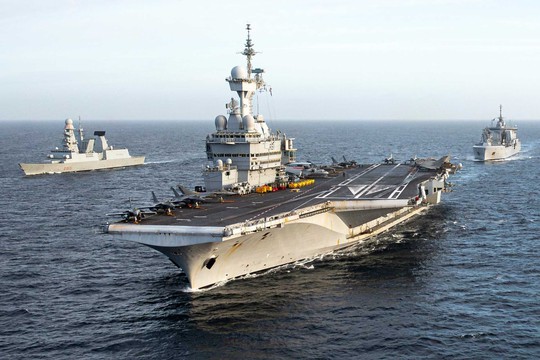
During the ORION 26 exercise, the Charles de Gaulle carrier strike group will conduct joint and allied training sequences that include air defense, anti-submarine warfare, surface combat, and precision strike coordination
Photo: French Navy
The aircraft carrier Charles de Gaulle and its carrier strike group had shifted from the Mediterranean to the Atlantic in order to participate in ORION 26, France’s largest joint and allied high-intensity exercise cycle scheduled to conclude on April 30, 2026.
The movement followed the group’s departure from the naval base of Toulon on January 27, 2026, and marked the transition from preparatory naval training to full integration within a national-level operational maneuver conducted across French territory, airspace, cyberspace, and surrounding maritime areas. The deployment places the carrier strike group within a broader framework designed to test France’s ability to lead coalition operations, sustain forces over time, and operate under conditions approaching a major conventional conflict in Europe.
ORION 26 is structured around a fictional scenario that is deliberately aligned with contemporary European security realities, while remaining formally detached from any single ongoing conflict. In the scenario, an expansionist European state named Mercure seeks to maintain regional dominance by destabilizing its neighbor, Arnland, and preventing its political and institutional integration into the European Union.
At Arnland’s request, France takes the lead of the ORION coalition on January 6, 2026, a political decision that triggers the military phases of ORION 26. The exercise is designed to move progressively from sub-threshold conflict into high-intensity warfare, requiring French and allied forces to manage escalation, deterrence failure, and large-scale combat operations. This progression obliges participants to operate under contested conditions across land, sea, air, cyber, and space domains, while maintaining political control and coalition cohesion. The scenario also integrates civilian and interministerial challenges, reflecting the impact of a major external conflict on national territory, public services, and critical infrastructure.
In terms of scale, ORION 26 involves 24 participating countries and approximately 10,000 personnel, and distributed across multiple regions of France and its maritime approaches. The Atlantic seaboard plays a central role, particularly for naval and amphibious phases linked to reinforcement routes and maritime security. The exercise stresses long-duration operations rather than short tactical events, focusing on command continuity, logistics flows, force regeneration, and the ability to coordinate large formations over several weeks. It also places French headquarters in a position equivalent to leading a NATO-level operation, testing procedures, staffing, and decision-making under sustained pressure.
Concrete force contributions underline the scale of ORION 26
The exercise includes two naval bases, one carrier strike group, two amphibious helicopter carriers, 25 major combat units, and 50 fixed-wing aircraft, alongside an army corps-level headquarters, three combined-arms brigades, and about 2,150 tactical vehicles. Air and air defense components comprise 40 helicopters, roughly 1,200 combat and specialist drones, two MALE drones, and six ground-based air defense systems. Space involvement is represented by 20 space sensors and the linkage of SparteX 2026 with ORION to integrate space command and control with other command structures. Cyber actions are embedded throughout all phases, connecting real cyber incident management to operational effects and to test defensive, offensive, and influence actions in the digital field.
Within this framework, the carrier strike group centered on the Charles de Gaulle forms a key maritime and air component of ORION 26. Prior to the Atlantic phase, the group conducted intensive joint and allied training in the Mediterranean, covering air defense, anti-submarine warfare, surface warfare, and coordinated precision strikes.
The Charles de Gaulle, France’s only nuclear-powered aircraft carrier, has a full-load displacement of about 42,500 tonnes, a length of 261.5 meters, a beam of 64.4 meters at the flight deck, and a draught of about 9.5 meters at full load.
The carrier typically embarks up to 2,000 personnel, and has previously supported combat operations over Afghanistan, Libya, Iraq, and Syria.
…The main thing in these naval maneuvers is to keep the aircraft carrier Charles de Gaulle from sinking.
This is how ‘The American Thinker’ describes its condition:
“The French nuclear carrier "Charles de Gaulle" has suffered from a seemingly endless string of problems since it was first conceived in 1986. The 40,000 ton ship has cost over four billion dollars so far and is slower than the steam powered carrier it replaced. Flaws in the "de Gaulle" have led it to using the propellers from its predecessor, the "Foch," because the ones built for "de Gaulle" never worked right and the propeller manufacturer went out of business in 1999.
Worse, the nuclear reactor installation was done poorly, exposing the engine crew to five times the allowable annual dose of radiation. There were also problems with the design of the deck, making it impossible to operate the E—2 radar aircraft that are essential to defending the ship and controlling offensive operations. Many other key components of the ship did not work correctly, including several key electronic systems.
The carrier has been under constant repair and modification. The "de Gaulle" took eleven years to build (1988-99) and was not ready for service until late 2000. It's been downhill ever since. The de Gaulle is undergoing still more repairs and modifications. The government is being sued for exposing crew members to dangerous levels of radiation.”
If Macron wants to scare somebody, and the plan for exercises with the “countries” Mercure and Arnland clearly alludes to the Ukrainian conflict, then he'd better ensure the combat readiness of his only aircraft carrier. Otherwise it might drown by accident.
read more in our Telegram-channel https://t.me/The_International_Affairs

















