РУССКИЙ
 10:20 21.03.2026 •
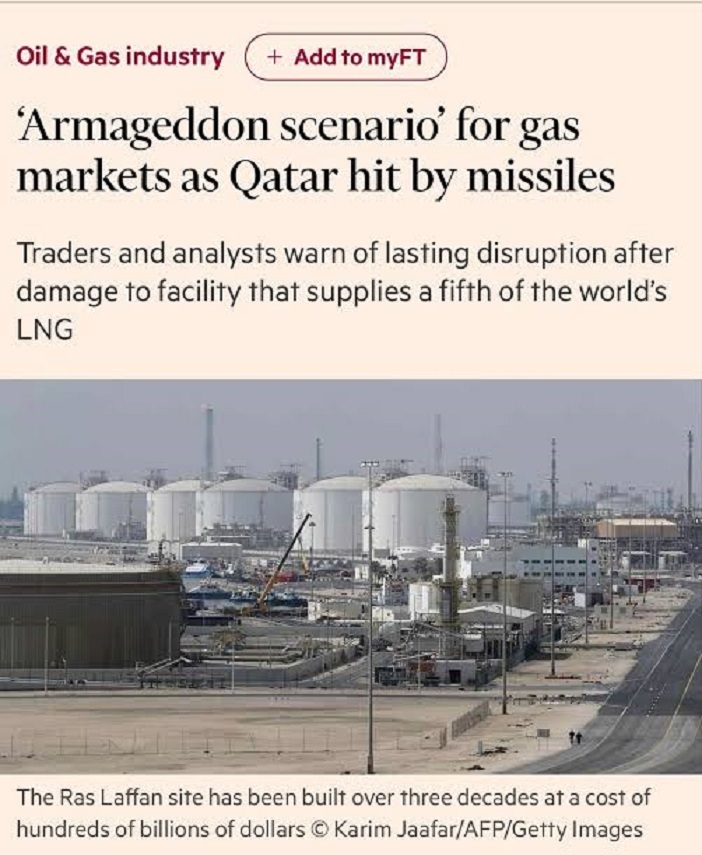
As emergency workers sifted through the smouldering wreckage at Qatar’s Ras Laffan complex on Thursday morning, traders in Europe and Asia were waking up to a fresh energy crisis, ‘Financial Times’ stresses.
In normal times, a fifth of the world’s supply of liquefied natural gas (LNG) flows from Ras Laffan, a vast industrial site almost three times the size of Paris built over three decades at a cost of hundreds of billions of dollars.
LNG terminals are some of the biggest and most complex constructions in human history, and Ras Laffan is the largest of them all, turning Qatar’s huge gas reserves into a super-chilled fuel that can be shipped around the world. At least before the Iranian missiles arrived.
“This has always been my nightmare scenario, my Armageddon scenario, the one I didn’t want to happen,” said Anne-Sophie Corbeau, a former head of gas analysis at BP who is now at Columbia University’s Center on Global Energy Policy.
Gas prices in Europe rose 30 per cent as markets reopened and have more than doubled since the start of the war, as traders try to calculate the impact of months, or longer, without Qatar’s gas flowing to world markets.
Oil prices also jumped 10 per cent to almost $119 a barrel, due to fears of further strikes on energy supplies.
State-owned QatarEnergy, the operator of Ras Laffan, told Reuters the damage to two of its LNG units, in which ExxonMobil was a co-investor, would take three to five years to repair, cost the company $20bn a year in lost revenue, and force it to cancel long term contracts with Italy, Belgium, Korea and China.
The volume of gas now lost for the foreseeable future is roughly 17 per cent of Qatar’s total capacity.
One trader said that gas prices in Europe would be pushed higher “through 2027” and that Europe would find it harder to refill its gas storage tanks this summer as Asian buyers snapped up LNG from the US to make up for the lost supply.
Asia was already facing shortages and rationing due to the loss of supply from the Gulf.
Europe, which has become more reliant on LNG since Russia slashed pipeline exports, is now expected to be pitched into direct competition against countries such as Japan and South Korea for limited cargoes.
Laurent Segalen, a clean energy investment banker, said: “It is apocalypse now. The coming months for gas importers are going to be a bloodbath.”
While some US projects are starting up shortly, there is no adequate compensation for Qatari gas that is “not politically very complicated”, said Corbeau, noting that some politicians had already been calling for a relaxation on bans on Russian gas.
...The latest talk of resuming Russian gas supplies to Europe is a pipe dream. Not only has Europe rejected Russian gas, but Russia has also rejected gas supplies to Europe. Let them live as they please without Russian energy.
The market is large, and Russian gas is being redirected to Asia.
Ciao, Europe!
read more in our Telegram-channel https://t.me/The_International_Affairs