
 РУССКИЙ
 10:43 19.03.2026 •
Pic.: FT
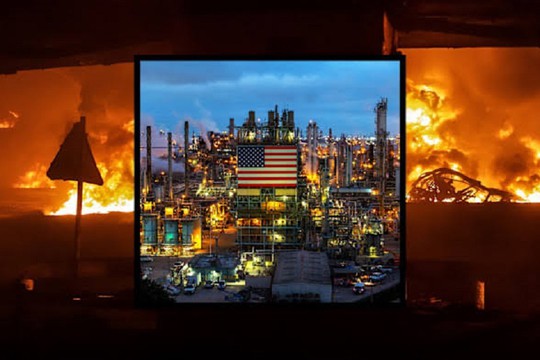
US oil companies stand to receive a windfall of more than $US60 billion ($86 billion) this year if crude prices maintain the levels they have hit since the start of the Iran war, ‘Financial Times’ reports.
Modelling by investment bank Jefferies estimates American producers will generate an extra $US5 billion cash flow this month alone following a roughly 47 per cent rise in oil prices since the conflict began on February 28.
If US oil prices remain elevated and average $US100 a barrel this year, the companies will receive a $US63.4 billion boost from oil production, according to energy research company Rystad.
As Brent crude prices surged past $US100, President Donald Trump boasted in a social media post: “The United States is the largest Oil Producer in the World, by far, so when oil prices go up, we make a lot of money.”
The extra cash flow should benefit US shale companies, which have limited operations in the Middle East. But the picture is more complicated for the largest international oil companies.
ExxonMobil and Chevron, as well as European rivals BP, Shell and TotalEnergies, have widespread assets in the Gulf and are more affected by the closure of the Strait of Hormuz.
Production has been shut at several facilities in which some of the five “super majors” have equity stakes, forcing Shell to declare force majeure on liquefied natural gas cargoes they planned to ship from QatarEnergy’s Ras Laffan plant.
Martin Houston, an oil industry veteran and chair of Omega Oil and Gas, said: “There are no winners in this situation – and it certainly isn’t the international oil companies. They would rather the status quo from two weeks ago than a crisis that temporarily raises oil prices.”
“National oil companies in the Middle East and their partners will have to rebuild damaged infrastructure. But the real concern is ... the unprecedented closure of the strait, even for a short period.”
A speedy resolution to the crisis does not appear close. Iran’s new supreme leader, Mojtaba Khamenei, last week said the nation’s military would keep the narrow waterway that carries a fifth of the world’s oil and gas closed as he seeks to build leverage against the US and Israel.
About 18 million of the 20 million barrels of oil that normally pass through the waterway each day remain blocked, according to research by Goldman Sachs. The shock is more dramatic for the LNG industry, with about a fifth of global production halted.
RBC Capital Markets on Friday said it expected the conflict to drag on into the northern spring and that Brent crude prices could exceed $US128 a barrel within three to four weeks.
Rystad’s Thomas Liles said: “The closure of the strait will hurt Middle Eastern national oil companies, while the [Western] oil majors – who account for around 20 per cent of total upstream production from Qatar, UAE, Iraq and the neutral zone [the land between Saudi Arabia and Kuwait] – could also see material impacts.”
BP and Exxon are among the most exposed to the Middle East crisis, with more than a fifth of the free cash flow they are expected to generate in 2026 from their global oil and LNG operations based in the region.
Paul Sankey, founder of Sankey Research, said the Middle East crisis would drive a much more aggressive push towards domestic energy sources free from the risk of supply disruption and surging prices.
“This could become a demand destruction event where everyone loses,” he said, noting that some of the worst-hit countries in Asia such as Taiwan could rethink their aversion to nuclear energy.
read more in our Telegram-channel https://t.me/The_International_Affairs

















