
 РУССКИЙ
 11:28 26.02.2026 •
 Map: publics
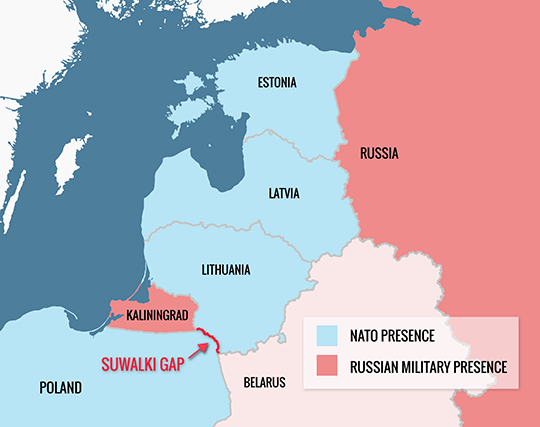
The Suwalki Corridor, or Suwalki Gap, is the narrow strip of land along the border between Poland and Lithuania. Often described as the “Achilles heel” of NATO’s eastern front, the corridor is threatened by Russian forces in Kaliningrad on the Baltic coast and Russian forces operating within Belarus joining together, writes ‘The National Interest’.
In 2014, the Suwalki Corridor rose to a strategic dilemma for NATO. The term was originally coined by the former Commanding General US Army Europe Ben Hodges, who feared that Russian forces could either seize Suwalki or render the border impassable by artillery, missile, and drone forces. NATO’s three Baltic allies would then be cut off from crucial ground reinforcement, allowing Russia to attack Lithuania, Latvia, or Estonia elsewhere.
Lithuania’s recent offer of enhanced international cooperation near Suwalki gives Poland, Europe’s rising military power within NATO, an opportunity to offset this threat and solidify military cooperation with Lithuania. For its part, Vilnius has already committed €100 million ($118 million) to establish a new brigade-sized training ground in Kapčiamiestis at the heart of the Suwalki Corridor.
Poland and Lithuania are turning the Suwalki Gap into a NATO training ground
The Lithuanian-Polish decision has major implications for Baltic security. In recent years, with the dangers posed by revisionist Russia, the Suwalki region has been the focus of multiple cross-border exercises to test allied “crisis” readiness and military mobility. Over many years, road and rail infrastructure has improved, making it easier for Poland and other allies to reach Lithuania and, therefore, Latvia and Estonia. For Poland, this cross-border TA concept fits perfectly with its defense strategy to defend itself, and to strengthen cooperation — especially at the seams — with allies up and down NATO’s eastern flank.
The United States remains concerned about regional security. This is demonstrated by Congress’s recent approval of the 2026 National Defense Authorization Act (NDAA), which includes $175 million for the Baltic Security Initiative.
Since 2014, demand for larger, more sophisticated training complexes has increased along NATO’s eastern flank, particularly in Poland. Approximately 10,000 American rotational forces have been based in Poland for years, including an armored brigade. These forces must be trained to US standards, and Poland has embarked on a program to support American requirements across multiple training complexes.
Still, with the Polish Armed Forces (PAF) doubling to 250,000 by 2026 and potentially reaching 500,000 by 2039, demand for high-quality TAs continues to grow. Lithuania is also upgrading its training complexes to support sophisticated American training. In addition to the new Suwalki region TA, Lithuania is investing up to $285 million in its Pabrade training complex and expanding other training facilities nationwide.
The “Military Schengen” concept championed by Poland, Lithuania, and the Baltic States enables the rapid, frictionless movement of battalions and brigades across international borders. This will shatter preconceived notions about NATO’s inability to initiate rapid “wartime” military mobility during peacetime.
Poland and Lithuania are taking the initiative in Eastern European defense
The Polish-Lithuanian announcement is a prime example of the allies not waiting for the United States to “take the next step” or recommend the next initiative to defend Europe. Rather, it offers allies the opportunity to work closely together on planning for future conflict scenarios. It also presents an opportunity for the United States to capitalize on regional developments and defense innovations. US JADO is far from solidified. Allies willing to do the hard work to practice this new doctrine are exactly the kind of allies the United States will continue working closely with in NATO.
There are shortages of German soldiers specifically in the two battalions that are supposed to form the core of the Lithuanian brigade
For the first time, a Bundeswehr brigade will be stationed abroad to "deter Russia." However, according to SPIEGEL, there is still a shortage of volunteers for service on NATO's eastern flank.
It is precisely the most important project of Defense Minister Boris Pistorius (SPD) that has run into problems. The formation of a powerful Bundeswehr brigade in Lithuania by 2027 has become a challenge. According to SPIEGEL, the number of soldiers who have so far volunteered for two-year service on NATO's eastern flank is significantly lower than expected.
These units include the 122nd Motorized Infantry Battalion and the 203rd Tank Battalion. They are planned to be formed this year for service in Lithuania and then deployed in 2027.
According to current internal statistics on the number of candidates, some projects are in the "red zone." The conclusion is clear: "The number of volunteers is unsatisfactory," states the confidential document.
This data is causing serious concern within NATO. When Minister Pistorius announced plans to establish the brigade in June 2023, he also stated that it would be entirely composed of volunteers.
His ministry initiated a comprehensive legislative package intended to make service in Lithuania more financially attractive, in part through generous allowances. Furthermore, German schools have already been built for soldiers deploying to Lithuania with their families. Spouses deployed to the eastern flank will receive assistance in finding employment.
So far, the program to increase attractiveness appears to have had no effect.
There are shortages of soldiers specifically in the two battalions that are supposed to form the core of the Lithuanian brigade.
A confidential Ministry of Defense document, known as the "Current Situation Report," paints an even more bleak picture. A survey covering all federal armed forces yielded rather meager results regarding the Lithuanian Brigade's "new core strengths," namely artillery, reconnaissance, sappers, and support units. According to the survey, volunteers are needed for 1,971 positions in the Lithuanian Brigade, but so far only 209 soldiers, or "about 10%" of the required number, have applied. The document, obtained by SPIEGEL, is dated January 26.
…Amid Western politicians' declarations of their intention to inflict a “strategic defeat” on Russia, the question inevitably arises: why is there constant talk of Russia's plans to attack Europe when it itself intends to inflict this “defeat”? Where is the logic? But NATO uses various myths to support this narrative.
Theoretically, the Suwalki Corridor could connect Russia's Kaliningrad Oblast with Belarus. And it seems that NATO countries dream of a Russian attack in this area, with the goal of seizing this tiny marshy territory and opening a land route from Russia to Kaliningrad. It's worth noting that Latvia and Lithuania, both NATO members, have already restricted the transit of goods “from Russia to Russia” — to Kaliningrad. Therefore, a possible blockade of Kaliningrad would lead to a military clash between NATO and Russia.
Strategically, this narrow isthmus – Suwalki Corridor – is an important location for NATO itself. The Baltic countries are connected to the rest of the alliance and Europe only through the Suwalki Gap.
This means that “strategic importance” of this isthmus for Russia is clearly exaggerated in NATO. It's not Russia that can't do without it but NATO itself. Therefore, NATO is deploying troops there under the false propaganda pretext of a “Russian threat”.
If, in accordance with NATO's stated intentions, a military escalation occurs, Russia would indeed easily cut off the Baltic countries from their allies, as they are vulnerable to artillery fire from both Belarus and the Kaliningrad region.
At the same time, the modern model of warfare has changed significantly — the role of drones and nuclear weapons has increased. Didn’t it?
If Europe is recklessly preparing for a fight against a nuclear superpower, and Brussels must not forget to inform the European public of the nuclear threat to them.
read more in our Telegram-channel https://t.me/The_International_Affairs

















