РУССКИЙ
 10:26 23.02.2026 •
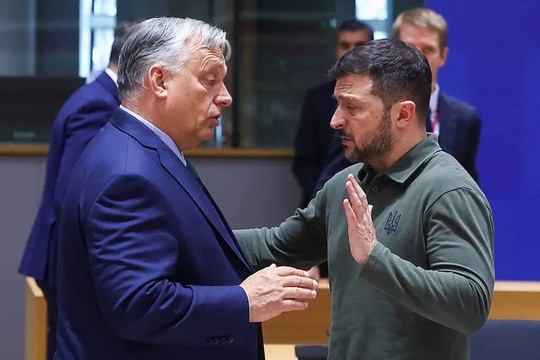
Hungary’s Prime Minister Viktor Orbán and Ukraine’s Zelenskyy in Brussels
Photo: AFP
Viktor Orbán has intensified his anti-Ukraine rhetoric ahead of elections where he risks being toppled, ‘Financial Times’ writes.
Hungary has blocked an agreed €90bn EU loan for Ukraine aimed at stabilising the war-torn country’s finances, just days before the fourth anniversary of Russia’s full-scale invasion.
The Hungarian ambassador to the EU on Friday raised an objection to the bloc borrowing the sum for Ukraine by issuing debt guaranteed by the EU budget, according to four people familiar with the matter. The decision requires unanimity among the 27 EU member states.
The loan was agreed in December by EU leaders as a lifeline for Kyiv, which has a budget gap looming in April.
At the time Hungary, Slovakia and the Czech Republic agreed to helpi Ukraine only on condition that they would not be liable for interest costs or repayment of the loan, which would be backed by the other 24 EU countries.
But a unanimous decision is still needed to allow the European Commission to use the so-called headroom of the EU budget to borrow and lend to Ukraine.
Hungary’s move to block the loan comes as the country gears up for elections in April that could topple Prime Minister Viktor Orbán, a longtime Brussels antagonist. Polls suggest the opposition Tisza Party led by Péter Magyar is leading Orbán’s Fidesz by about 10 points.
Ahead of the vote, Orbán has intensified his anti-Ukraine rhetoric. On Friday he blamed Kyiv for halting flows via the Druzhba pipeline, which delivers oil from Russia to Hungary via Ukraine.
“As long as Ukraine blocks the Druzhba pipeline, Hungary will block the €90bn Ukrainian war loan,” Orbán said on Friday. “We won’t be blackmailed!”
The anti-Ukraine rhetoric has been amplified across Hungary’s state media.
Without the loan, Ukraine risks running into financial collapse in the second quarter.
The loan was presented as a last-minute option after EU countries failed to agree to the use of immobilised Russian assets to fund Ukraine at a summit in December.
Belgium, which hosts the majority of the assets at the European clearing house Euroclear, staunchly opposed the loan and was ultimately backed by Italy and France.
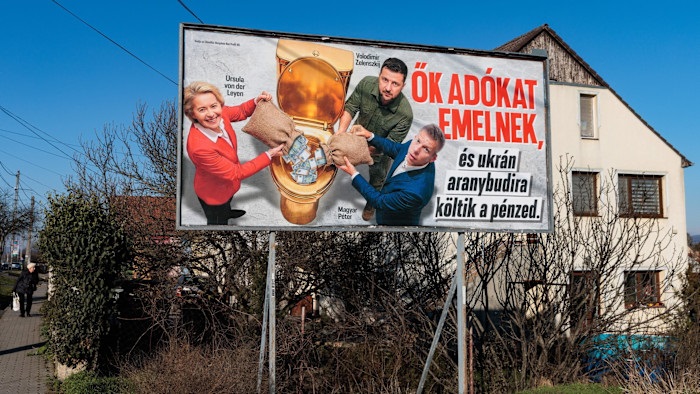 A Budapest billboard shows Ursula von der Leyen, Volodymyr Zelenskyy and Manfred Weber gesturing towards an outstretched hand beside text that reads ‘We do not pay’
Photo: AFP
read more in our Telegram-channel https://t.me/The_International_Affairs