
 РУССКИЙ
 11:56 19.02.2026 •
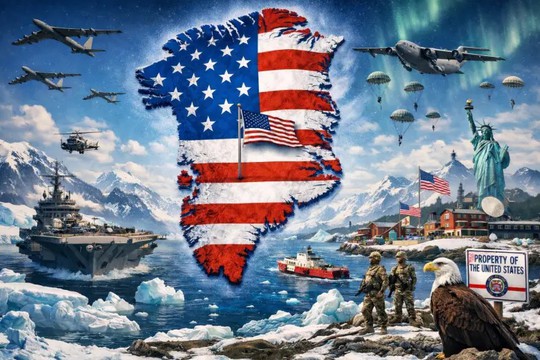
Pic.: publics
President Donald Trump’s threat last month to take Greenland by force has alarmed and angered the US’s traditional democratic allies.
And although Trump later walked back his comments, his words deeply challenged Europe's faith in the long-standing NATO defence partnership.
The noisy political storm however masked the real security issue behind Trump’s Greenland push, experts tell Newsweek.
It’s been a vital but barely discussed issue in the background: the world needs to contend with a looming new era of hypersonic weapons, missiles which travel so much faster and farther than ever before, resetting risk thresholds for every Western country.
"We need to start talking about the hypersonic era and how we're going to deal with it in the High North," Troy Bouffard, a professor for Arctic Security at the University of Alaska Fairbanks, told Newsweek.
Trump stated only vague security reasons for his Greenland aggression, saying the US needed to counter increasing Chinese and Russian activity in the Arctic and mentioning their “ships” without providing evidence.
But Prof Bouffard says the US President failed to articulate the key defense reason: the heightened dangers posed by hypersonic weapons – and that is why it’s necessary for the US to have assured access to Greenland, especially since Greenland was on a path to independence meaning the future of agreements was potentially uncertain.
"Greenland's role during the Cold War was wildly different from Greenland's role during this hypersonic era,” Bouffard says.
A dangerous new Era
Hypersonics are the next frontier and it’s been known for some time that Russia and China have also been pursuing the technology.
Unlike ballistic missiles, hypersonics can pretzel in the air, fly along the ground and even change course, making them exceedingly difficult to detect and block. They can carry both nuclear and non-nuclear weapons.
Russia has used them twice so far in its war against Ukraine, with one missile landing near the western Ukrainian city of Lviv and just 40 miles from the border with Poland in January. Moscow has also tested them in the Barents Sea in the Arctic.
In almost every measure they are superior to ballistics, moving at lower altitudes, with greater maneuverability and extreme speed to bypass defence systems.
To counter this, the US needs a suite of technology that includes ground sensors to track and take "custody" of them, Bouffard said.
The US can’t rely on satellites because they perform differently in the High North, slipping into polar orbit and requiring handover to other satellites. So ground-based technologies such as ‘over the horizon’ radars which bounce signals off the ionosphere to search for objects beyond the typical radar horizon are vital.
“That’s what’s going to work up there,” said Bouffard. "You have to have enough sensors that can triangulate and deal with the clock offset to understand where the missile is and where the missile is going," he said.
But they are being developed with Greenland as a main future location, said Bouffard. As such, the US needed assured access to Greenland to lay down these systems and and “redo” its whole defence framework, he said.
The US needs to look at next generation security systems and delivery systems like hypersonics and hyperglide vehicles, said P. Whitney Lackenbauer, a professor at Canada's Trent University and an expert in Arctic and security affairs.
"We know that the U.S. is going to do everything it needs to defend itself if it faced an existential kinetic threat," Lackenbauer told Newsweek.
He pointed to how the U.S. Department of Defense moved Greenland from U.S. European Command to U.S. Northern Command last year, pulling it into the western hemisphere and signalling an uptick in concern.
The security agreement between the U.S. and Denmark
A 75-year-old security agreement between the U.S. and Denmark, Greenland's sovereign ruler, provided the U.S. and Canada with security during the Cold War, an era dominated by ballistic missiles, and is still valid today.
But ensuring North American security in a new defense era could require expanded or new agreements—especially if Greenland gained independence, Bouffard said.
“Greenland is legitimately and absolutely critical to national security for the United States and Canada," he said.
read more in our Telegram-channel https://t.me/The_International_Affairs

















