РУССКИЙ
 11:45 04.03.2026 •

Inside the Mar-a-Lago war room – They don't have happy faces
Photo: BBC
Iran's response to the American and Israeli strikes on the country's territory on February 28 turned out to be much larger than expected. It is believed that neither Iran nor the United States is interested in prolonging the conflict – US President Donald Trump said on the evening of March 1 that Iran was ready to continue negotiations, but there was no confirmation from the Iranian side. Which countries are already involved in the Iranian conflict and how it has affected the global economy and Trump's rating can be found in the Izvestia article.
The number of participants in the conflict is growing
- In response to attacks from Israel and the United States, Iran has launched strikes on Israeli territory, as well as on American military bases in the Persian Gulf. The targets of the Iranian missiles were the service center of the 5th Fleet of the US Navy in Bahrain, as well as the Al-Udeid air base in Qatar, Ali al-Salem in Kuwait, Al-Dhafra in the UAE, the US Air Force bases Muwaffaq Salti in Jordan and Prince Sultan in Saudi Arabia, and one of the missiles was shot down over the American The base is located near Erbil airport in Iraqi Kurdistan. The port of Duqm in Oman, which was previously used by the US Navy, was also attacked by drones.
- The Persian Gulf countries have already announced possible retaliatory strikes against Iran, but experts rule out such a possibility, since American military bases, which are considered US territory, were attacked. The European powers are also being drawn into the conflict. On March 1, Britain, France and Germany threatened Iran with retaliatory strikes for attacks on the Persian Gulf countries. Libya became another party to the conflict on March 2. After Hezbollah fired on Israel, retaliatory rocket attacks hit Beirut.
- On the night of March 2, it was reported that Iranian drones attacked the British military airbase of Akrotiri in southern Cyprus. The strikes occurred shortly after Britain allowed American troops to use its military bases to strike Iran. On the eve of the security measures at the British bases on the island increased to the maximum level. British Prime Minister Keir Starmer also announced that he intends to involve the Ukrainian military in the protection of allied countries in the region.
Who else will be affected
- Ongoing attacks on Iran may provoke an aggressive response from groups that have traditionally enjoyed Tehran's support – Shiite groups in Iraq and the Yemeni Houthis, as well as lead to a surge in terrorist attacks on American facilities. The Houthis are called the greatest threat in the American press, especially since the leader of the Houthi movement, Abdul-Malik al-Houthi, has already declared the group's solidarity with Iraq. Houthi attacks can significantly complicate commercial shipping in the Red Sea, as well as become a real threat to Israel.
- Egypt may be among the countries affected by the conflict, especially if the Houthis resume attacks on ships in the Red Sea, as in this case the country will lose revenue due to falling traffic through the Suez Canal, which could lead to a serious economic crisis. The French company CMA CGM SA, the third largest container shipping operator in the world, has already announced the suspension of the passage of ships through the channel. Against the background of these reports, the exchange rate of the Egyptian pound in local banks has decreased, and on Monday, with the opening of markets, Egypt's national currency may fall even more.
- If the conflict drags on and leads to a prolonged decline in ship traffic through the Strait of Hormuz, the entire gas industry may suffer. Plants producing liquefied natural gas need stability in the supply and shipment of fuel, and disruptions in the supply of gas can lead to production stoppages. Insurers have already warned about the termination of contracts and the increase in insurance premiums for the transportation of oil and gas.
- Among the countries of the Persian Gulf, the United Arab Emirates may be the most affected. The country is already experiencing a crisis in the real estate market: the interest of foreigners in buying housing in the country has plummeted after the attacks on the American military base. In addition, the UAE received a steady income from tourism, which may now also be in question.
Market reaction
- The conflict in the region has led to an increase in oil prices. Brent rose above $80 per barrel, and OPEC+ countries decided to increase production from April in order to keep the course. Prices for fertilizers have also increased, with a third of their trade occurring through the Strait of Hormuz. At the same time, due to the fact that the Iranian response turned out to be larger than the market expected, demand for safe haven assets - gold, government bonds and the Swiss franc – is growing.
- Saudi Arabia's shares fell as a result of the strikes on Iran on February 28, losing up to 4.8%, which could jeopardize the country's ambitious Vision 2030 project. At the same time, the Saudi Aramco oil giant, on the contrary, rose in price by 3.2%, which turned out to be the largest daily jump for the company since October. This situation reflects investors' concerns about a possible blockade of the Strait of Hormuz, where traffic is already declining. The Strait of Hormuz is the only transport corridor for oil and gas supplies from Iraq, Kuwait, Qatar and Bahrain.
The reaction inside the United States
- The American strikes on Iraq provoked controversy within the US Republican Party, where not everyone supported Trump's decision. The main complaint against the US president is that he has not obtained congressional authorization for military action. The procedure for obtaining such an agreement implies justifying the need for an attack, the purpose of the operation, and calculating possible risks, and therefore Trump's critics believe that the US administration did not have serious arguments that would withstand discussion in Congress.
- The Democrats are already using the situation against Trump in their preparations for the upcoming elections. Amid dissatisfaction with the attack on Iran, the US Democratic Party has a chance to win a majority in both houses of Congress, which will significantly limit the powers of the US president. Much will depend on the results of the operation, but the prevailing opinion in the American press is that regime change in Iran is unlikely to be possible through an air operation, and even if successful, attacks could lead to the emergence of new forces hostile to the United States in the region.
- According to a Reuters/Ipsos poll conducted from February 28 to March 1, only 27% of Americans supported an attack on Iran. Among Republicans, 55% approved of the decision on strikes. Trump has failed to become a peacemaker in the opinion of Americans: 56% of the country's citizens believe that the president uses weapons too often and too willingly to advance the interests of the United States.
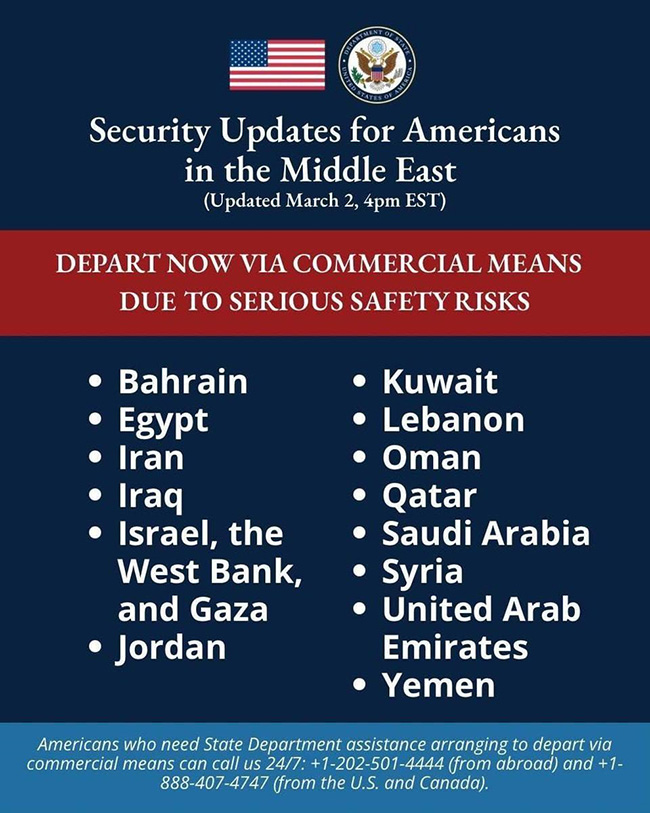
…Is this an evacuation of Americans or an escape from the fear and horror of a war they started themselves?
read more in our Telegram-channel https://t.me/The_International_Affairs