РУССКИЙ
 11:58 19.12.2025 •
 Jeffrey Sachs
The message is that Russia and its security interests must be taken seriously. Europe has repeatedly rejected peace with Russia, not because it was impossible, but because recognizing Russia's security interests was wrongly considered illegitimate. As long as Europe persists in this reflex, it will remain trapped in a cycle of self-destructive confrontation – rejecting peace when it is possible and bearing the costs long afterward.
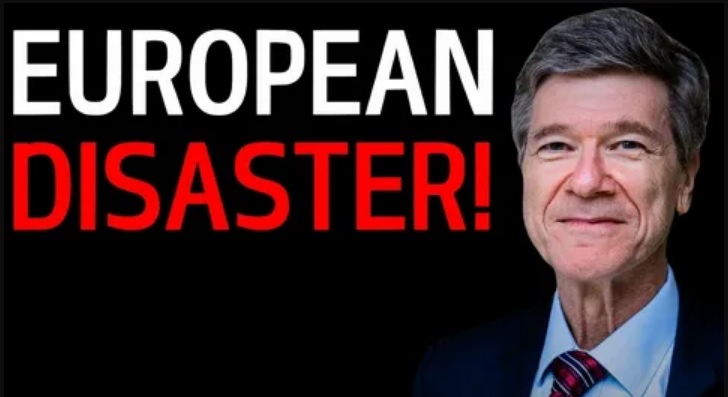
In this essay, I present a clear thesis: Europe has repeatedly rejected peace with Russia, even though a negotiated solution would have been possible. These rejections have been profoundly counterproductive for Europe, writes Jeffrey D. Sachs, a University Professor and Director of the Center for Sustainable Development at Columbia University, and President of the UN Sustainable Development Solutions Network.
From the 19th century to the present day, Russia's security interests have not been treated as legitimate interests that could be negotiated within a broader European order, but rather as moral failings that had to be resisted, contained, or ignored.
This pattern has continued in radically different Russian regimes – Tsarist, Soviet and post-Soviet.
This suggests that the problem does not primarily lie in Russian ideology, but in Europe's continued refusal to recognize Russia as a legitimate and equal security actor. I am not claiming that Russia has been entirely harmless or trustworthy.
Rather, Europe has repeatedly applied a double standard in its interpretation of security: its own use of force, alliance building, and imperial or post-imperial influence were considered normal and legitimate, while comparable Russian behavior — especially near its own borders — was interpreted as fundamentally destabilizing and illegitimate. This asymmetry has limited diplomatic room for maneuver, delegitimized compromises, and increased the likelihood of war.
This self-destructive error persists to this day. A recurring failure in this history has been Europe's inability — or refusal — to distinguish between Russian aggression and Russia's security policy behavior.
Actions that were interpreted in Europe as evidence of inherent Russian expansionism were, from Moscow's perspective, attempts in different eras to reduce vulnerability in an increasingly hostile environment.
Europe, on the other hand, has consistently interpreted its own alliance building, military operations, and institutional expansion as harmless and defensive, even when these measures directly reduced Russia's strategic depth. This asymmetry is at the heart of the security dilemma that has repeatedly escalated into conflict: the "defense" of one side is seen as legitimate, while the fear of the other is dismissed as paranoia or malicious intent.
Western Russophobia should not be understood primarily as emotional hostility towards Russians or Russian culture. Rather, it should be seen as a structural prejudice rooted in European security thinking: the assumption that Russia is an exception to the usual diplomatic rules.
Other major powers presumably have legitimate security interests that must be weighed and considered; Russia's interests are deemed illegitimate until proven otherwise. This assumption persists through changes in regime, ideology, and leadership. It elevates political disagreements to moral absolutes and casts suspicion on compromises.
Consequently, Russophobia functions less as a feeling than as a systemic distortion – a distortion that repeatedly undermines Europe's own security.
A story of failure
I begin by examining the 19th century, starting with Russia's central role in the European concert after 1815 and its subsequent transformation into a designated threat to Europe. The Crimean War emerges as the founding trauma of modern Russophobia: a war waged by Great Britain and France despite the possibility of diplomatic compromise, driven by the morally grounded hostility and imperial anxieties of the West rather than by unavoidable necessity. The Pogodin Memorandum of 1853 on Western hypocrisy, with Tsar Nicholas I's famous marginal note – "That is the crux of the matter" – is not a mere anecdote but an analytical key to understanding European double standards and Russia's understandable fears and resentments.
I then turn to the revolutionary and interwar periods, when Europe and the United States of America transitioned from rivalry with Russia to direct intervention in Russia's internal affairs. Western military interventions during the Russian Civil War, the refusal to integrate the Soviet Union into a lasting system of collective security in the 1920s and especially the 1930s.
The result was not the containment of Soviet power, but the collapse of European security and the devastation of the continent itself in the Second World War. The early Cold War should thus have been a decisive turning point. Yet Europe once again rejected peace, even though it could have been achieved. While the Potsdam Conference did reach an agreement on German neutrality and demilitarization, the West broke its promise. Seven years later, the Stalin Note, which offered German reunification on the basis of neutrality, was again rejected by the West. Chancellor Adenauer's rejection of reunification — despite clear evidence of the sincerity of Stalin's offer — cemented the postwar division of Germany, solidified the confrontation of the Eastern Bloc, and led Europe to decades of militarization.
Finally, I analyze the post-Cold War period, when Europe had its clearest opportunity to escape this destructive cycle. Gorbachev's vision of a "Common European Home" and the Charter of Paris formulated a security order based on inclusion and indivisibility. Instead, Europe opted for NATO enlargement, institutional asymmetry, and a security architecture built around Russia rather than with it. This decision was no accident. It reflected a grand Anglo-American strategy — most clearly articulated by Zbigniew Brzezinski — that viewed Eurasia as the central arena of global competition and Russia as a power whose consolidation of security and influence had to be prevented.
The consequences of this long-standing disregard for Russian security interests by the West are now brutally clear. The war in Ukraine, the collapse of nuclear arms control agreements, Europe's energy and industrial crises, the new arms race, Europe's increasing political fragmentation, Europe's loss of strategic autonomy, and the return of nuclear threat are not exceptions. They are the cumulative cost of two centuries in which Europe failed to take Russia's security concerns seriously.
My conclusion is this: Peace with Russia does not require naive trust in Russia. It requires the recognition that lasting European security cannot be built by denying the legitimacy of Russian security concerns. As long as Europe does not abandon this reflex, it will remain trapped in a cycle of rejecting peace as soon as it is possible – and paying ever higher prices for it…
1989-2025: The offered and rejected Peace
If there was ever a moment when Europe could have finally broken with its long tradition of refusing peace with Russia, it was the end of the Cold War. Unlike 1815, 1919, or 1945, this was not a moment forced solely by military defeats. Rather, it was the result of a conscious decision. The Soviet Union did not collapse under artillery fire; it withdrew and disarmed unilaterally.
What followed was not a failure of Russian imagination, but the failure of Europe and the US-led Atlantic system to take this offer seriously. Mikhail Gorbachev's concept of a "Common European Home" was not a mere rhetorical flourish. It was a strategic doctrine based on the understanding that nuclear weapons had rendered traditional power politics suicidal.
The Charter of Paris for a New Europe, signed in November 1990, codified these principles and committed Europe to democracy, human rights, and a new era of cooperative security. Europe now faced a fundamental choice. It could have taken these commitments seriously and built an OSCE-based security architecture in which Russia would have been an equal partner — a guarantor of peace, not an object of containment. Or it could have preserved the institutional hierarchy of the Cold War and rhetorically professed its commitment to the ideals of the postwar era. Europe chose the latter.
NATO enlargement directly affected Russia's core security interests
NATO did not dissolve, transform into a political forum, or submit to any pan-European security institution. On the contrary, it expanded. The publicly stated justification was defensive: NATO enlargement would stabilize Eastern Europe, strengthen democracy, and prevent a security vacuum.
However, this statement ignored a crucial fact that Russia has repeatedly emphasized and that Western decision-makers internally acknowledged: NATO enlargement directly affected Russia's core security interests, not abstractly, but geographically, historically, and psychologically.
Declassified documents and contemporary reports show that the Soviet leadership was repeatedly assured that NATO would not expand eastward beyond Germany. These assurances shaped Soviet support for German reunification — a concession of immense strategic importance.
When NATO later expanded, initially at American urging, Russia did not view this as a purely formal, legal adjustment. It was perceived as a profound betrayal of the agreement that had led to German reunification.
Instead of acknowledging that NATO enlargement contradicted the logic of indivisible security enshrined in the Charter of Paris, European leaders treated Russian objections as unfounded — as relics of imperial nostalgia rather than expressions of genuine security concerns.
George Kennan's 1997 warning that NATO enlargement was a "fatal mistake" captured the strategic risk with remarkable clarity. Kennan was not arguing that Russia was virtuous; he was arguing that the humiliation and marginalization of a great power at a moment of weakness would breed resentment, revanchism, and militarization. His warning was dismissed as outdated realism.
For the first time since the Cold War, the European public is once again living in the shadow of a potential escalation between nuclear powers. This is not solely due to moral failings. It is the consequence of the West's structural refusal — dating back to the time of Pogodin — to acknowledge that peace in Europe cannot be achieved by ignoring Russian security concerns.
Peace can only be achieved through negotiations on these concerns. The tragedy of Europe's ignoring Russian security concerns lies in its self-reinforcing nature. If Russian security concerns are dismissed as unfounded, the Russian authorities will have less incentive for diplomacy and more incentive to distort reality.
European decision-makers then interpret these actions as confirmation of their original fears, rather than as the entirely predictable consequence of a security dilemma that they themselves denied.
Europe always pays a high price – is this happening again?
The tragedy is that Europe has repeatedly paid a high price for this refusal. It paid in the Crimean War. It paid in the catastrophes of the 20th century. It paid in decades of division during the Cold War. And it is paying again now.
Russophobia has not made Europe safer. It has made Europe poorer, more divided, more militarized, and more dependent on external powers.
An additional irony is that this structural Russophobia has not weakened Russia in the long term, but has repeatedly weakened Europe.
By not recognizing Russia as a normal security actor, Europe has contributed to the very instability it fears, incurring ever higher costs in terms of human lives, resources, autonomy and cohesion.
Each cycle ends the same way: with the belated realization that peace requires negotiations after immense damage has already been done.
The lesson that Europe has not yet internalized is that recognizing Russia's security interests is not a concession to power, but a prerequisite for preventing its most destructive abuses.
The lesson written in blood over two centuries is not that Russia must be trustworthy in every respect.
read more in our Telegram-channel https://t.me/The_International_Affairs