РУССКИЙ
 10:48 08.03.2026 •
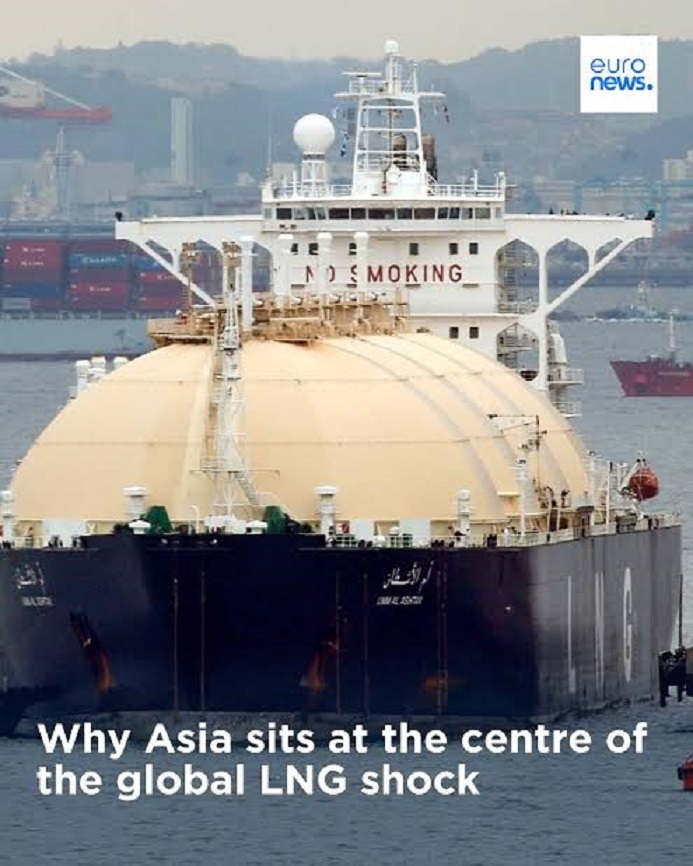
More tankers carrying liquefied natural gas are diverting towards Asia as buyers scramble for replacement cargoes after the Middle East war halted tanker traffic through the Strait of Hormuz and disrupted supplies from Qatar, the world's second-largest seller of the fuel.
Carrying US cargoes from the Plaquemines and Corpus Christi LNG terminals, respectively, the Simsimah and Clean Mistral tankers pivoted towards the South Atlantic on March 4 after heading northeast towards Europe.
Earlier this week, the BW Brussels, carrying a Nigerian cargo from Bonny LNG, pivoted away from its initial Atlantic-bound course on March 3, and is now Asia-bound via the Cape of Good Hope.
The price of the US Henry Hub gas benchmark was $2.97 per million British thermal units on Thursday versus $17.01 per mmBtu for the European Title Transfer Facility (TTF) benchmark and $15.495 per mmBtu for the Japan-Korea Marker, the Asian benchmark.
The higher European and Asian prices are more than enough to offset the cost of longer distances to move the cargoes to Asia.
"Cargoes have started to be diverted to Asia, away from Europe in recent days, and the prevailing JKM-TTF spreads, averaging much above the US shipping differentials, indicate flexible US cargoes will likely start to come to Asia on stronger netbacks," said Energy Aspects analyst Kesher Sumeet.
"India and Bangladesh are reportedly securing spot cargoes above $20 per mmBtu, but the volumes awarded remain well below the levels impacted due to Qatari disruptions," he said, adding that Asian buyers will unlikely be able to replace all the lost Qatari cargoes for March and April.
Cargo diversions could intensify competition between the Atlantic and Pacific basins. Asia takes more than 80 per cent of Qatar's LNG exports, and Europe is increasingly relying on LNG to fill gas storage since the region halted most Russian pipeline gas imports.
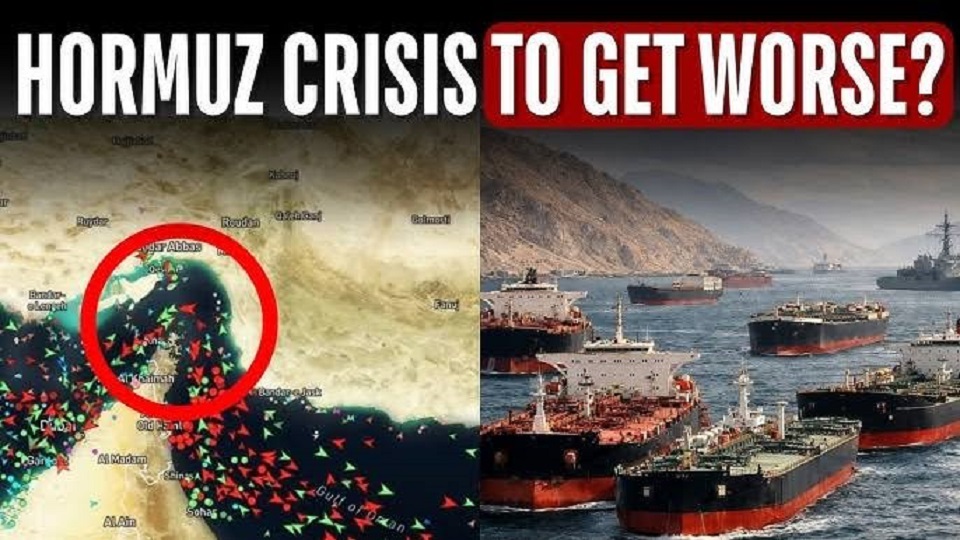 Pic.: You Tube
U.S., Australia can do little to replace lost Qatari LNG cargoes
Companies in the United States and Australia, two of the top global liquefied natural gas producers, have little spare capacity to offset lost supply after Qatar halted production and declared force majeure on shipments due to the conflict in the Middle East, according to Reuters calculations and industry analysts, Reuters reports.
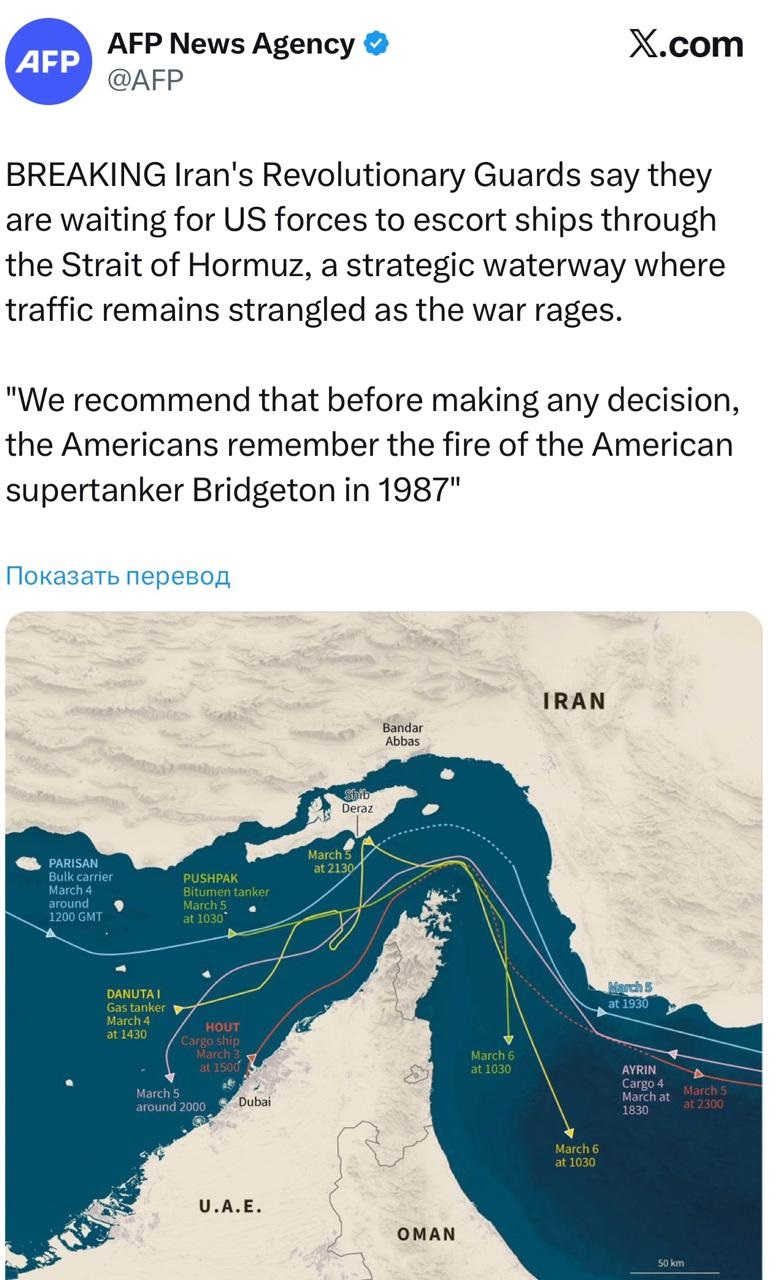
Qatar supplies around 20% of the world's LNG but stopped production this week because it is unable to send tankers full of the super-chilled gas through the Strait of Hormuz. Iran has said it would fire on any vessel that attempts to sail through the strait, and a vessel was damaged by a projectile on Wednesday as it sailed toward the shipping chokepoint at the entrance to the Middle East Gulf.
The U.S. is the world’s largest LNG producer, but its plants are running near full tilt and most cargoes are locked into long-term contracts. New U.S. production that could come online soon is unlikely to exceed 2 billion cubic feet per day, far short of the 10 bcfd gap left by Qatar – equal to about 80 million tons per year, according to Reuters calculations.
“There is no massive capacity on the sidelines,” said Alex Munton, director of global gas and LNG at research firm Rapidan Energy Group.
US, Australia and Qatar lead in global LNG
Global gas consumption is around 400 billion cubic feet per day, energy analysts estimate. Roughly 55 bcfd of that is traded as LNG, with the U.S., Australia and Qatar accounting for about 60% of global output, according to the International Gas Union. Most of that LNG is sold under long-term contracts.
Before halting production, Qatar supplied LNG to buyers in Europe and Asia. Australia, which ships around 11 bcfd, has few spot cargoes to plug the supply gap in Asia.
“There is almost no scope for pushing out additional LNG volumes from Australia as plants are run at full rates. Some LNG plant maintenance could be deferred to squeeze out up to three million tons over the next six months, but that’s about it,” said MST Marquee analyst Saul Kavonic.
...So what? The Europeans, who so insistently refuse Russian gas, will soon be left without any gas at all!
Are they idiots? No! They're Russophobes. And they'll pay the full price for their Russophobia.
Let them go without gas. Good luck, Russophobs!
read more in our Telegram-channel https://t.me/The_International_Affairs