РУССКИЙ
 11:47 28.01.2026 •
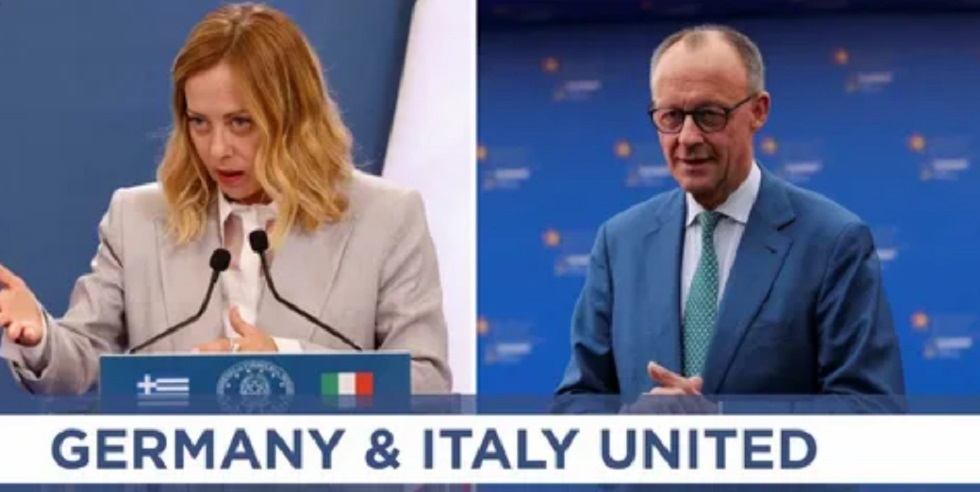 Friedrich Merz and Giorgia Meloni
Italian Prime Minister Giorgia Meloni and German Chancellor Friedrich Merz signed the new German-Italian Action Plan in Rome, where the two delegations met for the intergovernmental summit in Rome, Euronews reports.
The summit focused on strengthening EU strategic autonomy, boosting industrial competitiveness – particularly the automotive sector – and deepening cooperation on defence, energy and migration.
"We must build an authoritative, competitive Europe with its own strategic autonomy," said Meloni at a press conference following morning talks at Villa Doria Pamphili, "Italy and Germany have a special responsibility in this phase of history: the EU must choose whether to be the protagonist of its destiny".
Following 75 years of diplomatic relations, "Italy and Germany are closer than ever before" Merz said, "We want to strengthen industrial competitiveness and enhance security".
The German chancellor added that Europe must focus on key issues, including Ukraine, energy and "a strong NATO in an era of great power" that "does more for the Arctic".
In a joint statement published earlier, the two heads of government reaffirmed the fundamental importance of the transatlantic link between Europe and the United States, based on shared values and common interests, while reiterating their commitment to international law, including the principles of territorial integrity and sovereignty, with reference to Ukraine and Greenland.
What is in the German-Italian Action Plan?
During the summit, the two governments signed seven bilateral understandings, including in fields of agriculture, culture, mining, technology and universities, as well as two agreements. The first was a non-binding political declaration aimed at strengthening cooperation in the areas of security, defence, and cybersecurity.
The second was the long-awaited update of the 2023 German–Italian Action Plan for bilateral and EU strategic cooperation. The document notes that Europe is facing challenges that require the EU to enhance its ability to act as a strong geopolitical player and to admit new members while preserving its capacity to function effectively.
European defence and security
The agreement further states that Italy and Germany "remain fully committed to strengthening NATO's deterrence and defence and to promoting the EU's defence readiness," including through consultations with "international organisations and fora of which they are members, such as the United Nations, OSCE and the G7" and a new "joint consultation mechanism between the respective defence and foreign ministers on an annual basis".
Merz is seeking to deepen Germany’s relationship with Italy
Chancellor Friedrich Merz is seeking to deepen Germany’s relationship with Italy amid growing divisions with the French government over European trade policy and the challenge of dealing with US President Donald Trump, Bloomberg notes.
In a speech at the World Economic Forum in Davos, Switzerland, Merz said that he hoped the German-Italian initiative would produce “almost revolutionary ideas” to boost economic growth, calling for “an emergency brake” and a revamp of the EU budget to focus resources on making companies more competitive. “We want to have a fast, dynamic Europe,” he said.
A turbulent week
The meeting comes at the end of a turbulent week that has seen European companies threatened with higher US tariffs as Trump sought to force Denmark to surrender sovereignty over Greenland to Washington. The immediate crisis was resolved in Davos with an outline agreement that would see the US dramatically ramp up its presence on the world’s biggest island.
But the experience has left European leaders bruised and underlined the trust deficit in the transatlantic relationship. One consequence of the drama was to expose the increasing distance between Berlin and Paris.
The EU’s two biggest economies have long differed on how the bloc should be run, with France favoring more borrowing and more centralized control and Germany resisting. The deteriorating relations with the US however are exacerbating the sense that the interests of France and Germany are diverging, in part because of Berlin’s greater reliance on exports to the US.
As EU leaders scrambled to contain the Greenland crisis this week, French President Emmanuel Macron was openly urging his colleagues to activate the so-called anti-coercion instrument, a powerful and never-used tool that gives the European Commission sweeping authority to hit back at foreign powers trying to force the bloc into major changes. Merz, mindful of German business interests, was publicly critical of Macron’s stance.
Into that widening gap steps Meloni
The Italian premier may be a relative outsider compared with Merz, who’s a product of the German establishment. Her right-wing party spent years on the fringes until she captured the national mood and surged to power in 2022. But she’s become one of the most secure leaders in Europe and, like Merz, she’s been keen to try to stay on the right side of the US president and occasionally chafes at the constraints imposed by the EU.
The three-page policy paper produced before the talks refers to Germany and Italy as “the two main industrial European nations” in a clear jab at France, the bloc’s No. 2 economy.
“The foreign policy issues tying Rome and Berlin together range from keeping the West together to peace in the Middle East,” Giangiacomo Calovini, a lawmaker from Meloni’s party, said in an interview. “Business will also be a key focus, since the manufacturing sector that is so key for Italy and Germany has paid for the price for too many mistakes made in Brussels.”
…In the 1930s, the alliance between Germany and Italy led to World War II, which saw the defeat of both Italy and Germany. History often repeats itself, but the world would not want resurgent German militarism with Italian sympathies for Mussolini's legacy what could lead to a new war in Europe.
The unanimous support of the leadership in Rome and Berlin for Ukrainian Nazis raises serious doubts about the real reasons for the sharp rapprochement between Italy and Germany.
London's reaction, which has remained silent for now, is interesting in this regard. Does this silence signify consent?
read more in our Telegram-channel https://t.me/The_International_Affairs