
 РУССКИЙ
 11:08 27.12.2025 •
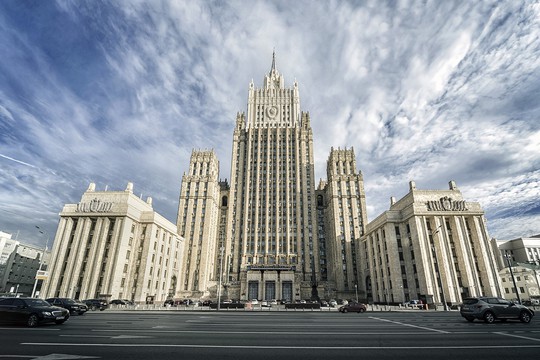
Photo: MFA
The Russian Ministry of Foreign Affairs released a “Key foreign policy outcomes of 2025”:
In 2025, Russia made a significant contribution to strengthening the foundations of a just multipolar world order based on international law and cooperation between countries. Decisive steps were taken to protect the country’s vital national interests on the external front, with a focus on the CIS countries and Eurasia. Practical engagement with countries and associations of the World Majority has been substantially expanded.
This year marked the 80th anniversary of the Great Victory. Alongside its like-minded international partners, Russia reaffirmed its commitment to inviolability of the post-war world order and its foundation in the form of the full body of principles enshrined in the UN Charter understood as an indivisible and interdependent whole. Major international events included celebrations attended by President Putin and leaders of friendly states in Moscow on May 9 to commemorate Victory in the Great Patriotic War, and in Beijing on September 3 to mark the 80th anniversary of the end of World War II.
In the Commonwealth of Independent States, 2025 was declared the Year of Peace and Unity in the Fight against Nazism. The Council of CIS Heads of State, as well as secretaries-general of the CIS, the CSTO, and SCO has approved statements on the 80th anniversary of the end of World War II and the founding of the UN in September 1945.
A solemn General Assembly session to commemorate WWII victims was held at Russia’s initiative at the New York UN headquarters in May. An annual resolution on combatting glorification of Nazism and neo-Nazism co-sponsored by 44 countries was adopted in December.
Comprehensive partnership and strategic interaction between Russia and China received a strong boost thanks to successful leader diplomacy by President Putin and Chinese President Xi Jinping and reciprocal visits to Moscow in May and to Beijing in September. Amid external pressure, practical cooperation between Moscow and Beijing demonstrated resilience, with mutual settlements transitioned to national currencies in full. Humanitarian ties benefitted from the success of the cross Years of Culture in 2024-2025. The visa-free travel on both sides created additional opportunities to strengthen friendship and mutual understanding between the peoples of Russia and China.
After the new US administration came to the White House in January, political dialogue with Washington at the top levels was restored. During the Russia-US summit in Anchorage on August 15, understandings were reached that could form the basis for resolving the Ukraine conflict by addressing its underlying causes, including military threats to Russia created by NATO expansion and policies undermining the rights of the Russian and Russian-speaking populations. With US assistance, the Istanbul process was resumed. After three rounds of direct Russia-Ukraine talks, agreements on prisoner exchanges and the transfer of servicemen’s remains were reached and implemented.
A significant step towards strengthening the shared defence space of the Union State of Russia and Belarus was the entry into force in March of the security guarantees treaty, which establishes mutual obligations to protect the sovereignty and constitutional order of our countries, the inviolability of the Union State’s territory and external borders, using all available forces and means. Relations with North Korea took on a new dimension, with the DPRK providing allied assistance in liberating the Kursk Region from Ukrainian militants and contributing significantly to creating proper conditions for the region’s return to peaceful life, in accordance with the Comprehensive Strategic Partnership Treaty. A new stage in relations with Iran was marked by the signing in January and entry into force in October of the Comprehensive Strategic Partnership Treaty.
State visits by President Putin to Tajikistan in October and Kyrgyzstan in November opened new prospects for advancing political dialogue, trade and investment-industrial cooperation, and humanitarian collaboration with these countries. During the state visit of President of Kazakhstan Kassym-Jomart Tokayev to Russia in November, a declaration was signed upgrading Russia-Kazakhstan relations to a level of comprehensive strategic partnership and alliance. Following the second Russia-Central Asia summit in Dushanbe in October, a Joint Action Plan for 2025-2027 was adopted.
Tangible results were achieved in supporting integration processes in Eurasia. The circle of external partners of the Eurasian Economic Union was expanded. With strong Russia’s involvement, an economic partnership agreement with the UAE was signed in June, a temporary trade agreement with Mongolia also in June, and a free trade agreement with Indonesia in December. Implementation of a preferential trade agreement with Iran began.
Within the Collective Security Treaty Organisation (CSTO), priority tasks were identified for implementing the collective security strategy, steps were taken to strengthen the combat readiness of collective forces, and an anti-narcotics strategy through 2030 was approved. At the November session of the CSTO Collective Security Council, Eurasian security issues were designated as a priority of Russia’s CSTO chairmanship in 2026.
To enhance the international role of the CIS, the participants of the October session of the Council of Heads of Participating States in Dushanbe decided to grant the SCO observer status within the CIS and to establish the CIS Plus format. A concept for military cooperation through 2030 was approved.
Decisions adopted with Russia’s support at the SCO summit in Tianjin, China (August 31-September 1) gave a strong boost to the organisation. The SCO Development Strategy through 2035 was approved, and agreements were signed on the Universal Centre for Countering Security Challenges and Threats in Tashkent and the Anti-Narcotics Centre in Dushanbe.
Agreements reached during President Putin’s December visit to India confirmed overlapping strategic objectives and the enduring and time-tested mutual trust between the two countries. A comprehensive joint statement was adopted, along with a package of 28 documents, including a programme for the development of strategic areas of Russia-India economic cooperation through 2030.
Russia’s official recognition of the Islamic Emirate of Afghanistan in July opened the way for establishing intergovernmental cooperation in various fields, including regional security.
Visits to Russia by the leaders of Vietnam in May, Laos in July, Malaysia in May and August, and Myanmar in March and September underscored the strength of Russia’s ties with Southeast Asian countries. Relations with Indonesia also marked significant milestones, as Indonesia acquired the status of a BRICS member state on January 1, 2025. Two Russia–Indonesia high-level meetings took place during the year; in June, a bilateral declaration on strategic partnership was adopted, and in December, as mentioned above, a free trade agreement between the EAEU and Indonesia was signed.
A ceremony held in November to install a reactor casing for the El-Dabaa nuclear power plant being built by Russia and attended via videoconference by President Putin and President Abdel el-Sisi was a major step in promoting traditionally friendly relations with Egypt. High-level engagement continued with Saudi Arabia, the UAE, Algeria, Qatar, and other Arab countries in the Middle East and North Africa. Relations were also established with the new government of the Syrian Arab Republic. President Ahmed al-Sharaa visited Moscow in October to be hosted by President Putin.
Russia improved its position in Africa. A dialogue mechanism, Russia-Confederation of Sahel States, was established at the level of foreign ministers. The Second Ministerial Conference of the Russia-Africa Partnership Forum in Cairo in December laid the foundation for the next Russia–Africa summit in 2026. Intergovernmental agreements on the fundamentals of relations were concluded with Mali and Togo. The Russian embassy in South Sudan became operational in December.
In relations with Latin America and the Caribbean, contacts with Brazil, which chaired BRICS in 2025, were particularly fulfilling. The depth of the strategic partnership with Nicaragua was demonstrated by the Sandinista leadership’s decision to recognise the Donetsk and Lugansk people’s republics, as well as the Zaporozhye and Kherson regions, as integral parts of the Russian Federation, and to conclude cooperation agreements with them and with the city of Sevastopol in September. During Venezuelan President Nicolas Maduro’s visit to Moscow in May, a bilateral treaty on strategic partnership and cooperation was signed, which entered into force in November. Russian diplomatic presence in the LAC region was further expanded with the opening of an embassy in the Dominican Republic in April.
The signing by 71 countries at the high-level conference in Hanoi in October of the UN Convention against Cybercrime, developed at Russia’s initiative, which is the first universal legal instrument in the field of international information security, was a global milestone.
On December 14, at the initiative of Russia and other member states of the Group of Friends in Defence of the UN Charter, the UN General Assembly proclaimed the International Day for the Elimination of Colonialism in all its forms, and on December 4, the International Day for Combatting Unilateral Coercive Measures. These decisions laid the political and legal foundation for taking joint practical steps with like-minded partners in anti-neocolonial and anti-sanctions initiatives. The session of the Standing Committee of the Forum of Supporters of the Fight against Contemporary Neocolonial Practices - For the Freedom of Nations! Movement organised in November by the All-Russian political party United Russia made a significant contribution to advancing the anti-neocolonial project.
Russia maintained its status as a leading host of major international forums, including the St Petersburg International Economic Forum (with leaders from Bahrain, China, Indonesia, and South Africa participating in the plenary session), the Eastern Economic Forum, the International Meeting of High Representatives on Security Issues, the International Economic Forum “Russia - Islamic World: KazanForum, World Nuclear Week, and Russian Energy Week, to name a few.
The willingness of the World Majority countries to develop cultural cooperation with Russia was reflected in the engaged participation of their broadcasters and performers in organising and hosting the international music competition Intervision, which successfully took place in the Moscow Region in September. The innovative Games of the Future tournament launched a year earlier in Kazan at Russia’s initiative became a leading promoter of the phygital movement which represents the fusion of sports and digital technologies. The second tournament was hosted by the UAE in December. Russia’s membership in the International Paralympic Committee was restored in September as well.
The geography of visa-free travel for Russian citizens was expanded. In addition to the visa-free travel between Russia and China mentioned above, intergovernmental agreements on mutual visa waiver for holders of regular passports entered into force with Oman and Jordan; a similar agreement was signed with Myanmar; and a mutual visa exemption for holders of all types of passports was concluded with Saudi Arabia. To counter Western legal aggression, bilateral agreements were signed with Belarus, Myanmar, and Nicaragua to mutually protect citizens from abuses in the sphere of international criminal justice.
The firm defence of national interests in relations with the countries whose governments undertake hostile anti-Russian actions forced them to recognise the impossibility of inflicting on Russia a “strategic defeat on the battlefield” and led them to adopt a concept of an immediate cessation of hostilities in the Ukrainian theatre of operations. Measures taken to protect Orthodox Christianity and other Russian religions and denominations created favourable conditions for the resettlement of foreign nationals, including from countries with unfriendly governments, to our country under the framework of the Presidential Executive Order On Providing Humanitarian Support to Individuals Sharing Traditional Russian Spiritual and Moral Values.
Efforts to combat the spread of untruthful information about Russia in foreign printed and social media intensified, including through cooperation with our international partners within the International Fact-Checking Network.
read more in our Telegram-channel https://t.me/The_International_Affairs

















