РУССКИЙ
 11:55 11.02.2026 •
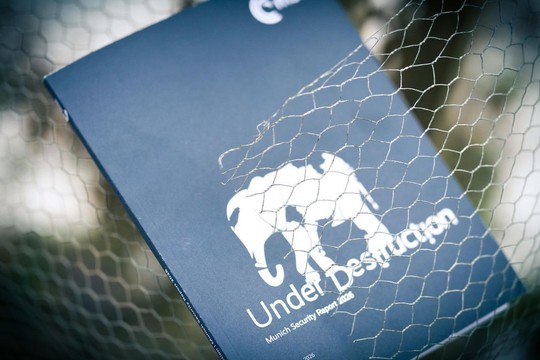
Photo: securityconference.org
The leadership of the Munich Security Conference is demonstrating a sense of panic. It's worth recalling that five years ago, the theme of the main report at the Conference was “Westlessness”. Now, in the context of the West's continued loss of its dominant role in the world, this formula has been extended with a harsh assessment of a new phase in the decline of the West's collective power over Planet Earth.
The new report of the Munich Security Conference is titled “Under Destruction”. We provide an overview of this document.
The world has entered a period of wrecking-ball politics. Sweeping destruction – rather than careful reforms and policy corrections – is the order of the day. The most prominent of those who promise to free their country from the existing order’s constraints and rebuild a stronger, more prosperous nation is the current US administration. As a result, more than 80 years after construction began, the US-led post-1945 international order is now under destruction.
A World under destruction
The Munich Security Report 2026 analyzes the far-reaching consequences of the rise of political forces that favor destruction over reform. Their disruptive agendas build on widespread disenchantment with the performance of democratic institutions and a pervasive loss of trust in meaningful reforms and political course corrections.
In all G7 countries surveyed for the Munich Security Index 2026, only a tiny proportion of respondents say that their current government’s policies will make future generations better off. And both domestically and internationally, political structures are now perceived as overly bureaucratized and judicialized, impossible to reform and adapt to better serve the people’s needs.
The result is a climate in which those who employ bulldozers, wrecking balls, and chainsaws are cautiously admired if not openly celebrated.
In many Western societies, political forces favoring destruction over reform are gaining momentum. Driven by resentment and regret over the liberal trajectory their societies have embarked on, they seek to tear down structures that they believe will prevent the emergence of stronger, more prosperous nations. Their disruptive agendas build on widespread disenchantment with the performance of democratic institutions and a pervasive loss of trust in meaningful reforms and political course corrections.
The threat came from Trump side
The most powerful of those who take the axe to existing rules and institutions is US President Donald Trump. For his supporters, Washington’s bulldozer politics promises to break institutional inertia and compel problem-solving on challenges marked by gridlock. The breakthroughs on NATO defense spending targets and on a ceasefire between Israel and Hamas are cases in point.
Yet, it is unclear whether destruction is really clearing the ground for policies that will increase the security, prosperity, and freedom of the people. Instead, we might see a world shaped by transactional deals rather than principled cooperation, private rather than public interests, and regions shaped by regional hegemons rather than universal norms. Ironically, this would be a world that privileges the rich and powerful, not those who have placed their hopes in wrecking-ball politics.
The US administration’s renunciation of core elements of the existing international order is impacting different regions of the world and disrupting various policy domains. The effects are particularly apparent in Europe and the Indo-Pacific, where governments have long relied on and hugely benefitted from “Pax Americana.” Likewise, few policy fields have felt the effects of Washington’s U-turn on existing institutions and rules more strongly than global trade and international development and humanitarian assistance.
The US approach to European security is now perceived as volatile, oscillating between reassurance, conditionality, and coercion. Facing shifting signals from Washington, European nations are striving to keep the US engaged while preparing for greater autonomy.
An ever more powerful China is making a forceful bid for regional dominance
In the Indo-Pacific, US partners face a similar situation – but have fewer coping mechanisms. An ever more powerful China is making a forceful bid for regional dominance, with provocations and coercion that threaten regional stability. Many regional players have responded by stepping up their own defense efforts. Meanwhile, doubts have grown about US security guarantees and strategic interest in the region. While the US claims to be countering Chinese dominance, regional players view its recent actions as contradictory to that goal. Some of them even worry that dealmaking with Beijing is now more important to Washington than backing its partners. Lacking mechanisms on a par with the EU or NATO, Indo-Pacific actors are torn between trying to attract US commitment and hedging their bets, often through outreach to China.
China’s rise and the United States’ industrial decline
In recent decades, the global trade system has become increasingly contested, as the promise of equal growth has not materialized and the WTO has often struggled to act as a fair custodian of the common rules. According to the US administration, these failures have contributed to China’s rise and the United States’ industrial decline. Since Trump’s return to office, Washington has openly dispensed with the rules of global trade it once helped create. Among others, it has imposed vast, non-WTO-compliant tariffs on nearly every country and has heavily deployed economic coercion to secure bilateral deals that benefit America first. Meanwhile, China has continued its market-distorting practices and escalated its weaponization of economic chokepoints. Confronted with unfair trade practices by the US and China, governments around the world have imposed trade restrictions – but many have also doubled down on liberalizing trade and forging new and deeper partnerships anchored in WTO law.
Like global trade, development cooperation and humanitarian assistance have long been under strain. Facing economic pressure, populist disinformation campaigns, and a more geopolitically competitive reality, traditional donor countries have defined their national interests more narrowly. As a result, even before Trump’s second term, the world was not on track to achieve any of the 17 UN Sustainable Development Goals (SDGs) by 2030 and many humanitarian responses remained underfunded. Yet US policies have pushed the already strained development and humanitarian systems into an existential crisis. The Trump administration has rejected the SDGs, denouncing them as “globalist endeavors.” And its budget cuts are already impacting people in many low- and middle-income countries. As nothing suggests that the gaps left will be fully filled by nontraditional donors, those still committed to solidarity with the most vulnerable have focused on reforms, trying to improve the efficiency and effectiveness of the development and humanitarian systems.
Growing demands for improvements
The challenges are thus substantial. But the examples also reveal that actors still invested in a rules-based order are organizing, trying to contain the effects of wrecking-ball politics and probing new approaches that do not depend on Washington’s lead.
Many understand that, if they continue to be bystanders to bulldozer politics, they will end up at the mercy of great power politics and should not be surprised to find cherished rules and institutions in rubble.
Yet, containing the worst expressions of a policy of destruction will require these actors to step up – above all, by significantly investing in their own power resources and pooling them through closer cooperation. But governments opposed to demolition politics will also have to credibly demonstrate that meaningful reforms and political course corrections are viable – and much more likely to satisfy growing demands for improvements than a policy of widespread destruction.
read more in our Telegram-channel https://t.me/The_International_Affairs