
 РУССКИЙ
 11:16 25.01.2026 •
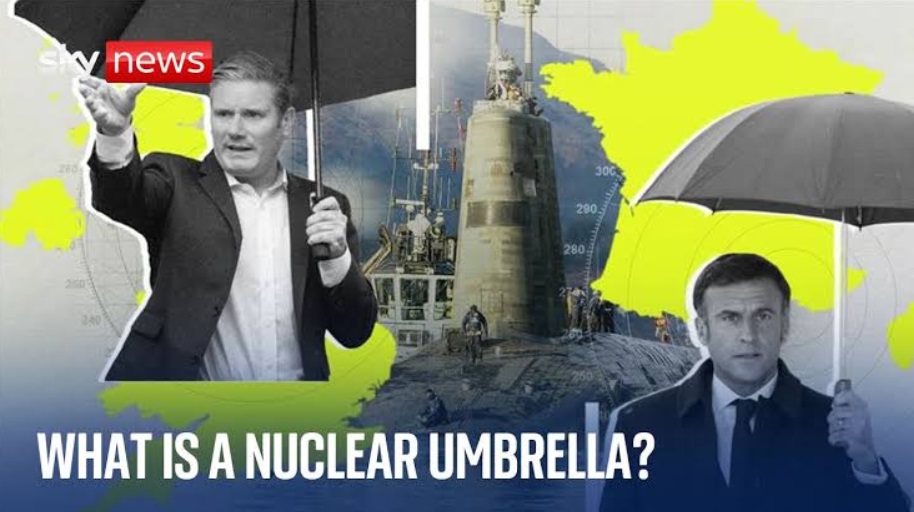
Questioning America’s decades-long commitment to guard them against a nuclear-armed Russia, European nations are looking at ways to bolster their own arsenals rather than continue to rely on the U.S., according to six senior European officials, NBC News reports.
European leaders are discussing whether to rely more on nuclear-armed France and Britain instead of the U.S. or even develop their own atomic weapons, three of the senior European officials said. The discussions have taken on a new urgency in recent weeks as President Donald Trump, who blasted European nations in a speech at Davos on Wednesday, demands the U.S. acquire Greenland, these officials said.
French President Emmanuel Macron, whose country is the only member of the European Union with the bomb, is expected to deliver a major speech on France’s nuclear policy in the coming weeks, the officials said.
“We are discussing how to protect Europe with a nuclear deterrent with or without the United States,” one of the European officials said. Another described the discussions among European leaders about ways to guard against a nuclear-armed Russia without the U.S. as “intense and productive.”
The new push by some of America’s closest allies to chart a future for their security that doesn’t include a core tenet of U.S. support underscores how alarmed European leaders are by Trump’s increasingly hostile stance toward the continent and a growing threat from Russia. The discussions also signal shifting security dynamics in the West that could upend decades of global efforts to reduce, not enhance, nuclear proliferation.
To violate the Nuclear Non-Proliferation Treaty?
Emma Belcher, an arms control expert and president of Ploughshares, a foundation focused on reducing the threat of nuclear weapons, said Europe is experiencing “a crisis of confidence.”
“We’ve had this system of extended deterrence and the U.S. promise to allies that if they’re attacked with a nuclear weapon, the United States would respond,” Belcher said “That has really kept nuclear weapons from spreading for decades. But the challenge right now is that it only works if allies believe that the U.S. commitment is real.”
European nations are exploring a range of options, three of the European officials said. They said those include improving France’s nuclear weaponry, redeploying French nuclear-capable bombers outside of France, and beefing up French and other European conventional forces on NATO’s eastern flank.
Another option under discussion is to equip European countries that do not have nuclear weapons programs with the technical abilities to acquire them, these European officials said.
Having the technical ability to potentially build a nuclear weapon would not violate the Nuclear Non-Proliferation Treaty, but actually taking concrete steps, such as making highly enriched uranium, would.
Two for all?
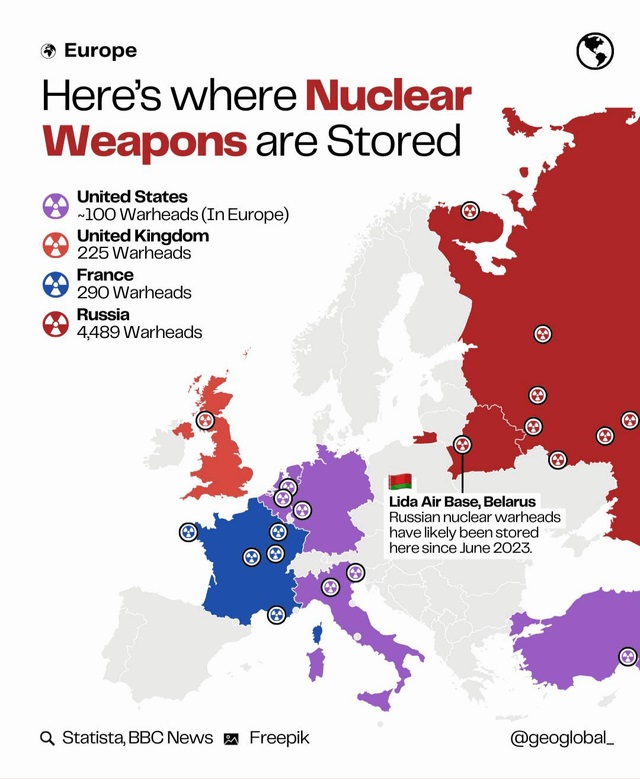
Within the NATO alliance, France and the U.K. are the only members that have nuclear weapons apart from the U.S, though their arsenals are much smaller and less capable.
The U.S. has approximately 3,700 nuclear warheads. France has about 290, which are capable of being launched from submarines and aircraft, and the United Kingdom has an estimated 225 warheads for its submarine fleet.
A former senior U.S. official said France and the U.K. lack the firepower to deter Russia on their own, dismissing the idea as “ridiculous.” Their nuclear stockpiles are “pitiful,” the official said, as they have not maintained it for several decades and relied on the U.S. nuclear umbrella.
Some European officials also are skeptical that France could provide a credible alternative to the vast American nuclear arsenal, and they worry that any changes Macron commits to make could be scrapped depending on who wins France’s 2027 elections.
Far-right leader Marine Le Pen, for instance, has said France’s nuclear arsenal should only be used for France.
Poland wants it, Britain is being opaque
Polish Prime Minister Donald Tusk said in March that his country “is talking seriously” with French officials about coming under the protection of France’s nuclear weapons. And even before he took office, German Chancellor Friedrich Merz said last year he was open to the idea of France providing a nuclear umbrella for Germany, a proposal that previous German governments rejected.
Their comments came after Macron publicly proposed to begin talks with European states to discuss how France’s nuclear capability could contribute to the security of the continent.
Dutch Foreign Minister David van Weel, speaking to NBC News while in Davos for the World Economic Forum, added, “We still consider NATO to be the cornerstone of our security. At the same time, we do see that the world is changing and that we’re entering a world of geopolitical competition where also Europe needs to step up and needs to become more of an equal partner to the U.S. than we are right now.”
A British official declined to comment directly on nuclear weapons discussions among European nations. “Our posture is in constant review and responds to evolving threats,” the official said.
Unlike France, Britain is heavily dependent on the U.S. military for nuclear missiles and other support for its arsenal.
read more in our Telegram-channel https://t.me/The_International_Affairs

















