
 РУССКИЙ
 12:13 11.12.2025 •
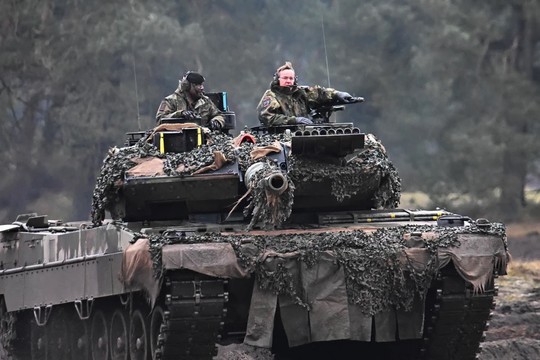
German Defense Minister Pistorus is already in a tank.
Photo: Reuters
The leaked “OPLAN DEU” document, outlining how Germany could become NATO’s central hub of military planning against Russia, is a fascinating exercise in self-delusion.
“Europhoria” is a term I created several years ago to describe the excessively exuberant view that most European elites had of their otherwise bleak geopolitical situation, writes Brandon J. Weichert, a senior national security editor at The National Interest. This exuberance tends to lead to overreaction and disastrous military policies — policies that, if push ever came to shove, would presumably result in the Americans having to bail Europe out.
What Is NATO’s “OPLAN DEU”?
OPLAN DEU, or Operation Plan Germany, is an example of this Europhoria. It’s a 1,200-page war plan developed by NATO that calls for the movement of “up to 800,000 NATO troops across Europe in the event of a Russian attack,” per Newsweek. And it is totally detached from the political, economic, and military realities in Germany and wider Europe today.
OPLAN DEU outlines a process by which Germany is to again be made into a frontline country in any potential conflagration with nuclear-armed Russia. That’s an astounding move, considering that just 30 years ago the Soviet Red Army voluntarily removed itself from East Germany and allowed for the reunification of the German state.
Up until 2023, in fact, Germany maintained a tight-knit trading relationship with Moscow — notably in the energy sector. Indeed, one must describe the post-Cold War German economic miracle (and, by extension, the post-Cold War European Union economic prosperity) as having been built upon cheap Russian energy supplies.
Those days are over.
The Most Aggressive and Ambitious War Plan
OPLAN DEU developed by NATO and, specifically, Germany since the Cold War. Jordan King of Newsweek writes that “the blueprint signals a departure from the peacetime mindset and a renewed ‘all-of-society’ approach to defense.”
Notably, the plan calls not just for the deployment of an astonishing nearly one million NATO troops to Germany. Under its terms, private civilian European defense firms would be fused with government agencies. No one dares to ask why forcing Germany’s businesses to become war profiteers would be a good idea when they could have easily continued growing Germany’s once-impressive economy by further trade with Russia.
Nor at any point did anyone in Berlin’s government ask the German people whether this was a course of action they supported. In fact, a whopping 59 percent of all Germans polled have admitted that they opposed war with Russia and would not fight in Germany’s defense — even if Germany itself were attacked by the Russians. This is hardly a sound basis for a military buildup.
Since the Ukraine War began and someone (who, indeed?) destroyed the Nord Stream 2 natural gas pipeline linking Germany with Russia, the German economy has been in a freefall. Meanwhile, its political system has utterly destabilized and moved decisively away from the post-Cold War neoliberal political order that once reigned supreme in the country. So what is Germany — and the rest of NATO, for that matter — doing? Why, despite these facts, do we appear closer to a European war today than we have been in years?
To be clear: the leaked war plan is called “Operation Plan Germany,” but it is not a German affair. Far from it.
OPLAN DEU: A Plan for Germany that Doesn’t Understand Germany
After all, the most recent assessments of Germany’s Bundeswehr states that there are around 182,000 active troops under arms, with plans to increase this number to 250,000 over the next decade. There is no way that all 182,000 of those Bundeswehr forces would be included in the 800,000 NATO troops sent to fight the Russians in the east.
The rearmament that European leaders — including Berlin’s elite — keep ranting about in public for the last year is little more than a delusion, a set of empty promises on top of a long-line of false hopes and empty gestures by Europe when it comes to its own defense. Yet European leaders continue beating their chests at Russia over the Ukraine War. French politicians and prominent intellectuals have taken to the airwaves to accuse the Americans of not only “abandoning” Europe… but “betraying” Ukraine!
This is a shocking claim, considering that the United States has provided far and above the highest level of lethal aid and support to Ukraine over the last decade — to the detriment of America’s own national security in many cases.
OPLAN DEU Is How NATO Forces America to Comply
With the revelation of OPLAN DEU, it’s even more shocking that anyone would accuse the Americans of doing anything other than being far too pro-Europe — especially when factoring in the fact that American troops would obviously form the bulk of the proposed 800,000-strong NATO army that’d deploy to fight Russia.
On top of all this, the chief military officer for NATO floated the possibility of having to preemptively strike Russia — all as the Americans were trying to negotiate a peace deal with Russia over Ukraine!
Oh, and after those comments were made by NATO’s military chief, the international press got a hold of the previously-classified 1,200-page OPLAN DEU document.
By all measures, the Russians are winning the Ukraine War. Russia’s war machine, despite the massive economic sanctions imposed upon Russia by the West as well as the constant attacks on Russia’s energy production capabilities, is producing every three months what it takes NATO’s combined industrial base an entire year to make.
Somehow, though, the German government and the governments of their European NATO partners believe that they can pick a fight with Russia’s war machine… and win?
Why Does Europe Want a War with Russia So Badly?
Throughout all of this, contrary to what the Europeans may believe or fear, there has been no indication from Moscow that Russia’s rulers seek to expand their conflict in Ukraine beyond that country. In fact, the bulk of Russia’s Armed Forces remain ensconced in the Russian-speaking eastern provinces of Ukraine and Crimea.
NATO argues that Russia will have built for itself a war machine that could strike Europe directly by 2029. What few European leaders clearly understand is that, if Moscow wanted to, they could easily strike anywhere in Europe — repeatedly — and there’d be little that the Europeans could do to stop them. The fact of the matter is that the Russians do not want to attack Europe, nor do they yearn for a greater war with NATO.
Despite this, there exists a fantastical 1,200-page document in Berlin about how Europe will trigger a conflict with Russia and get a massive American land army to fight (and die) for Europe against the Russian non-threat next door. The only phenomenon that explains these unwanted developments from Germany is “Europhoria.” It seems there’s no cure.
P.S.
German lawmakers are set to approve 29 military procurement contracts worth a record €52 billion ($61 billion), part of the government’s push to transform the Bundeswehr into Europe’s strongest conventional army, Bloomberg reports.
The orders cover a wide range of materiel and services, including €22 billion for basic military gear and clothing, €4.2 billion for Puma infantry fighting vehicles, €3 billion for Arrow 3 air-defense interceptor missiles and launchers and €1.6 billion for surveillance satellites, according to people familiar with the planning.
Merz addressed his pledge to make the Bundeswehr Europe’s strongest conventional army in a townhall meeting with citizens on Monday evening broadcast live on public broadcaster ARD.
“It’s very simple, I repeat the same sentence over and over again: We want to be able to defend ourselves, so that we never have to defend ourselves,” Merz said, drawing applause from the audience.
… The sad experience of attacks on Russia in the 19th and 20th centuries should be remembered. Russians never attacked Europe first, nor do they yearn for a greater war with NATO now…
read more in our Telegram-channel https://t.me/The_International_Affairs

















