
 РУССКИЙ
 10:51 20.03.2026 •
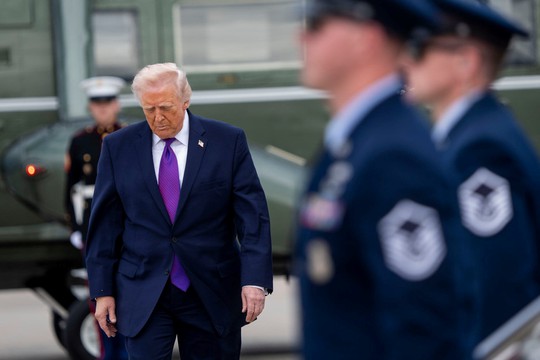
Photo: NYT
As the conflict with Iran expands and intensifies, President Trump’s options — to fight on, or to move toward declaring victory and pulling back — both carry deeply problematic consequences, ‘The New York Times’ writes.
Two weeks into a war against Iran that he chose to launch, President Trump faces a stark choice — stay in the battle to achieve the dauntingly ambitious goals he has set, or try to extract himself from an expanding and intensifying conflict that is generating damaging military, diplomatic and economic shock waves.
He has quickly discovered that both options are deeply problematic, littered with consequences that he and his team downplayed when he plunged the United States, alongside Israel, into the biggest war in the Middle East in nearly a quarter-century.
He can continue to fight a weakened enemy that has nevertheless proved adept at extracting a fast-rising economic price for the United States and its allies, tying the global energy markets in knots and striking a dozen countries across the region.
Angst within Mr. Trump’s political base
Battling on would put more American lives at risk, accelerate the financial costs and risk further fraying alliances. There is angst within Mr. Trump’s political base over the sharp departure from his pledge to avoid entangling the nation in more wars.
Or he can begin to pull back, even though most of his objectives — including assuring that Iran never again possesses the capability to produce a nuclear weapon — are not yet met.
Moreover, if Mr. Trump leaves now, the stockpile of near-bomb-grade nuclear fuel that is at the heart of fears that Iran could manufacture 10 or more nuclear weapons would remain inside Iranian territory, within reach of a wounded Iranian government that may be more motivated than ever to turn that fuel into weapons.
“People are going to have to go and get it,” Secretary of State Marco Rubio said just as the war began, alluding to a ground operation to retrieve the material from deep underground storage in the heart of Iran, an immensely risky operation that Mr. Trump has said he is considering but not ready to order.
Strait of Hormuz, the vital waterway, remains all but shut down
Despite Defense Secretary Pete Hegseth’s assertion that Iran’s success in threatening shipping traffic through the Strait of Hormuz was nothing to worry about, that vital waterway remains all but shut down, choking off a big chunk of global trade, especially in oil. By Saturday, Mr. Trump appealed on social media for China, France, Japan, South Korea and Britain to send naval forces to secure the strait.
Mr. Trump has wrestled publicly with his stay-or-leave options, sometimes suggesting that the war is all but won and at others seeming to acknowledge that there is still heavy fighting ahead. The president, who said he ordered the attack because he had a “good feeling” that Iran was preparing to preemptively attack U.S. forces in the region, said the other day that he would also rely on his instincts on when to get out. He told Fox News he would “feel it in my bones.”
The second week of the war brought a recognition by the Trump administration that Iran’s willingness and ability to disrupt the global economy by choking off the Strait of Hormuz was greater than officials had anticipated, as was Tehran’s capacity to widen the war across the region, according to interviews with officials in the United States and Israel, many of whom spoke on the condition of anonymity to discuss national security matters.
And some Republicans worried that Mr. Trump’s political base — deeply suspicious of foreign interventions — could fracture if the American commitment grows and U.S. casualties mounted.
Trump pressed Gen. Dan Caine, the chairman of the Joint Chiefs of Staff
At a meeting in the Oval Office last week, a frustrated Mr. Trump pressed Gen. Dan Caine, the chairman of the Joint Chiefs of Staff, about why the United States could not immediately reopen the Strait of Hormuz.
The answer was straightforward: Even one Iranian soldier or militia member zipping across the narrow neck of the strait in a speedboat could fire a mobile missile right into a slow-moving supertanker, or plant a limpet mine on its hull.
With oil already hovering around $100 a barrel, and insurance premiums for transiting the Persian Gulf surging.
The strait was Exhibit A in Iran’s ability to seize an asymmetric advantage. Despite ramped-up strikes in recent days against what little is left of the Iranian Navy, traffic through the strait has come to a near halt. A New York Times analysis concluded that as of Thursday, at least 16 oil tankers, cargo ships and other commercial vessels had been attacked in the Persian Gulf, including three in the narrowest part of the strait.
read more in our Telegram-channel https://t.me/The_International_Affairs

















