
 РУССКИЙ
 11:35 23.01.2026 •
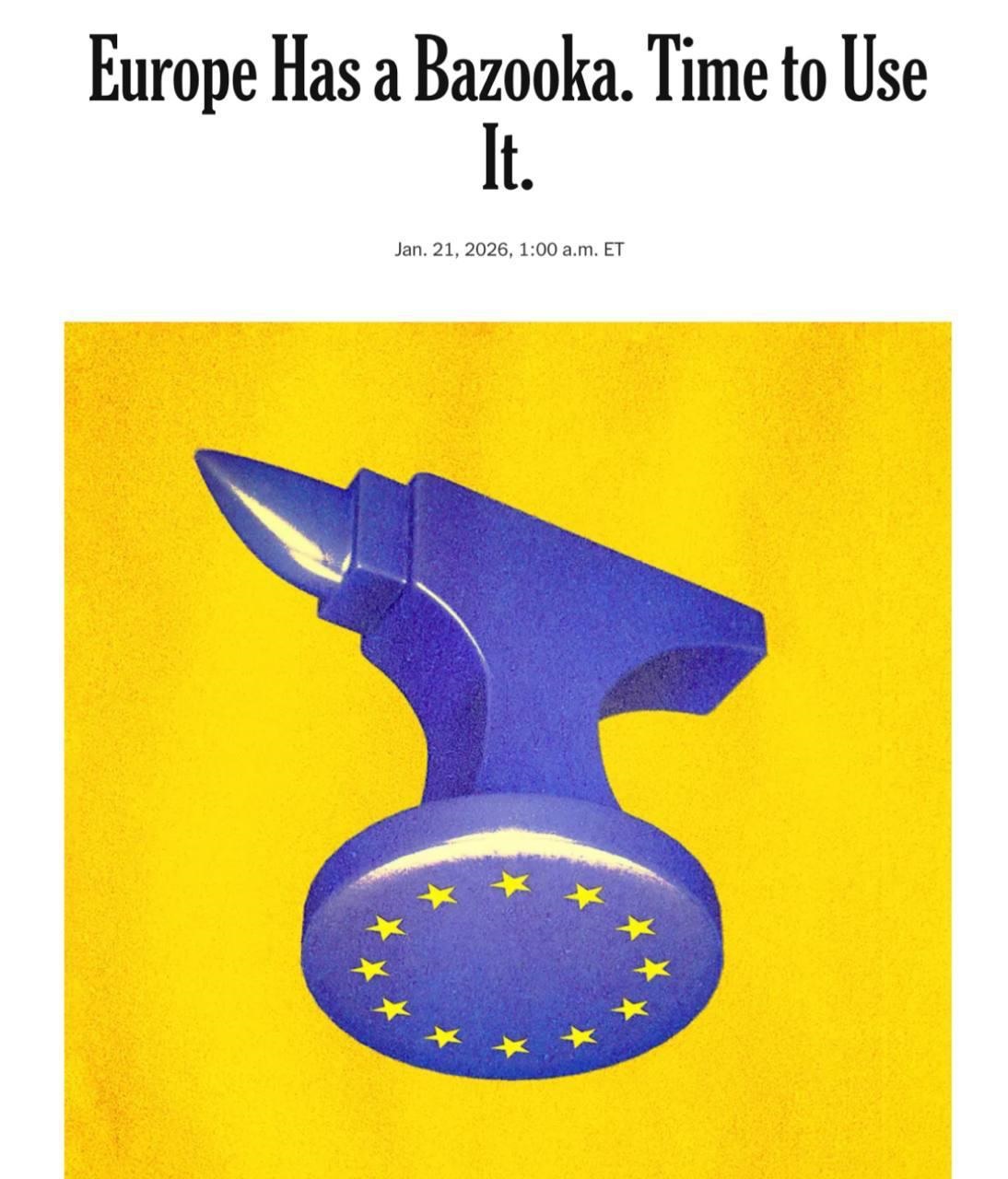
Ever since Donald Trump started talking about taking Greenland away from Denmark, European leaders have hoped that his notoriously short attention span would save them. Mr. Trump’s threat of tariffs against eight European countries may be dimming those hopes, ‘The New York Times’ writes.
After the European countries held a small military exercise in Greenland, Mr. Trump announced an economic punishment. He said he would impose new tariffs, starting at 10 percent on Feb. 1 and jumping to 25 percent on June 1, until Denmark agreed to sell Greenland to the United States. While Europeans worry that Mr. Trump’s demands could destroy NATO, Treasury Secretary Scott Bessent has suggested they have little choice. “The European leaders will come around, and they will understand that they need to be under the U.S. security umbrella,” he said. “What would happen in Ukraine if the U.S. pulled its support out? The whole thing would collapse.”
The only way to maintain European independence is to escalate back. To do this well, Europe needs to incorporate ideas into its economic thinking that seem alien to a continent that prefers soft power to hard security strategies — deterrence, credible threats and escalation dominance.
Repeated submission has gotten Europe into a mess. To get out, Europe needs to commit to not back down.
Should Europe apply an “Escalation Dominance”?
The notion of “escalation dominance,” developed by the RAND futurist and nuclear strategist Herman Kahn, plays a crucial role in determining who backs down and who doesn’t. Escalation dominance suggests that if a fight escalates into a tit-for-tat, the power more willing to endure pain and keep on hitting back will dominate. So long as other powers understand this, they won’t pick fights in the first place.
Such ideas may have motivated the eight European countries that ran a small military exercise in Greenland last week. They certainly didn’t think their brief expedition could defend a huge territory against an American military incursion.
If America invades a territory that has the explicit military support of eight NATO allies, it has to worry that it will precipitate a much bigger political crisis. The tactics appear to have worked: The Trump administration quickly shifted from military threats to economic ones.
European governments have dithered over how to fend off Mr. Trump for nearly a decade. Still, they do have an economic tripwire, however imperfect, if they can agree to deploy it: the so-called anti-coercion instrument, or trade bazooka, as it is often referred to.
The instrument was introduced in 2023, after European officials became alarmed by the increasing threat of trade weaponization. It is a platform for economic warfare, allowing European Union officials to deploy trade quotas, deny access to financial markets, revoke intellectual property, ban investment and impose import and export restrictions on countries that try to coerce Europe.
So what next?
Last year, one jaundiced European Union insider privately compared the anti-coercion instrument to the Doomsday Machine in Stanley Kubrick’s “Dr. Strangelove.” (Mr. Schelling was an adviser on the movie.) The fictional weapon was automatically triggered by a nuclear attack, but it was kept top secret, rendering its ability to deter futile. European officials, on the other hand, talk incessantly about the anti-coercion instrument, but it still fails to deter because they seem so extraordinarily reluctant to deploy it.
Now an attack is underway. Mr. Trump is using tariffs and other threats to force Europe into submission. So what next?
The European Union is hedging. It is considering imposing tariffs worth 93 billion euros (about $109 billion) on America but has yet to decide or activate the anti-coercion instrument. France has proposed using it, but a majority of E.U. states want dialogue with Mr. Trump before going further, and Germany’s chancellor has said that any retaliation would have to be one that “protects Germany’s interests,” which include maintaining exports.
This is exactly the kind of situation that the instrument was designed for. Europe, however, seems too timid to use it. Mr. Bessent has scoffed that Europe’s most forceful weapon is the “dreaded European working group,” suggesting it will never get around to using the instrument. Europe seems in no hurry to prove him wrong.
The author, whether intentionally or not proposes a trade war between the US and Europe. This will serve to further divide the so called “collective” West. Let's wish success to both sides in this war with a bazooka at the ready!
read more in our Telegram-channel https://t.me/The_International_Affairs

















