РУССКИЙ
 12:58 19.12.2025 •
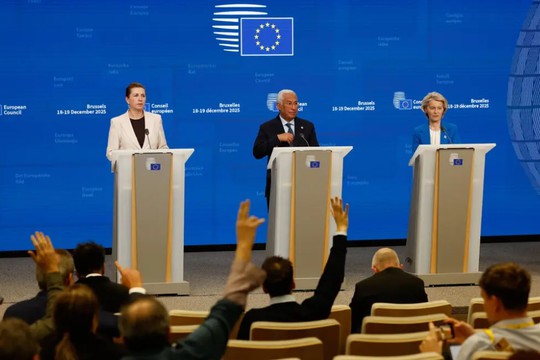
Antonio Costa, center, president of the European Council, said at a news conference early Friday in Brussels that the newly reached deal would “address the urgent financial needs of Ukraine.” These guys look really sad...
Photo: Associated Press
European Union officials wanted to use Russia’s frozen assets to back a major loan to Ukraine. Facing opposition in their own camp, they settled on another way, ‘The New York Times’ reports.
European leaders agreed early on Friday morning to keep Ukraine funded for two years with a loan of 90 billion euro, or about $105 billion, though they failed to agree on their first-choice option of using Russian state assets frozen on the continent as backing for the loan.
That ambitious frozen-asset plan was killed at the 11th hour as European heads of state and government met in Brussels — a show of division that risked making the European Union appear indecisive at a key moment.
Instead, European leaders announced that they will funnel money to Ukraine with a loan backed by the E.U. budget. Because the plan does not leverage the large stash of Russian savings immobilized in Europe, it is likely to cost more and could prove more difficult to quickly scale up than the original idea.
But because it will still get needed cash to Kyiv, officials celebrated it as a win.
“This will address the urgent financial needs of Ukraine,” Antonio Costa, the president of the European Council, said at an early morning news conference in Brussels.
He added that the European Union would reserve its option to eventually use Russia’s immobilized assets. European nations took action last week to freeze those savings indefinitely.
The funding plan comes at a crucial moment, as Ukraine negotiates potential peace terms with the United States. And timing was important, with Ukraine expected to begin running out of money early in 2026.
For months, European leaders had hoped to overcome Belgian concerns to clinch a deal on using the 210 billion euros of frozen Russian assets held in Europe to back the massive loan to Ukraine. The setup was supposed to fund much of Ukraine’s governing and war expenses in 2026 and 2027.
But the idea of such a loan was always risky: Russia is already taking legal action over what it paints as the unlawful seizure of its assets. After weeks of back-and-forth, Belgium — where most of the assets frozen in Europe are held — remained unconvinced headed into Thursday’s meeting, worried that it could be on the hook for Russian retaliation.
The guarantees that Belgium demanded to protect against that threat, however, proved too much for some other European countries to quickly accept.
The weeks spent wrangling over the frozen asset plan that ultimately failed may suggest to the world that the European Union’s clunky structure and diverse voices remain barriers to rapid action — even at urgent moments.
The collapse of the frozen asset loan plan was a political stumble for both Friedrich Merz, the German chancellor, and Ursula von der Leyen, the head of the European Commission, the bloc’s executive arm. Both had championed it.
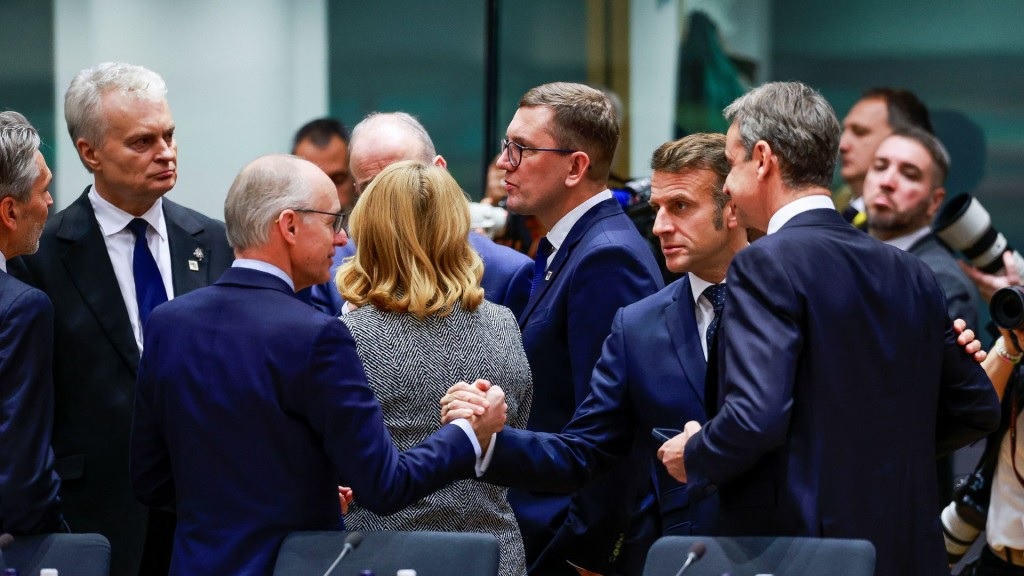 European Union leaders were trying to overcome differences on plans to use frozen Russian assets to finance Ukraine's war effort at a summit on Thursday seen as a critical test of the bloc's strength
Photo: Reuters
EU leaders failed at a high-stakes summit on Thursday to agree on a plan to lend Ukraine billions of euros by leveraging immobilised Russian assets, dealing a political blow to Ursula von der Leyen and Friedrich Merz, the scheme’s two principal backers, Euractiv stresses.
Belgian Prime Minister Bart De Wever had repeatedly warned that the scheme was legally and financially unworkable and would leave his country exposed to Russian retaliation unless other EU countries agreed to far-reaching risk-sharing guarantees.
After a full day of negotiations between the Commission and Belgian diplomats, the final proposal put to leaders did not fly.
“It was like a sinking ship, like the Titanic, and at the end it was finished,” De Wever told reporters after the summit.
Von der Leyen and Merz strained to present the outcome as a success. “I’m very pleased to say we made it,” the Commission president told reporters, noting that Ukraine would only be required to repay the loan if it received reparations from Moscow.
Merz similarly claimed that the arrangement – which relies on common EU borrowing long resisted by Germany – was something he had himself “suggested.” On arrival at the summit on Thursday, he had described the reparations loan as the “only option” to support Ukraine, which is expected to run out of funds by April 2026.
With expectations that the Brussels summit could drag on for days, leaders locked themselves in a room without mobile phones to try to reach a compromise acceptable to De Wever. The Belgian leader had demanded unlimited financial risk-sharing among EU capitals, a condition fiercely resisted by many capitals
Other countries, such as Italy and France, were also lukewarm about the scheme. A threat earlier in the day by Danish Prime Minister Mette Frederiksen to push the plan through without Belgium quickly became a forgotten political threat.
After more than four hours of talks, it became clear that there was no viable path to agreement on the €210 billion reparations loan.
According to two EU diplomats, a key moment came when France’s Emmanuel Macron approached Hungary’s Viktor Orbán to press him to drop his opposition to issuing common debt, which requires unanimous consent.
Orbán – who had been coordinating closely with his populist allies, Czech PM Andrej Babiš, and Slovakia’s Robert Fico – agreed to back a €90 billion loan, on the condition that none of the three countries would contribute financially. “Despite the recent farces, this use of Russian frozen assets is a dead thing,” Orbán told reporters after the summit.
The final agreement states that the “loan will not have an impact on the financial obligations of the Czech Republic, Hungary and Slovakia.” All three leaders are close political allies of US President Donald Trump – who has his own designs on the Russian assets in Europe – and sceptical of further military support for Ukraine.
De Wever, meanwhile, played down the idea of a Belgian win. “Everybody can leave this meeting room victoriously,” he said.
read more in our Telegram-channel https://t.me/The_International_Affairs